
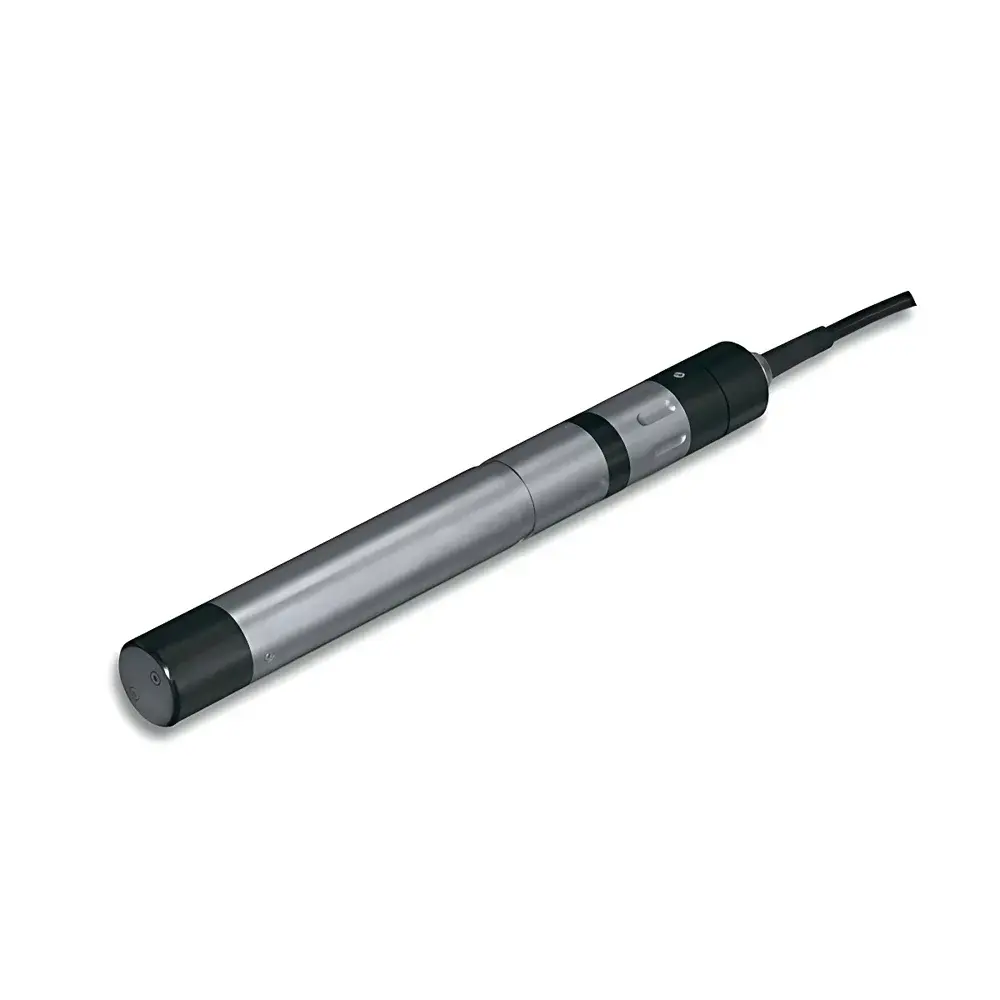
WTW TetraCon LR Conductivity Sensor
| Brand | WTW |
|---|---|
| Origin | Germany |
| Model | TetraCon LR |
| Measurement Principle | 4-Electrode Conductivity |
| Range | 1 µS/cm to 2 S/cm |
| Minimum Resolution | 0.01 µS/cm (dependent on transmitter) |
| Electrode Constant | K = 0.475 cm⁻¹ (standard), adjustable range 0.475–1.008 cm⁻¹ |
| Temperature Compensation | Built-in, -5 °C to +60 °C |
| Pressure Rating | 10 bar (20 °C) |
| Accuracy | ±2% of reading ±1 µS/cm at 25 °C |
| Response Time (t₉₀) | <20 s |
| Compliance | ISO 7888, ASTM D1125, DIN EN 27888 |
Overview
The WTW TetraCon LR Conductivity Sensor is a high-precision, four-electrode conductivity probe engineered for continuous, stable online water quality monitoring in demanding industrial and environmental applications. Designed and manufactured in Germany, it operates on the four-electrode (tetrapolar) measurement principle—eliminating polarization effects and electrode fouling errors inherent in two-electrode systems. This architecture ensures long-term stability, high reproducibility, and minimal drift across wide conductivity ranges—from ultrapure water (low µS/cm) to highly saline or process streams (up to 2 S/cm). Its robust stainless-steel body, chemical-resistant PEEK housing, and pressure-rated construction (10 bar at 20 °C) enable reliable deployment in flow cells, pipelines, open-channel systems, and wastewater treatment plants. The sensor delivers digital output natively compatible with WTW IQ SensorNet platforms; analog output (0/4–20 mA) is supported via optional signal adapters for integration with legacy controllers such as the WTW 28x and 202 series.
Key Features
- Four-electrode measurement technology for accurate, fouling-resistant conductivity detection across broad dynamic ranges
- Fixed or field-adjustable electrode constant (K = 0.475 cm⁻¹ standard; configurable between 0.475–1.008 cm⁻¹) to optimize calibration for specific media and flow conditions
- Built-in Pt1000 temperature sensor enabling automatic, linear or non-linear (e.g., natural water) temperature compensation per ISO 7888 and ASTM D1125 standards
- Wide operational temperature range: –5 °C to +60 °C, with thermal stability verified over repeated thermal cycles
- IP68-rated housing and 10-bar pressure rating suitable for submersible and pressurized inline installations
- Digital IQ interface for plug-and-play connectivity, real-time diagnostics, and firmware-upgradable functionality within WTW’s modular sensor network ecosystem
- Low t₉₀ response time (<20 seconds) ensuring rapid tracking of transient conductivity events in dynamic process environments
Sample Compatibility & Compliance
The TetraCon LR is validated for use in potable water, surface water, groundwater, wastewater effluent, cooling water, boiler feedwater, and brackish process streams. It complies with international standard methods for conductivity determination, including ISO 7888 (Water quality — Determination of electrical conductivity), ASTM D1125 (Standard Test Methods for Electrical Conductivity of Water), and DIN EN 27888. Its design supports GLP-compliant data integrity when paired with WTW’s IQ System transmitters featuring audit-trail logging, user access control, and 21 CFR Part 11–ready configuration options. Calibration verification is traceable to NIST-certified KCl reference solutions (e.g., 0.01 mol/kg, 0.1 mol/kg, 1 mol/kg).
Software & Data Management
When integrated into the WTW IQ SensorNet platform, the TetraCon LR enables centralized configuration, remote calibration validation, and predictive maintenance alerts via the iuva® software suite. All measurements—including raw conductivity, compensated conductivity, salinity (SAL), TDS (calculated per EN 27888), and temperature—are timestamped and stored with full metadata (sensor ID, calibration history, operator log). Data export supports CSV, PDF report generation, and OPC UA integration for SCADA and MES systems. Firmware updates are delivered securely over-the-air, ensuring ongoing alignment with evolving regulatory expectations for environmental monitoring instrumentation.
Applications
- Real-time conductivity monitoring in municipal drinking water distribution networks and desalination pre-treatment stages
- Effluent compliance reporting under EU Urban Wastewater Treatment Directive (91/271/EEC) and US EPA NPDES permit requirements
- Process control in pharmaceutical water systems (PW, WFI) per USP and EU GMP Annex 1 guidelines
- Corrosion potential assessment in closed-loop cooling systems through conductivity trend analysis
- Salinity profiling in estuarine and coastal monitoring stations using standardized SAL conversion algorithms
- Leak detection in dual-pipe district heating networks via differential conductivity signatures
FAQ
Is the TetraCon LR compatible with non-WTW transmitters?
Yes—via optional analog adapter modules (e.g., WTW Adapter 28x/202), it supports 0/4–20 mA current loop output for integration with third-party PLCs and DCS systems.
What calibration standards are recommended?
NIST-traceable KCl solutions at 0.01 mol/kg (1413 µS/cm), 0.1 mol/kg (12.88 mS/cm), and 1 mol/kg (111.3 mS/cm) are recommended; multi-point calibration improves accuracy across extended ranges.
Can electrode constant be adjusted in-field?
Yes—the sensor supports manual K-value entry in compatible transmitters (e.g., IQ SensorNet Multi 910/920), allowing optimization for specific cell geometries or fluid viscosity conditions.
Does it require periodic cleaning or maintenance?
While fouling resistance is enhanced by the four-electrode geometry, routine inspection and gentle mechanical cleaning (e.g., soft brush, dilute HCl rinse for carbonate deposits) every 3–6 months is advised in high-fouling environments.
Is temperature compensation configurable?
Yes—linear, natural water (non-linear), or user-defined polynomial compensation curves can be selected in the transmitter to match local water chemistry behavior.







