
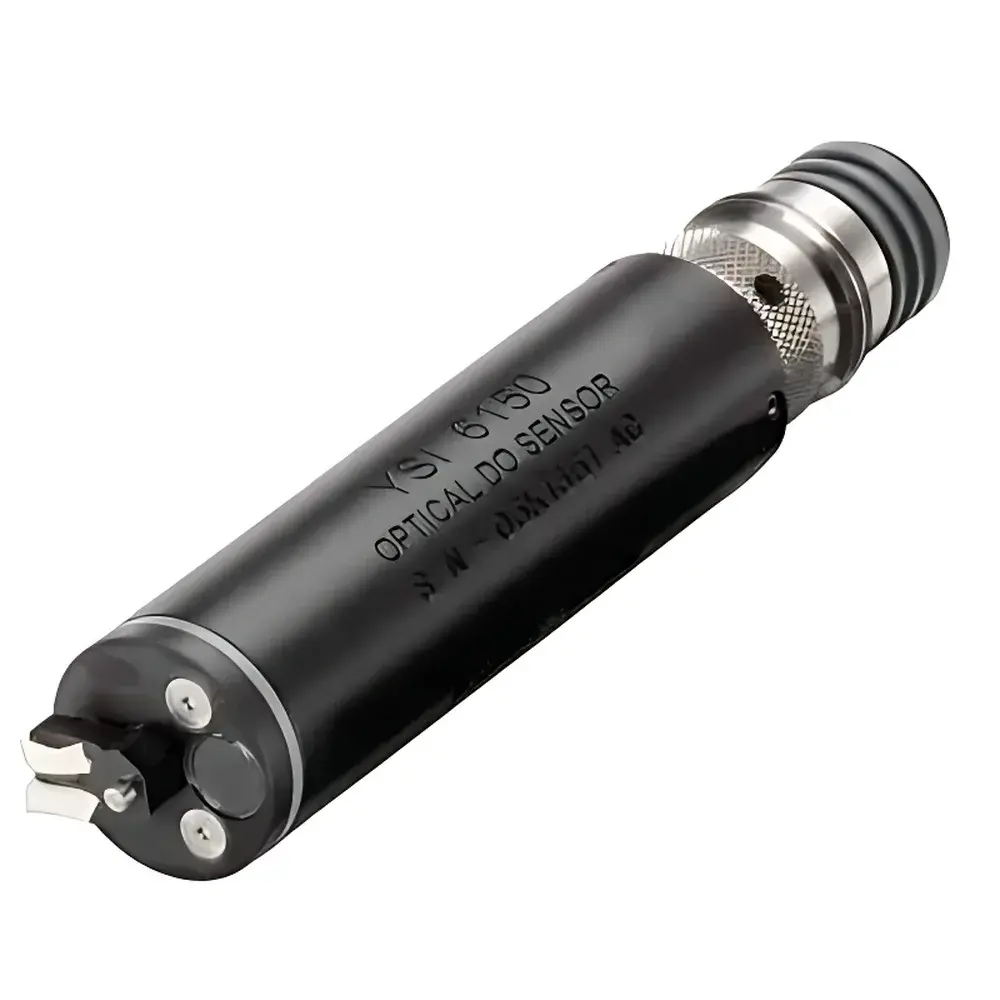
YSI ROX Optical Dissolved Oxygen Sensor
| Brand | YSI |
|---|---|
| Origin | USA |
| Model | YSI ROX |
| Measurement Principle | Fluorescence Lifetime Detection |
| DO Range (Air Saturation) | 0–500% |
| Resolution (Air Saturation) | 0.1% |
| Accuracy (0–200%) | ±1% of reading or ±1% air saturation, whichever is greater |
| Accuracy (200–500%) | ±15% of reading |
| DO Range (mg/L) | 0–50 mg/L |
| Resolution (mg/L) | 0.01 mg/L |
| Accuracy (0–20 mg/L) | ±1% of reading or ±0.1 mg/L, whichever is greater |
| Accuracy (20–50 mg/L) | ±15% of reading |
| Membrane Life | Up to 12 months |
| Flow Independence | Yes |
| Zero-Point Calibration | Supported |
| H₂S Resistance | Yes |
| Compatibility | Fully compatible with YSI ProDSS and EXO platforms (via optical port), YSI 6-Series multiparameter sondes |
Overview
The YSI ROX Optical Dissolved Oxygen Sensor is an advanced, field-deployable dissolved oxygen (DO) measurement device engineered for long-term, high-reliability operation in challenging aquatic environments—including hypoxic zones, sulfide-rich sediments, polluted rivers, groundwater wells, and low-flow or stagnant water bodies. Unlike conventional electrochemical Clark-type sensors, the ROX employs fluorescence lifetime detection—a photophysical method based on the quenching of ruthenium-based luminophore emission by molecular oxygen. This principle delivers inherent immunity to oxygen consumption at the sensing surface, eliminates electrolyte depletion and cathode poisoning, and removes flow dependency—making it uniquely suited for unattended monitoring, deep-well profiling, and sediment-porewater applications where mechanical agitation is impractical or impossible.
Key Features
- Fluorescence lifetime technology ensures exceptional long-term stability, minimal drift (<0.5% per month typical), and high reproducibility across temperature gradients (0–50 °C).
- Flow-independent measurement enables accurate DO quantification in static, laminar, or ultra-low-velocity conditions—critical for groundwater, stratified reservoirs, and benthic chambers.
- Integrated mechanical cleaning sweep system with corrosion-resistant titanium shaft and programmable actuation—designed for autonomous operation in H₂S-laden, biofouling-prone environments.
- Pre-loaded factory calibration coefficients stored in onboard memory; supports both single-point (air-saturation) and two-point (zero + air-saturation) calibration protocols compliant with ASTM D888 and ISO 5814.
- Replaceable optical sensing cap with proprietary hydrophobic, gas-permeable membrane—rated for 12 months of continuous deployment under typical field conditions.
- Optical interface fully compatible with YSI ProDSS, EXO, and legacy 6-Series multiparameter sondes; firmware upgrades available via YSI’s secure support portal.
Sample Compatibility & Compliance
The ROX sensor operates across a broad physicochemical matrix: freshwater, seawater (up to 45 psu), wastewater effluents, anaerobic digesters, and acid mine drainage. Its H₂S tolerance (>10 ppm) and absence of consumable electrolytes eliminate failure modes common in electrochemical systems exposed to reducing environments. The sensor meets design requirements for GLP-compliant environmental monitoring programs and supports audit-ready data traceability when paired with YSI’s EcoWatch™ software (21 CFR Part 11–enabled configuration available). Calibration documentation, including NIST-traceable reference standards and uncertainty budgets, is provided with each unit.
Software & Data Management
Data acquisition and configuration are managed through YSI’s ECO Software Suite, which supports real-time telemetry, automated calibration logging, drift compensation algorithms, and export to CSV, Excel, and EPA-compatible formats (e.g., WQX). All calibration events—including timestamps, operator IDs, ambient pressure/temperature inputs, and validation residuals—are recorded with immutable audit trails. Firmware updates preserve backward compatibility and introduce enhancements such as adaptive sweep scheduling and extended low-oxygen signal processing (sub-0.1 mg/L resolution mode).
Applications
- Long-term in-situ DO profiling in lakes, reservoirs, and estuaries under seasonal hypoxia/anoxia cycles.
- Regulatory compliance monitoring for NPDES permits, TMDL assessments, and wastewater discharge reporting.
- Research-grade measurements in biogeochemical studies—e.g., denitrification potential, organic matter decomposition rates, and redox zonation in wetland soils.
- Process control in aquaculture recirculating systems, activated sludge basins, and membrane bioreactors.
- Groundwater quality assessment in contaminated plumes where traditional sensors suffer from sulfide fouling or oxygen scavenging artifacts.
FAQ
Does the ROX sensor require stirring or flow during measurement?
No. The fluorescence lifetime method is intrinsically flow-independent; no minimum velocity threshold applies.
Can the ROX be calibrated at zero oxygen?
Yes. Chemical zeroing using sodium sulfite solution or nitrogen sparging is supported, enabling trace-level DO verification in anoxic environments.
How often does the optical membrane need replacement?
Under typical field use (20–25 °C, moderate biofouling), the membrane maintains performance for up to 12 months; visual inspection and calibration drift >2% signal deviation are recommended indicators for replacement.
Is the ROX compatible with third-party data loggers?
Only when interfaced via YSI’s certified communication modules (e.g., YSI RS-485 adapter or SDI-12 converter); native protocol support is limited to YSI sonde platforms.
What maintenance is required beyond membrane replacement?
None. The sensor contains no electrolytes, electrodes, or moving parts aside from the optional cleaning sweep; routine optical window inspection and gentle rinsing with deionized water suffice.
Related Products







