
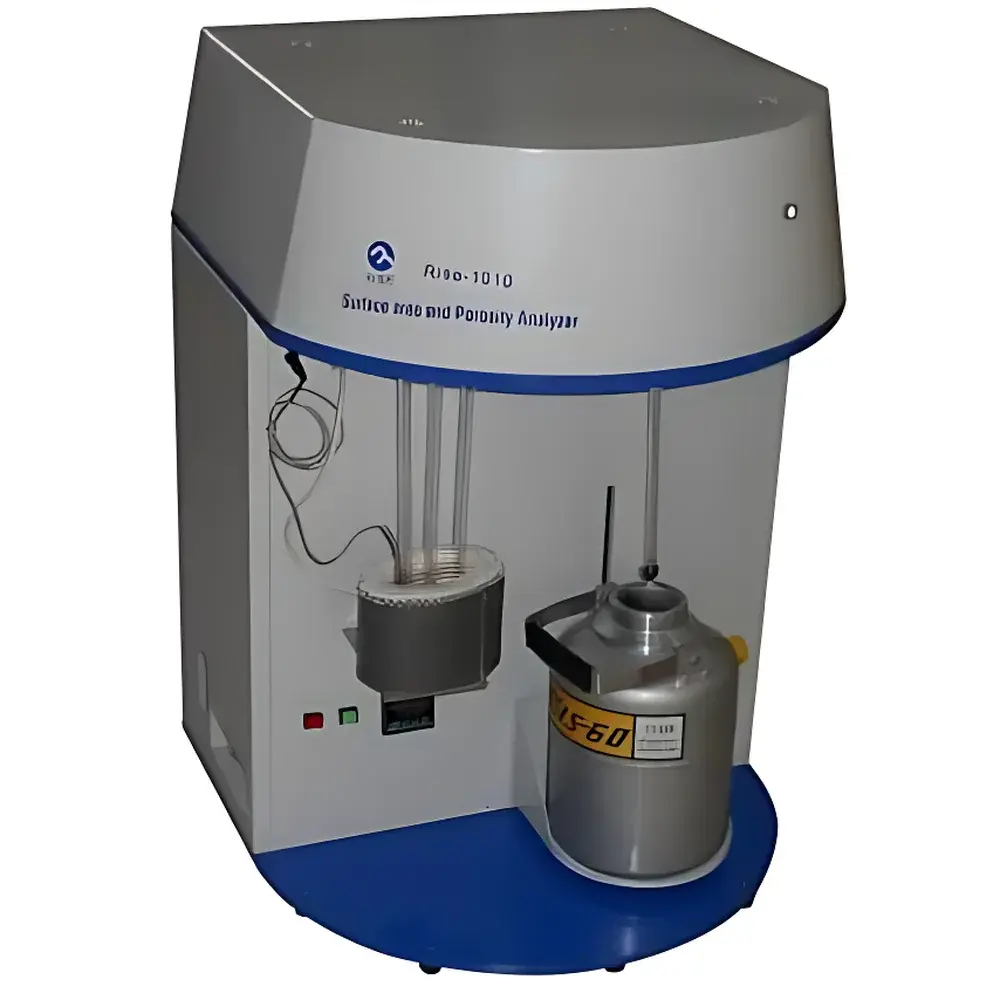
Rise-1010 Automated Specific Surface Area and Pore Size Analyzer
| Origin | Beijing, China |
|---|---|
| Manufacturer Type | Authorized Distributor |
| Origin Category | Domestic (China) |
| Model | Rise-1010 |
| Pricing | Upon Request |
Overview
The Rise-1010 Automated Specific Surface Area and Pore Size Analyzer is a high-precision instrument engineered for quantitative characterization of porous solids using the static volumetric gas adsorption method at cryogenic temperature (77 K). It operates in strict compliance with ISO 9277 (determination of specific surface area by gas adsorption), ISO 15901 (pore size distribution analysis), and GB/T 119587 (Chinese national standard for physical adsorption analysis). The system measures nitrogen adsorption–desorption isotherms under ultra-high vacuum conditions (≤1.0 × 10⁻⁴ Torr), enabling rigorous application of gas adsorption theory—including monolayer formation, capillary condensation, and micropore filling—to derive fundamental textural parameters. Its core measurement principle relies on mass balance equations applied to controlled gas dosing into a calibrated sample cell, where pressure transients—measured via three high-stability absolute pressure sensors (0–133 kPa, ±0.12% full scale)—are converted into adsorbed moles using the ideal gas law and real-gas corrections.
Key Features
- Modular all-stainless-steel vacuum manifold architecture minimizes dead volume and eliminates elastomeric seals, ensuring long-term vacuum integrity and eliminating hydrocarbon contamination risks.
- Proprietary metal Dewar flask (2 L capacity) maintains stable 77 K bath temperature for ≥80 hours without liquid nitrogen replenishment—enabling unattended overnight runs and eliminating thermal drift from evaporative cooling fluctuations.
- High-resolution data acquisition: 22-bit analog-to-digital conversion coupled with PT-100 temperature sensor (±0.1 °C accuracy) ensures traceable thermal stability critical for low-pressure (<10⁻⁶ P/P₀) measurements.
- Fully automated operation: Computer-controlled gas dosing, equilibration timing, and valve sequencing eliminate manual intervention across adsorption, desorption, and degassing stages.
- Dual-theoretical pore modeling engine supporting both classical (BJH, t-plot, D-A, H-K) and modern statistical approaches (NLDFT, GCMC) for comprehensive pore structure quantification across micro-, meso-, and macroporous regimes.
Sample Compatibility & Compliance
The Rise-1010 accommodates solid powders, granules, monoliths, and extrudates with minimal sample preparation—typically requiring only outgassing under vacuum or inert gas flow prior to analysis. It supports routine quality control and R&D workflows in catalyst development, battery electrode materials, pharmaceutical excipients, geosorbents (e.g., clays, soils), MOFs, zeolites, silica gels, and alumina-based supports. All measurement protocols align with ASTM D3663 (BET surface area), ISO 9277 (BET), ISO 15901 (pore size), and USP (porosity testing for pharmaceuticals). Audit-trail-enabled software complies with GLP/GMP documentation requirements, including user authentication, electronic signatures, and immutable raw data archiving per FDA 21 CFR Part 11 principles.
Software & Data Management
The embedded analysis suite provides real-time isotherm visualization, automatic equilibrium detection, and batch processing of multi-point BET, Langmuir, and t-plot analyses. It generates fully customizable reports—including adsorption/desorption isotherms, cumulative and differential pore volume distributions, surface area histograms, and comparative overlays—with direct export to Excel (.xlsx) and PDF formats. Raw pressure–time datasets are stored in vendor-neutral ASCII format for third-party reprocessing. Software validation documentation (IQ/OQ protocols) is available upon request to support laboratory accreditation (e.g., ISO/IEC 17025).
Applications
- Catalyst characterization: Quantifying active surface area, pore accessibility, and diffusion-limiting pore structures in supported metal and acid catalysts.
- Battery materials: Assessing specific surface area and pore tortuosity of cathode/anode composites (e.g., NMC, silicon anodes, carbon blacks) to correlate with electrochemical performance.
- Pharmaceutical solids: Determining surface energetics and porosity of APIs and excipients to predict dissolution rate, tablet compaction behavior, and stability.
- Environmental sorbents: Evaluating total pore volume and mesopore surface area of activated carbons and clay minerals for contaminant adsorption modeling.
- Advanced ceramics & MOFs: Resolving narrow micropore distributions (<1 nm) using DFT kernel libraries validated for carbon, silica, and zeolitic frameworks.
FAQ
What adsorption theory models are natively supported?
BET (single- and multi-point), Langmuir, BJH (desorption branch), t-plot, Dubinin–Astakhov, Horvath–Kawazoe, and non-local density functional theory (NLDFT) / grand canonical Monte Carlo (GCMC) kernels for slit-carbon, silica, and zeolite surfaces.
Is the system compatible with gases other than nitrogen?
Yes—while optimized for 77 K N₂, the vacuum and pressure control architecture supports argon (87 K), krypton (120 K), and CO₂ (273 K) isotherms with appropriate calibration and temperature stabilization modules.
How many samples can be processed per day?
One sample undergoes simultaneous adsorption–desorption analysis; up to three samples may be pre-conditioned (degassed) in parallel using the integrated heating station with independent temperature control (room temperature to 400 °C).
Does the software meet regulatory data integrity requirements?
Yes—the system implements role-based access control, electronic audit trails, and tamper-evident raw data storage aligned with FDA 21 CFR Part 11 and EU Annex 11 for computerized systems in regulated environments.
What vacuum performance is required for low-pressure micropore analysis?
The integrated dual-stage rotary vane pump achieves ≤1.0 × 10⁻⁴ Torr base pressure, sufficient for reliable P/P₀ down to 1 × 10⁻⁶—enabling accurate assessment of ultramicropores (<0.7 nm) via DFT modeling.
Related Products



