
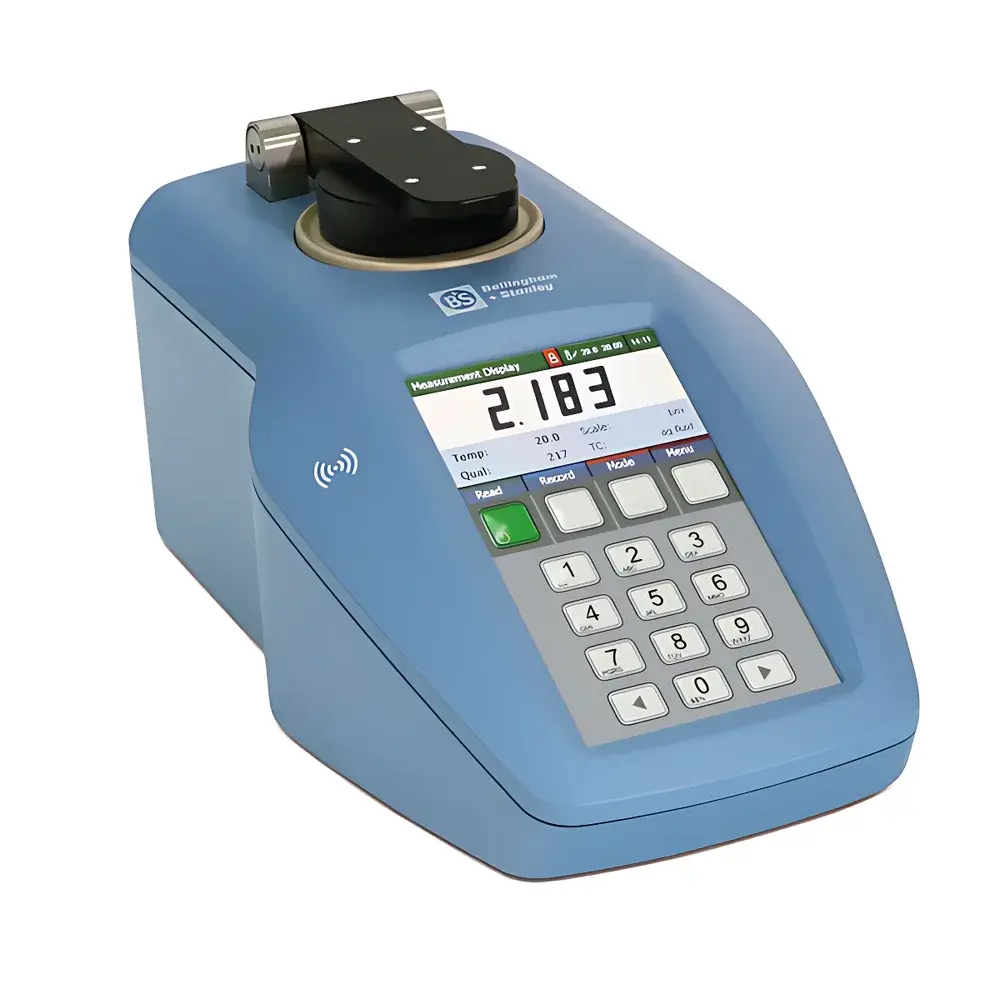
B+S RFM340-T Desktop Digital Refractometer
| Brand | Bellingham + Stanley |
|---|---|
| Origin | United Kingdom |
| Model | RFM340-T |
| Product Type | Benchtop Refractometer |
| Temperature Control | Peltier-based, programmable (5–40 °C, ±0.01 °C stability) |
| Display | 7-inch capacitive touchscreen |
| Measurement Range | Refractive Index (nD) 1.320000–1.580000 |
| Resolution | 0.000001 RI / 0.001 °Brix |
| Accuracy | ±0.00002 RI / ±0.01 °Brix (at 20 °C, sucrose standard) |
| Sample Volume | 0.5–2.0 mL |
| Prism Material | Sapphire-coated optical glass |
| Data Storage | >8,000 measurements with timestamp, user ID, method ID, and temperature log |
| Compliance | FDA 21 CFR Part 11 (electronic signatures, audit trail), GLP/GMP-ready |
| Connectivity | USB 2.0 host/device, optional Ethernet |
| Language Support | 12 UI languages (English, German, French, Spanish, Italian, Portuguese, Dutch, Polish, Czech, Turkish, Chinese, Japanese) |
Overview
The B+S RFM340-T is a high-precision benchtop digital refractometer engineered for regulated laboratory and quality control environments where traceability, thermal stability, and multi-scale reporting are critical. It operates on the principle of total internal reflection at the prism–sample interface, measuring the critical angle of incident light to determine the sample’s refractive index (nD) with sub-micro-RI resolution. The instrument integrates a solid-state Peltier temperature control system directly coupled to the sapphire-coated optical prism, enabling rapid thermal equilibration (±0.01 °C) across a programmable range of 5–40 °C—essential for eliminating thermal drift in viscosity-sensitive or temperature-dependent matrices such as fruit juices, soft drinks, syrups, and industrial resins. Unlike analog or basic digital units, the RFM340-T applies real-time SMART temperature stability verification: no reading is displayed or stored until thermal equilibrium is confirmed at the prism surface, ensuring metrological integrity per ISO 21748 and ASTM D1218 guidelines.
Key Features
- Peltier-controlled prism with ±0.01 °C thermal stability, validated via embedded platinum resistance thermometer (PT100)
- 7-inch high-resolution capacitive touchscreen with intuitive icon-driven GUI and multi-language support (12 languages)
- Dual-scale simultaneous display: primary measurement (e.g., °Brix or nD) and derived equivalent scale (e.g., sucrose-specific gravity or acid-corrected Brix)
- Method-based configuration system supporting up to 100 user-defined scales—including product-specific corrections (e.g., citric acid offset for orange juice, daily drift compensation for coffee solids)
- FDA 21 CFR Part 11 compliance suite: electronic signatures, role-based user access, immutable audit trail, and secure PDF export with digital watermarking
- Onboard memory storing >8,000 full records—including timestamp, operator ID, method ID, temperature log, and raw RI/Brix values
- USB 2.0 interface for data backup, instrument cloning, firmware updates, and direct printing to password-protected PDF
- RFID-enabled user authentication for seamless, contactless login and permission management
Sample Compatibility & Compliance
The RFM340-T accommodates a broad spectrum of homogeneous and heterogeneous liquid samples. Its large-aperture sapphire-coated prism (28 mm × 12 mm) supports viscous, particulate-laden, and low-surface-tension media—including pulpy fruit juices, emulsified sauces, edible oils, polymer solutions, and uncured epoxy resins—without requiring filtration or dilution. Sample contact time is minimized by rapid thermal stabilization (<90 seconds from ambient to setpoint), reducing evaporation artifacts in volatile matrices. The instrument meets ISO 21748:2017 (repeatability and reproducibility of refractometric measurements), ASTM D1218 (standard test method for refractive index of hydrocarbon liquids), and USP (refractometry in pharmaceutical excipient testing). Its design conforms to IEC 61010-1 for electrical safety and EN 61326-1 for electromagnetic compatibility in laboratory settings.
Software & Data Management
The embedded firmware implements a hierarchical method architecture that decouples calibration, correction, and reporting logic. Each method stores calibration constants, temperature compensation coefficients, product-specific offsets, pass/fail limits, and default output scales. All data entries include metadata fields compliant with GLP and GMP documentation requirements: operator identity (via RFID or PIN), instrument serial number, environmental temperature/humidity (if external sensor connected), and method revision history. Audit trails record every action—including parameter changes, calibration events, user logins/logouts, and data deletions—with tamper-proof timestamps. USB export generates encrypted PDF reports containing embedded digital signatures, QR-coded instrument certification status, and full traceability to NIST-traceable sucrose standards.
Applications
- Food & Beverage QC: Real-time Brix monitoring in juice concentration, syrup blending, soft drink formulation, and honey adulteration screening
- Pharmaceutical Manufacturing: Excipient concentration verification (e.g., glycerin, propylene glycol), osmolality proxy assessment, and cleaning validation rinse water analysis
- Chemical & Coatings: Resin solids content, monomer conversion tracking, and solvent recovery efficiency evaluation
- Agricultural Labs: Field-deployable density equivalence for citrus grading, sugar beet processing, and maple syrup certification (per USDA AMS standards)
- Contract Manufacturing: Cross-site method harmonization using cloned instrument configurations and standardized PDF reporting templates
FAQ
Does the RFM340-T support automatic temperature compensation for non-sucrose solutions?
Yes—via user-defined polynomial correction tables linked to each measurement method, allowing accurate RI-to-concentration conversion for acids, alcohols, glycols, and proprietary formulations.
Can historical calibration data be exported for regulatory review?
Yes—all calibration events (date, operator, standard used, deviation values, pass/fail status) are stored in the audit trail and exportable in CSV or signed PDF format.
Is the sapphire prism resistant to aggressive solvents like acetone or THF?
The sapphire coating provides enhanced chemical inertness; however, prolonged exposure to strong fluorinated or chlorinated solvents is not recommended—consult the B+S Chemical Compatibility Matrix before routine use.
How does the SMART temperature stability check differ from conventional thermostat delay timers?
It monitors real-time thermal gradient across the prism surface using dual PT100 sensors—not just bulk heater temperature—ensuring measurement only initiates when thermal equilibrium is physically achieved at the optical interface.
Can the instrument be integrated into a LIMS via network protocol?
While native Ethernet is optional, USB-connected instruments support HL7-compliant data export; API integration requires B+S LabLink middleware (sold separately) for bidirectional communication with major LIMS platforms.





