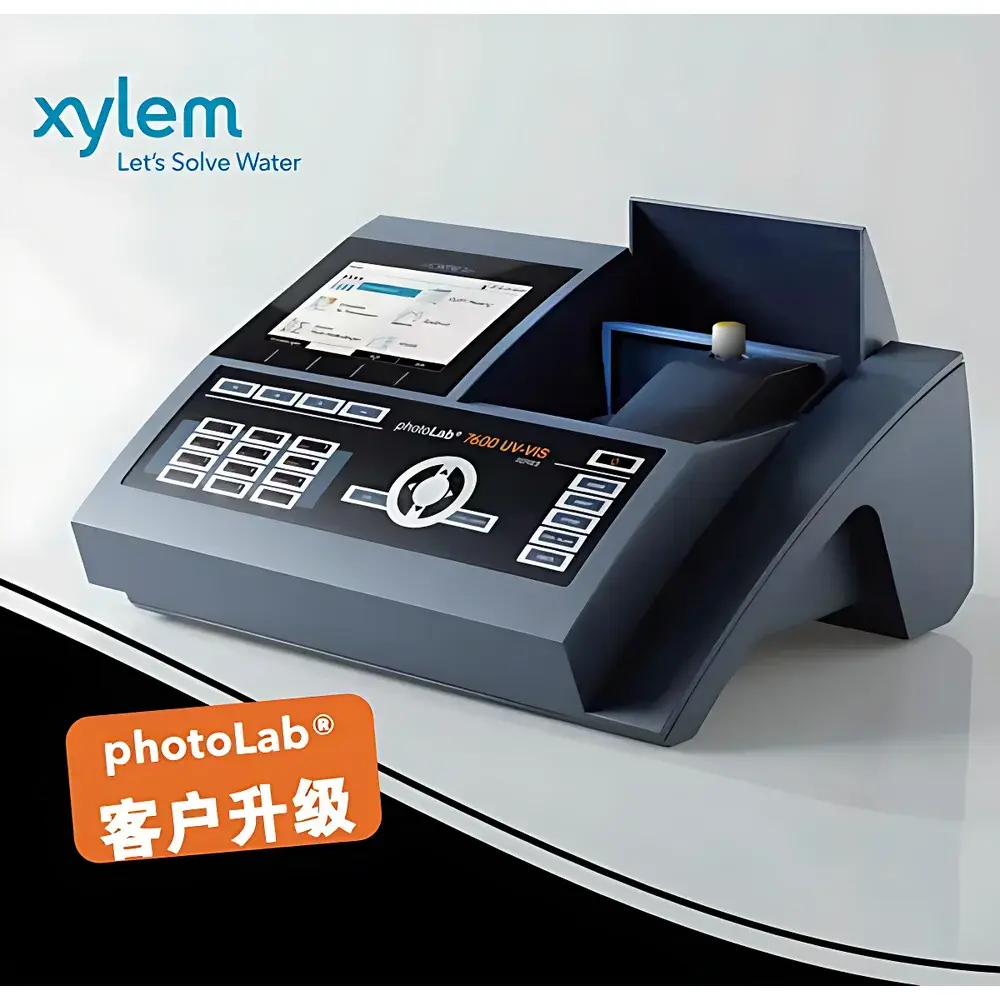
photoLab® 7100 VIS Spectrophotometer
| Brand | WTW |
|---|---|
| Origin | Germany |
| Model | photoLab® 7100 VIS |
| Wavelength Range | 320–1100 nm |
| Optical Design | Dual-Beam Reference Channel |
| Light Source | Xenon Pulse Lamp |
| Display | High-Resolution Color TFT Touchscreen |
| Connectivity | USB, Ethernet, PDF Export |
| Software | SpectroLab Data Management Suite (GLP-Compliant) |
| Compliance | ISO/IEC 17025, ASTM E275, USP <857>, FDA 21 CFR Part 11 Ready |
Overview
The photoLab® 7100 VIS Spectrophotometer is a high-precision, dual-beam visible-range spectrophotometer engineered for routine and advanced water quality analysis in environmental monitoring laboratories, municipal wastewater treatment plants, and industrial QC facilities. Operating across a spectral range of 320–1100 nm, it employs a stable xenon pulse lamp as its light source—eliminating warm-up time and extending operational lifetime compared to conventional tungsten-halogen or deuterium lamps. Its integrated reference beam architecture ensures real-time compensation for lamp intensity drift, optical path fluctuations, and ambient temperature variations—delivering high reproducibility (<0.5% RSD for absorbance at 546 nm) and long-term photometric stability essential for regulatory-compliant measurements. Designed as a direct upgrade path from the photoLab® 6000 series, the 7100 VIS maintains full backward compatibility with existing cuvette holders, calibration standards, and method protocols while introducing enhanced data integrity features required under GLP and ISO/IEC 17025 frameworks.
Key Features
- Dual-beam reference channel for automatic baseline correction and drift compensation during kinetic or multi-point measurements
- Xenon pulse lamp technology: zero warm-up delay, >10⁶ flash cycles lifetime, consistent spectral output across visible range
- 7-inch capacitive color TFT touchscreen with intuitive icon-driven interface and context-sensitive on-screen guidance
- Preloaded EPA, ISO, and DIN-compliant methods—including COD (via optional OptRF-compatible upgrades), nitrate, phosphate, ammonia, and chlorine
- Integrated PDF report generator with embedded metadata (operator ID, timestamp, instrument serial, calibration status)
- USB host port for flash drive data export; Ethernet interface supporting DHCP, static IP, and remote firmware updates
- Onboard memory stores ≥10,000 measurement records with full audit trail (user login, parameter changes, result edits)
Sample Compatibility & Compliance
The photoLab® 7100 VIS accepts standard 10 mm, 20 mm, 50 mm, and micro-volume cuvettes—including UV-transparent quartz for future UV-extension readiness. It supports both liquid-phase transmission measurements and solid-surface reflectance via optional accessories. All factory-calibrated wavelengths are traceable to NIST-certified filters, and photometric accuracy meets ASTM E275 Class A specifications (±0.005 AU at 0.5 AU, ±0.01 AU at 1.0 AU). The system adheres to GLP principles through mandatory user authentication, electronic signature capability, and immutable result logging. When paired with SpectroLab software, it satisfies FDA 21 CFR Part 11 requirements for electronic records and signatures—including role-based access control, audit trail review, and secure data archiving.
Software & Data Management
SpectroLab Data Management Suite is a Windows-based application enabling bidirectional communication with the instrument via USB or Ethernet. It provides automated method import/export, customizable report templates (PDF/XLS), and seamless integration with LIMS platforms via CSV or ODBC drivers. The software enforces data integrity by recording all procedural events—including calibration date, wavelength verification results, and cuvette position history. Batch processing tools support statistical evaluation (mean, SD, CV%, confidence intervals) across multiple samples per method. Raw spectral data (absorbance vs. wavelength) is stored in vendor-neutral ASCII format for third-party analysis in MATLAB, Python, or R environments.
Applications
The photoLab® 7100 VIS serves as a core analytical platform in municipal wastewater treatment compliance testing (e.g., effluent discharge monitoring per EU Urban Wastewater Directive), surface water quality assessment (e.g., nutrient loading studies per ISO 15681-1), and industrial process water control (e.g., cooling tower chemistry per ASTM D4582). Its rapid response and reagent-free capability—particularly when upgraded to OptRF-enabled configurations—enable same-day COD and nitrite quantification without digestion, mercury, or dichromate. This eliminates hazardous waste generation, reduces labor time by >80% versus standard APHA 5220D methods, and aligns with green laboratory initiatives endorsed by the European Environment Agency and U.S. EPA’s Safer Choice program.
FAQ
Is the photoLab® 7100 VIS compatible with existing photoLab® 6000 accessories and calibration standards?
Yes—mechanical, optical, and electrical interfaces are fully preserved. Cuvette holders, calibration kits (e.g., KCl solution for absorbance verification), and method files migrate directly.
Does the instrument require annual recalibration by an authorized service provider?
While not mandated by regulation, WTW recommends biannual wavelength and photometric verification using certified reference materials. Full factory recalibration is advised every 24 months or after major hardware intervention.
Can SpectroLab software be deployed on virtualized Windows environments (e.g., Citrix or VMware)?
Yes—tested and supported on Windows Server 2016/2019 LTSB editions with .NET Framework 4.8 and Microsoft Visual C++ Redistributables installed.
What validation documentation is provided for GMP-regulated laboratories?
A comprehensive IQ/OQ protocol package—including installation checklist, operational test scripts, and performance qualification templates—is available upon request and aligned with Annex 11 and ASTM E2500 guidelines.
Is method development possible without programming knowledge?
Yes—SpectroLab includes a graphical method editor allowing users to define custom curves (linear, quadratic, polynomial), set acceptance criteria, assign units, and embed calculation logic via drag-and-drop workflow builder.