
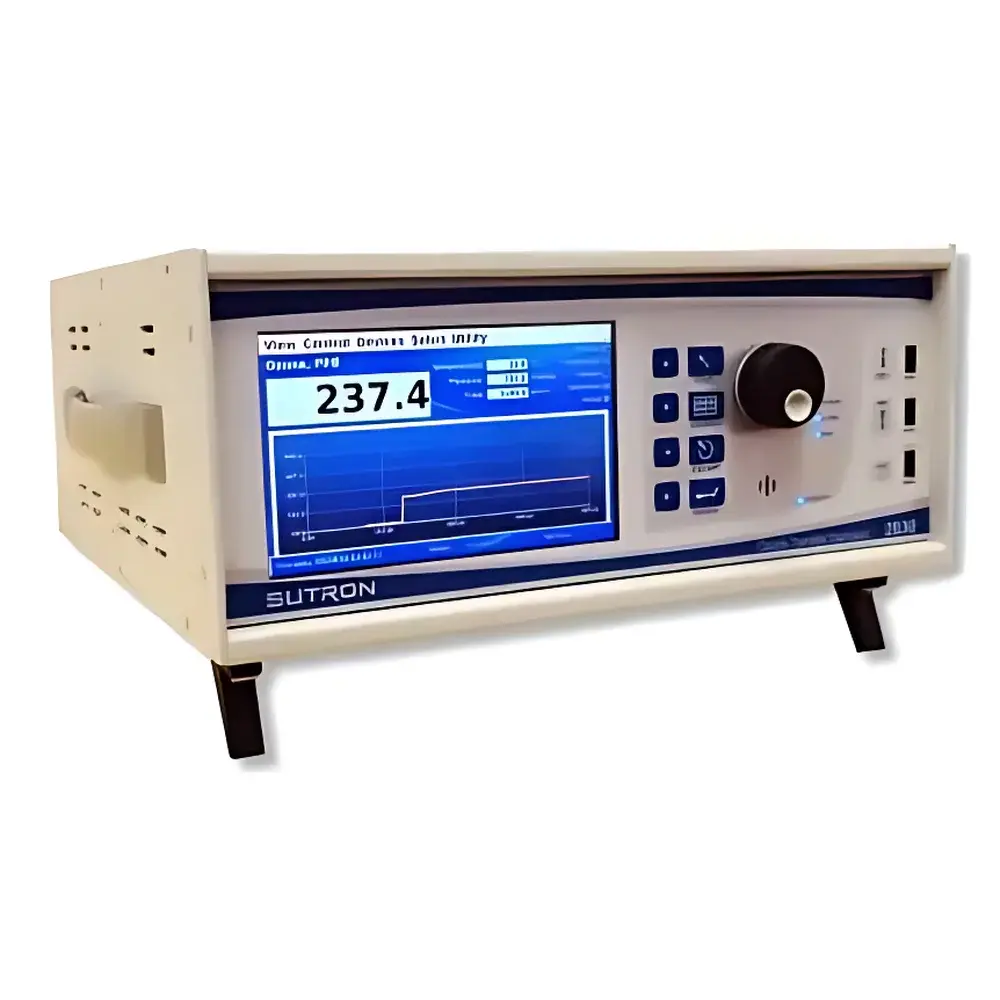
Sabio Model 2030 Portable Ozone Calibrator
| Brand | Sabio |
|---|---|
| Origin | USA |
| Manufacturer Type | Authorized Distributor |
| Origin Category | Imported |
| Model | Model 2030 |
| Price | Upon Request |
| Measurement Principle | UV Absorption at 254 nm (Beer–Lambert Law) |
| Range Options | 0–100 / 0–200 / 0–500 ppb or 0–1 / 0–2 ppm |
| Detection Limit | 1 ppb |
| Zero Noise | 0.6 ppb RMS |
| Zero Drift | <1.0 ppb/24 hr, <2.0 ppb/7 days |
| Span Drift | <1% per month |
| Response Time | 20 s (10 s delay) |
| Accuracy | ±1 ppb |
| Linearity | ±1% of full scale |
| Sample Flow Rate | 1 L/min |
| Operating Temperature | 5–45 °C |
| Power Supply | 98–132 VAC / 196–264 VAC, 50/60 Hz |
| Analog Outputs | Four independent, scalable (0.1 V / 1 V / 2 V / 5 V / 10 V) |
| Digital Interfaces | USB, RS-232/RS-485 (DB-9) |
| Display | Color LCD with touchscreen, front-panel keys, external keyboard/mouse support |
| Data Storage | Internal logging with timestamped records |
| Built-in Ozone Generator | 0.05–1.5 ppm @ 5 SLM, ±2% of setpoint or ±3 ppb @ 5 SLM |
| Auto Zero Compensation | Yes |
| Temperature & Pressure Compensation | Yes |
| Dimensions | 15.6 cm H × 36.4 cm W × 31.6 cm D |
| Weight | 9.1 kg |
Overview
The Sabio Model 2030 Portable Ozone Calibrator is a laboratory-grade, field-deployable instrument engineered for trace-level ozone quantification in ambient air and calibration gas streams. It operates on the fundamental principle of ultraviolet absorption spectroscopy at 254 nm — a wavelength strongly absorbed by ozone molecules in accordance with the Beer–Lambert law. Unlike conventional dual-beam analyzers, the Model 2030 employs a single optical cell architecture where sample and reference light paths are sequentially measured using a high-stability deuterium lamp and precision photodiode detector. This design eliminates inter-channel variability, reduces optical alignment complexity, and enables real-time zero-point correction without manual intervention. The instrument is calibrated traceably to NIST-standard ozone transfer standards and meets performance criteria specified in U.S. EPA Reference Method EQOA-0111-122 and ISO 13964:2021 for UV-based ozone analyzers. Its compact chassis, integrated ozone generator, and battery-ready power architecture make it suitable for mobile calibration audits, ambient monitoring network validation, and regulatory compliance verification under field conditions.
Key Features
- Single-cell UV photometric design minimizing optical drift and alignment sensitivity
- Onboard ozone generator delivering stable, programmable output from 0.05 to 1.5 ppm at 5 SLPM, certified to ±2% of setpoint or ±3 ppb
- Real-time auto-zero compensation algorithm that corrects for baseline drift without interrupting measurement cycles
- Four independently configurable analog outputs (0.1 V to 10 V), each scalable to user-defined concentration ranges for PLC integration or data acquisition systems
- Color LCD touchscreen interface with multilingual menu support, complemented by physical front-panel keys and optional external HID peripherals
- Comprehensive environmental compensation: simultaneous temperature and barometric pressure correction using integrated sensors (±0.5 °C, ±1 hPa accuracy)
- Embedded firmware with diagnostic logging, error code reporting, and time-series bar graph visualization for immediate trend assessment
- Internal non-volatile memory storing >100,000 timestamped readings with UTC synchronization capability via USB host connection
Sample Compatibility & Compliance
The Model 2030 is designed for clean, dry, particle-free gas streams typical of ambient air sampling, calibration laboratories, and indoor air quality assessments. It accepts sample flow rates of 1.0 ±0.1 L/min and accommodates inlet pressures from 80 to 106 kPa absolute. Particulate filtration (0.5 µm) and moisture removal (dew point ≤ –20 °C) are recommended upstream to prevent optical window contamination or condensation-induced signal attenuation. The analyzer complies with IEC 61000-6-2 (EMC immunity) and IEC 61000-6-3 (EMC emissions), and its electrical safety conforms to UL 61010-1 and CSA C22.2 No. 61010-1. For regulated environments, the firmware supports audit-trail-enabled operation meeting FDA 21 CFR Part 11 requirements when paired with validated software protocols and user access controls. It is routinely deployed in EPA-certified ambient monitoring stations and fulfills QA/QC criteria outlined in ASTM D5012 and EN 14625 for ozone reference instruments.
Software & Data Management
The Model 2030 runs Sabio’s proprietary embedded firmware v3.2+, supporting bidirectional communication via USB 2.0 (CDC class) and RS-232/RS-485 (Modbus RTU protocol). A Windows-compatible desktop application provides remote configuration, real-time data streaming, calibration certificate generation, and firmware updates. All stored measurements include metadata: date/time stamp (with NTP sync option), ambient T/P values, lamp intensity, zero/span status flags, and diagnostic codes. Export formats include CSV (comma-separated), XML (for LIMS ingestion), and PDF reports compliant with GLP documentation standards. The system maintains a tamper-evident log of all configuration changes, user logins, and calibration events — essential for GMP and ISO/IEC 17025 accredited laboratories.
Applications
- Field validation and recalibration of fixed-site ozone monitors in national air quality networks (e.g., U.S. AQS, EU AirBase)
- Performance verification of UV photometric ozone analyzers prior to regulatory submission or third-party certification
- Mobile source emission testing where portable, traceable ozone references are required for dilution tunnel calibration
- Indoor air quality studies assessing ozone generation from office equipment, HVAC systems, or air purifiers
- Research applications involving atmospheric chemistry modeling, photochemical reaction kinetics, and sensor cross-sensitivity characterization
- Training and proficiency testing for environmental technicians under EPA Method TO-11A or ISO 13964-based protocols
FAQ
What ozone concentration ranges does the Model 2030 support?
The instrument offers six selectable full-scale ranges: 0–100 ppb, 0–200 ppb, 0–500 ppb, 0–1 ppm, 0–2 ppm, and 0–5 ppm — configured via firmware menu or remote command.
Is the built-in ozone generator NIST-traceable?
Yes. The generator is factory-calibrated against primary ozone standards maintained by NIST and documented in the Certificate of Calibration shipped with each unit.
Can the Model 2030 operate unattended for extended periods?
It supports continuous logging for up to 30 days at 1-minute intervals using internal memory; external power or UPS is recommended for deployments exceeding 8 hours.
Does the analyzer meet EPA equivalency requirements for reference methods?
The Model 2030 satisfies the performance specifications of EPA EQOA-0111-122 and is listed in the EPA’s Compendium of Methods for the Determination of Inorganic Compounds in Ambient Air (Method TO-11A) as a qualified calibration transfer standard.
How is zero drift corrected during long-term operation?
The instrument performs automatic zero checks every 30 minutes using an internal nitrogen purge cycle, updating the baseline offset in real time without requiring operator input or gas cylinders.
Related Products







