
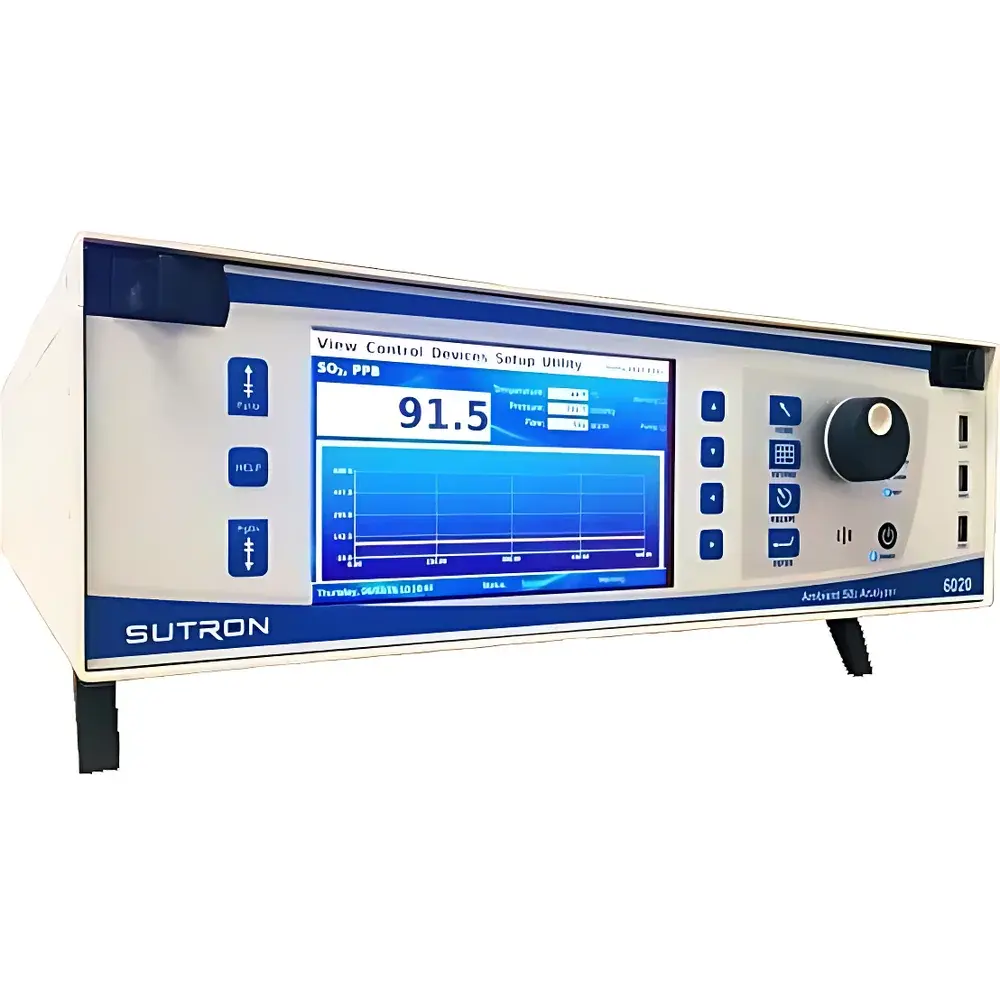
Sabio Model 6020 Fluorescence-Based Sulfur Dioxide (SO₂) Analyzer
| Brand | Sabio |
|---|---|
| Origin | USA |
| Manufacturer Type | Authorized Distributor |
| Import Status | Imported |
| Model | Model 6020 |
| Price | Upon Request |
| Measurement Principle | Pulsed UV Fluorescence (PUVF) |
| Range | 0–50 ppb to 0–20 ppm (user-selectable) |
| Detection Limit | < 0.4 ppb |
| Noise | < 0.2 ppb |
| Zero Drift | < 0.5 ppb/24 hr |
| Accuracy | < 1% Full Scale |
| Sample Flow Rate | 0.4–0.8 L/min |
| Operating Temperature | 5–40 °C |
| Power Consumption | 200 W |
| Dimensions (H×W×D) | 133 × 432 × 571.5 mm |
| Weight | 11.3 kg |
| Display | High-resolution color TFT LCD with touchscreen support |
| Communication Interfaces | Ethernet (TCP/IP), USB 2.0, RS-232/485 |
| Analog I/O | 4 configurable voltage channels (0.1 V, 1 V, 2 V, 5 V, 10 V output ranges) |
| Digital I/O | 8 standard TTL-compatible channels |
| Data Logging | Internal non-volatile memory with timestamped records |
| Compliance | EPA Reference Method EQOA-0808-191 (equivalent to EPA Method 40 CFR Part 53, Class I) |
| Software | Menu-driven embedded OS with diagnostic suite, barcode-enabled time-series visualization, Modbus RTU/TCP support |
| Environmental Compensation | Automatic temperature and barometric pressure correction |
Overview
The Sabio Model 6020 Fluorescence-Based Sulfur Dioxide (SO₂) Analyzer is an EPA-designated reference-grade instrument engineered for continuous, real-time quantification of sulfur dioxide in ambient air at sub-ppb sensitivity levels. It operates on the principle of pulsed ultraviolet fluorescence (PUVF), where SO₂ molecules are excited by a short-wavelength UV pulse (typically 214 nm), inducing characteristic fluorescence emission near 320 nm. This optical signal is isolated via narrow-band filtering and measured by a low-noise photomultiplier tube (PMT), enabling high specificity and minimal interference from common atmospheric constituents such as ozone, NO₂, or hydrocarbons. Designed to meet U.S. Environmental Protection Agency (EPA) Performance Specification EQOA-0808-191 and equivalent to 40 CFR Part 53 Subpart C requirements for Class I reference analyzers, the Model 6020 delivers metrologically traceable measurements suitable for regulatory monitoring networks, air quality research stations, and compliance reporting under NAAQS standards.
Key Features
- Pulsed UV fluorescence detection with < 0.4 ppb method detection limit and < 0.2 ppb RMS noise baseline — optimized for low-concentration urban and background monitoring.
- User-selectable measurement ranges spanning 0–50 ppb up to 0–20 ppm, supporting both ambient air quality assessment and industrial stack emission verification.
- Integrated environmental compensation algorithms automatically correct for temperature (5–40 °C operational range) and barometric pressure variations, ensuring long-term stability without manual recalibration.
- High-resolution color TFT LCD with multi-input interface options: capacitive touchscreen, front-panel membrane keypad, external USB keyboard/mouse — enabling flexible deployment in field shelters or laboratory control rooms.
- Robust communications architecture featuring native Ethernet (TCP/IP), USB 2.0 host/device ports, and RS-232/485 serial interfaces — compatible with SCADA systems, data acquisition servers, and central monitoring platforms.
- Four programmable analog voltage outputs (0.1 V to 10 V full scale) and eight TTL-level digital I/O lines support seamless integration into facility-wide control logic and alarm relay systems.
- Onboard non-volatile data logger stores timestamped concentration values, system diagnostics, calibration events, and environmental parameters — retained for ≥30 days at 1-minute intervals.
Sample Compatibility & Compliance
The Model 6020 is validated for use with ambient air, filtered or unfiltered (with optional particle filter), and conditioned sample streams meeting EPA-specified flow (0.4–0.8 L/min) and dew point (< 10 °C) criteria. It complies with U.S. EPA Reference Method equivalency requirements under 40 CFR Part 53 for Class I reference analyzers and is routinely deployed in State and Local Air Monitoring Stations (SLAMS) and National Core (NCore) networks. The analyzer supports GLP-aligned operation through audit-trail-capable firmware logging, user-access-level authentication, and Modbus TCP register mapping for third-party validation. All calibration procedures follow EPA-recommended protocols using certified SO₂ permeation tubes or dynamic dilution systems traceable to NIST SRMs.
Software & Data Management
The embedded menu-driven operating system provides intuitive access to configuration menus, real-time status dashboards, spectral diagnostics, and maintenance logs. Time-series SO₂ concentration plots can be retrieved directly via barcode scanning of instrument-generated session IDs — eliminating manual data export steps. Firmware updates, configuration backups, and raw data extraction are performed over USB or Ethernet using standardized file transfer protocols. Data output formats include CSV and ASCII text streams compliant with AQS-1000 and AirNow ingestion specifications. Optional software packages enable remote web-based supervision, automated QA/QC flagging per 40 CFR Part 58 Appendix A, and electronic signature support aligned with FDA 21 CFR Part 11 requirements for regulated environments.
Applications
- Ambient air quality monitoring for regulatory compliance with NAAQS SO₂ standards (75 ppb 1-hour, 0.5 ppm 3-hour).
- Long-term trend analysis in background, urban, and industrial-adjacent sites requiring high temporal resolution and low-drift performance.
- Calibration verification and transfer standards for secondary monitoring instruments across regional networks.
- Process emissions monitoring in power generation, petroleum refining, and metallurgical facilities where real-time SO₂ feedback informs scrubber control logic.
- Field-deployable research platforms for atmospheric chemistry studies involving sulfur cycle modeling and oxidation kinetics.
- Mobile monitoring applications when integrated with GPS-synchronized sampling trailers or UAV-mounted payload systems (subject to mechanical mounting and power interface validation).
FAQ
What regulatory methods does the Model 6020 satisfy?
It meets U.S. EPA Performance Specification EQOA-0808-191 and is designated as an equivalent method to 40 CFR Part 53, Subpart C for Class I reference analyzers.
Is automatic zero/span verification supported?
Yes — the analyzer accepts external zero air and span gas inputs via solenoid-controlled valves; automated sequences can be scheduled and logged with full audit trail.
Can the instrument operate unattended for extended periods?
With its internal data logger, temperature-compensated optics, and < 0.5 ppb/24 hr zero drift, it is qualified for continuous unattended operation up to 30 days between routine maintenance.
Does the Model 6020 support remote diagnostics and firmware updates?
Yes — Ethernet-based remote access enables live parameter monitoring, error log retrieval, and secure over-the-air firmware upgrades without physical site visits.
What sample conditioning accessories are recommended for high-humidity environments?
A Nafion™ dryer or chilled mirror dew point controller is advised to maintain sample dew point below 10 °C and prevent condensation-induced signal attenuation.





