
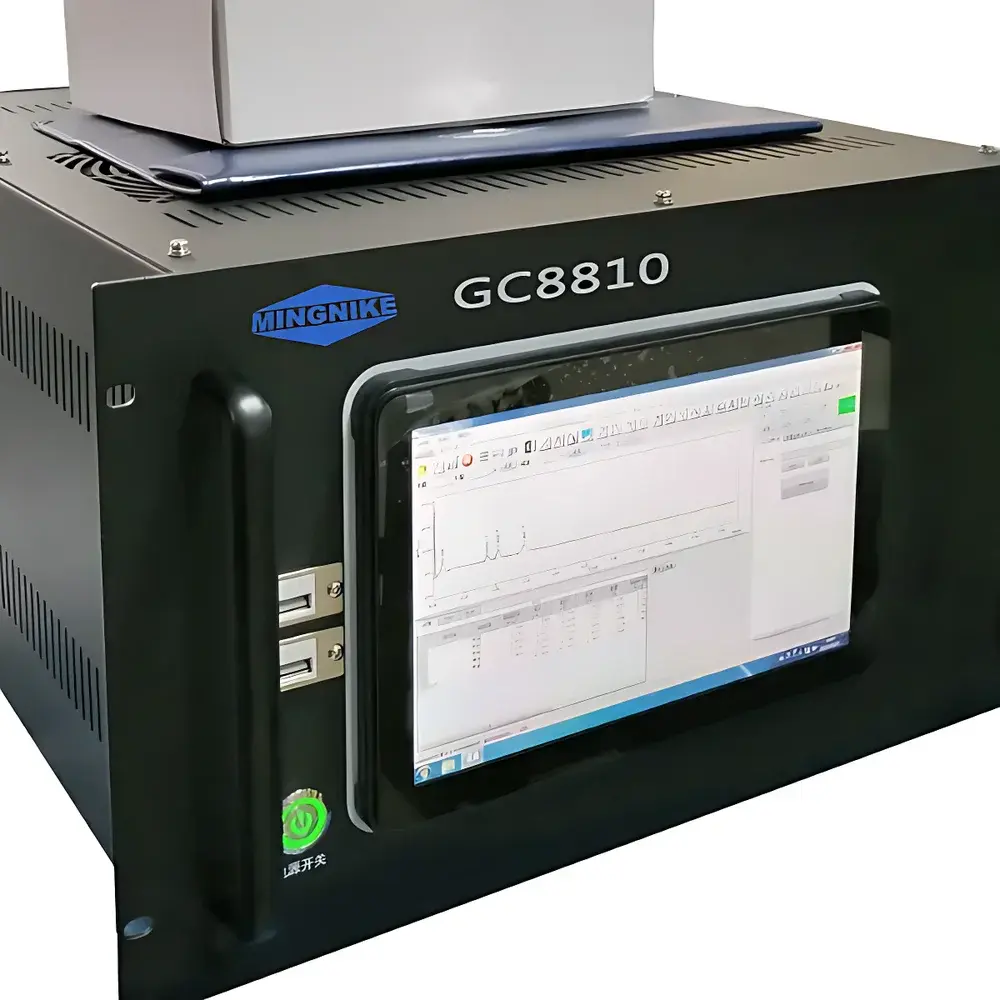
MNK GC-8810 Mobile Refinery Gas Analyzer
| Brand | MNK |
|---|---|
| Origin | Beijing, China |
| Model | GC-8810 |
| Instrument Type | Laboratory Gas Chromatograph |
| Application Domain | Coal Industry Specific |
| Detection Limits | Permanent Gases (N₂, CO₂, O₂) < 10 ppm |
| Analysis Time | ≤ 2 min (including backflush) |
| Modular Configuration | Up to 4 independent GC channels |
| Detector Technology | NEMS-based silicon micro-TCD |
| Flow Control | Electronic Pressure Control (EPC) per channel |
| Temperature Control | Independent oven and column-zone heating per module |
Overview
The MNK GC-8810 Mobile Refinery Gas Analyzer is a purpose-engineered portable gas chromatograph designed for on-site, real-time compositional analysis of complex refinery process streams and associated fuel gases. It operates on the fundamental principle of gas-phase separation via capillary or packed column chromatography, coupled with highly stable thermal conductivity detection (TCD) based on nanoelectromechanical systems (NEMS) technology. Unlike conventional benchtop GC systems, the GC-8810 integrates ruggedized mechanical architecture, battery-backed power management, and field-optimized pneumatic control to deliver laboratory-grade reproducibility in non-laboratory environments — including refinery perimeters, coal gasification units, flare stacks, and mobile monitoring vehicles. Its core function is quantitative speciation of permanent gases (N₂, O₂, CO₂, CH₄, H₂), light hydrocarbons (C₁–C₆), aromatic VOCs (benzene, toluene, ethylbenzene, xylenes), sulfur compounds (H₂S, COS), and halogenated species — all within sub-two-minute cycle times.
Key Features
- Modular multi-channel architecture supporting up to four independent GC analysis paths — each with dedicated column oven, pre-column, analytical column, and NEMS-enhanced micro-TCD detector
- Electronic Pressure Control (EPC) for precise, drift-free carrier gas flow regulation (He or H₂) across all channels, enabling retention time stability ±0.02 min over 24 h
- Independent temperature zoning: main oven (35–220 °C, ±0.1 °C), valve box (40–180 °C), and detector block (80–250 °C), all PID-controlled and calibrated per ASTM E1510
- Backflush-enabled column configuration minimizes carryover and enables rapid turnaround between samples without column bake-out
- Field-ruggedized chassis with IP54-rated enclosure, shock-absorbing mounting, and integrated uninterruptible power supply (UPS) for operation during transient grid outages or vehicle-mounted deployment
- Plug-and-play module interface compliant with IEC 61000-6-2/6-4 for electromagnetic compatibility in industrial zones
Sample Compatibility & Compliance
The GC-8810 accommodates pressurized gas samples delivered via stainless-steel sampling loops (0.25–1.0 mL), direct line injection, or canister-based grab sampling (SUMMA-treated electropolished canisters). It complies with method requirements outlined in ASTM D1945 (analysis of natural gas), ASTM D1946 (analysis of reformed gas), ISO 6974-2 (natural gas — determination of composition), and GB/T 13610–2014 (Chinese standard for gas chromatographic analysis of refinery gases). All hardware components contacting sample streams meet ASME B31.4 and B31.8 material specifications for hydrocarbon service. Data integrity adheres to ALCOA+ principles; audit trails, user access logs, and electronic signatures are enforced under configurable role-based permissions aligned with FDA 21 CFR Part 11 readiness.
Software & Data Management
Instrument control, method development, and data processing are managed through MNK ChromaView v3.2 — a Windows-based platform featuring intuitive workflow templates for refinery gas analysis (e.g., “LPG Quick Screen”, “Flare Gas Composition”, “Coal-Derived Syngas Profiling”). The software supports automated calibration curve generation using internal standard addition (e.g., argon or methane), peak deconvolution for co-eluting C₃–C₅ isomers, and real-time spectral validation against NIST Chemistry WebBook reference libraries. Raw data files (.cdf) are stored with embedded metadata (operator ID, GPS timestamp, ambient T/P, module configuration hash) and exportable to LIMS via ASTM E1384-compliant XML or direct ODBC connection. All software updates undergo verification per ICH Q9 quality risk management guidelines.
Applications
- Rapid LPG quality verification at loading terminals per ASTM D2158 and GB 11174
- Real-time monitoring of syngas composition from coal gasifiers to optimize air-to-fuel ratios and slag viscosity control
- Flare gas auditing for environmental compliance (EPA Method 25A, EU Directive 2010/75/EU)
- Corrosion risk assessment via continuous H₂S and mercaptan tracking in amine-treated gas streams
- Startup/shutdown emissions profiling during plant commissioning or turnaround events
- Mobile QA/QC support for pipeline custody transfer points where fixed analyzers are unavailable
FAQ
What carrier gases are compatible with the GC-8810?
Helium and hydrogen are supported; hydrogen offers faster analysis and higher sensitivity for permanent gases, while helium provides greater safety in unventilated field enclosures.
Can the system be integrated into a SCADA network?
Yes — Modbus TCP and OPC UA server modules are available as optional firmware upgrades, enabling seamless integration with DCS or central monitoring systems.
Is method validation documentation provided?
Each instrument ships with a Factory Acceptance Test (FAT) report, system suitability test results per USP , and a traceable calibration certificate for detector response factors.
What maintenance intervals are recommended for field operation?
Column conditioning every 200 injections; micro-TCD filament inspection every 6 months; EPC valve cleaning every 12 months — all procedures documented in the Field Service Manual (FSM-8810 Rev. D).
Does the analyzer meet explosion-proof certification requirements?
The base unit is rated for Class I, Division 2, Group D environments; ATEX/IECEx-certified variants (GC-8810-EX) are available upon request with flameproof enclosure and intrinsically safe signal interfaces.
Related Products



