
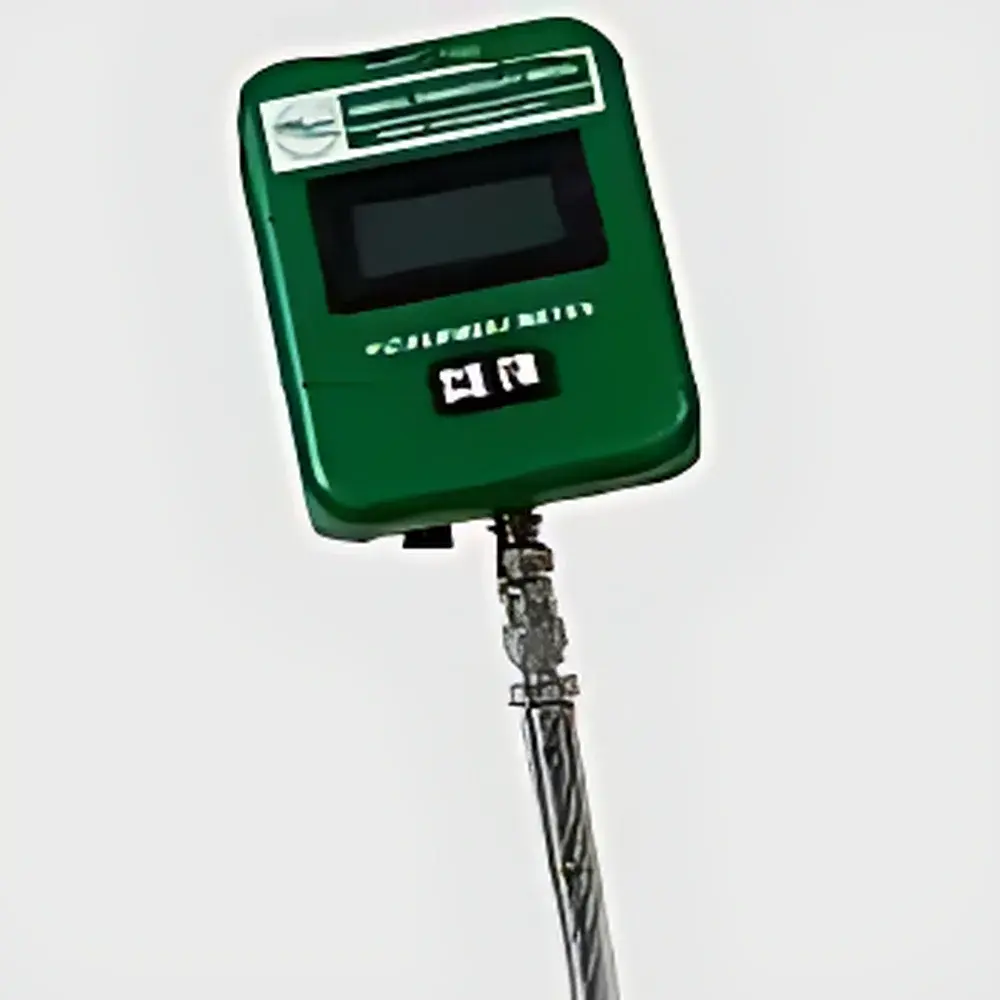
EMCEE Model 1152 Digital Conductivity Meter for Aviation Fuel and Engine Oil Electrical Conductivity Testing
| Brand | EMCEE |
|---|---|
| Origin | USA |
| Model | Model 1152 |
| Measurement Range | 0–1999 pS/m |
| Resolution | 1 pS/m |
| Accuracy | ±2% of reading + 1 pS/m |
| Display | 3-digit LCD, digit height 0.27 cm |
| Power Supply | 3 × alkaline batteries (6 V total) |
| Operating Temperature | 0–75 °C |
| Probe | Removable stainless-steel, intrinsically safe |
| Safety Certifications | UL, CSA (Canada), LCIE |
| Calibration | Internal reference, field-adjustable via two-button interface ("M" for Measure, "C" for Calibrate) |
| Overrange Indication | Leading "1" on display |
| Enclosure | Solvent-resistant molded polymer housing |
| Grounding | Banana jack terminal |
| Battery Low/Overrange Alerts | Visual indicators |
Overview
The EMCEE Model 1152 Digital Conductivity Meter is a purpose-engineered instrument designed specifically for the rapid, field-deployable measurement of electrical conductivity in hydrocarbon-based engine fuels—including aviation turbine fuel (Jet A, Jet A-1), diesel, kerosene, and lubricating oils—where electrostatic charge accumulation poses operational and safety risks. It operates on the principle of two-electrode AC conductance measurement at a fixed frequency, optimized to minimize polarization effects and ensure stable readings in low-conductivity non-aqueous media. Compliant with ASTM D2624 – Standard Test Method for Electrical Conductivity of Aviation Turbine Fuels, the Model 1152 delivers traceable, repeatable results critical for verifying fuel antistatic additive performance and ensuring compliance with IATA, API RP 2003, and DEF STAN 91-87 requirements for safe fuel handling, transfer, and storage. Its compact, battery-powered architecture enables use in hangars, fuel farms, marine refueling stations, and mobile QC labs without reliance on mains power or external signal conditioning.
Key Features
- Intrinsically safe probe assembly certified to UL, CSA (Canada), and LCIE standards—approved for use in Class I, Division 1 hazardous locations where flammable vapors may be present.
- True field-calibratable design: internal reference circuit allows zero and span verification using only the instrument’s built-in calibration function—no external standards required for routine checks.
- High-contrast 3-digit LCD display with 0.27 cm digit height ensures legibility under low-light or outdoor conditions common in fuel depots and aircraft maintenance bays.
- Robust solvent-resistant polymer enclosure protects internal electronics from hydrocarbon exposure, jet fuel splash, and industrial cleaning agents.
- Dual-button control interface (“M” for measurement, “C” for calibration) minimizes operator error and supports glove-compatible operation in PPE environments.
- Integrated battery status and overrange detection—visual alerts prevent misinterpretation of out-of-spec readings during high-throughput fuel sampling.
- Removable stainless-steel probe with integrated grounding banana jack enables secure earth bonding per API RP 2003 Section 4.3.2, reducing static discharge risk during measurement.
Sample Compatibility & Compliance
The Model 1152 is validated for direct immersion measurement in undiluted, unfiltered hydrocarbon liquids with conductivity values between 0 and 1999 pS/m—a range encompassing untreated base fuels (typically <50 pS/m) and fully treated fuels containing Stadis 450, FSII, or similar antistatic additives. It is not intended for aqueous solutions, biodiesel blends above B5, or fuels containing suspended particulates or water emulsions, which may cause electrode fouling or erroneous readings. The instrument meets the metrological and procedural requirements of ASTM D2624 (2023 edition), including electrode geometry specifications, temperature compensation limitations (no automatic temp correction; manual ambient recording recommended), and repeatability thresholds (<±5% RSD for replicate measurements). It supports GLP-aligned documentation when paired with external logbooks or LIMS-integrated reporting workflows.
Software & Data Management
The Model 1152 operates as a standalone analog-to-digital measurement system with no embedded firmware update capability or USB/Bluetooth connectivity. All data acquisition is manual: users record displayed values alongside time, sample ID, temperature, and calibration status in auditable paper or electronic logs. While no proprietary software is provided, its deterministic output format (3-digit integer pS/m) facilitates structured entry into laboratory information management systems (LIMS) or Excel-based QA dashboards. For regulated environments operating under FDA 21 CFR Part 11 or ISO/IEC 17025, laboratories must establish written procedures for instrument verification, calibration frequency (recommended prior to each shift or after 10 consecutive samples), and record retention—consistent with ASTM D2624 Annex A1 guidance.
Applications
- Pre-transfer verification of aviation fuel conductivity at airport hydrant systems and bowser trucks.
- QC release testing of batch-certified turbine fuels prior to tank farm entry or aircraft refueling.
- Monitoring antistatic additive depletion during long-term fuel storage (>30 days).
- Troubleshooting electrostatic incidents by correlating low conductivity (<50 pS/m) with filter/water separator performance.
- Field validation of fuel handling equipment grounding integrity via probe-body continuity checks.
- Supporting root-cause analysis during fuel quality investigations per ATA Spec 103 or SAE ARP4775.
FAQ
Does the Model 1152 require annual recalibration by an accredited lab?
No—its internal calibration is user-verifiable in-field per ASTM D2624 Section 7.3. However, laboratories operating under ISO/IEC 17025 must define and document their own calibration interval (typically 6–12 months) and retain evidence of functional checks.
Can the probe be cleaned with acetone or MEK?
Yes—the stainless-steel probe and solvent-resistant housing tolerate brief immersion in common hydrocarbon solvents. Avoid prolonged exposure to strong oxidizers or chlorinated solvents.
Is temperature compensation available?
No. ASTM D2624 specifies measurement at ambient temperature (15–30 °C); users must record ambient temperature separately and apply manual correction if required by internal SOPs.
What battery type is used, and how long does it last?
Three standard 1.5 V alkaline AA batteries (6 V total). Under typical usage (100 measurements/day), battery life exceeds 12 months. Low-battery indication appears before voltage drops below 4.8 V.
Can the instrument measure conductivity in biodiesel blends?
Not reliably. ASTM D2624 excludes B6–B20 blends due to variable polarity and dielectric behavior. Use only for conventional petroleum-based fuels unless validated per ASTM D7467 Annex X3.






