
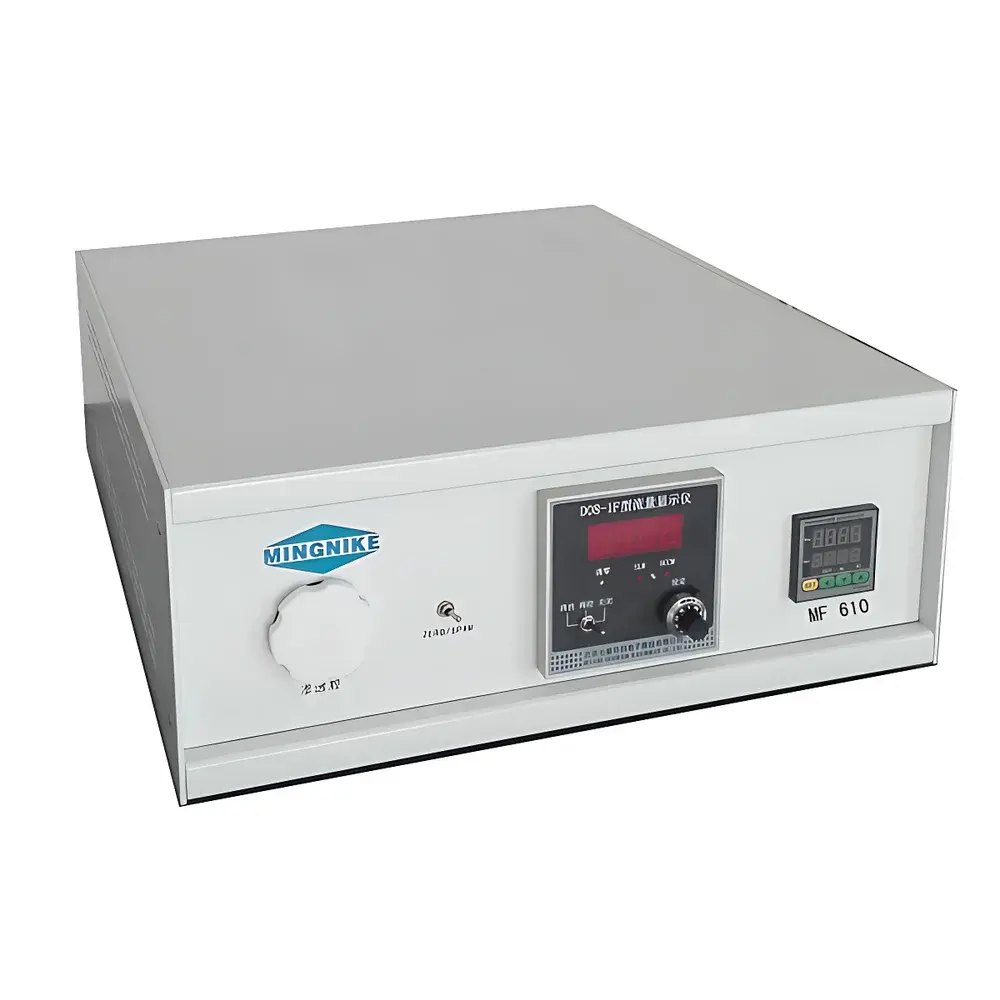
MNK MF610 Multi-Component Permeation Tube-Based Gas Standard Generator for Formaldehyde, Mercury Vapor, and BTEX Compounds
| Brand | MNK |
|---|---|
| Origin | Beijing, China |
| Model | MF610 |
| Temperature Range | 25–100 °C (±0.1 °C stability) |
| Permeation Chamber Dimensions | Φ24 mm × 130 mm |
| Mass Flow Range | 0–10 L/min (configurable with optional 1 L/min or 20 L/min modules) |
| Dilution Ratio | 6:1 to 96:1 (standard configuration) |
| Power Supply | AC 220 V, 200 W |
| Dimensions (L×W×H) | 490 × 402 × 155 mm |
| Weight | 18 kg |
Overview
The MNK MF610 is a precision-engineered, permeation tube-based gas standard generator designed for the dynamic, trace-level production of certified reference gas mixtures containing formaldehyde, elemental mercury vapor, and aromatic hydrocarbons (benzene, toluene, ethylbenzene, and xylenes—collectively BTEX). It operates on the well-established principle of controlled thermal permeation: certified permeation tubes—each containing a pure, stable analyte sealed within a polymer membrane—are placed inside a thermostatically regulated chamber. At a precisely maintained temperature, the analyte diffuses through the membrane at a predictable, gravimetrically calibrated rate (typically expressed in ng/min). A high-stability mass flow controller delivers a constant carrier gas stream (e.g., zero air or nitrogen), which sweeps the permeated analyte from the chamber outlet, generating a stable, known concentration (µg/m³ or ppb(v)) in real time. This method provides metrologically traceable, continuous output without reliance on cylinder-based standards, making it ideal for long-duration calibration, linearity verification, and instrument performance validation in regulated environmental and occupational hygiene laboratories.
Key Features
- High-precision temperature control system with ±0.1 °C stability and 0.1 °C resolution over a 25–100 °C operating range—critical for maintaining consistent permeation rates across volatile and semi-volatile compounds.
- Dual-stage flow architecture: primary carrier flow through the permeation chamber (0–10 L/min, field-configurable) combined with optional dilution flow up to 20 L/min, enabling precise generation of concentrations spanning three orders of magnitude (sub-ppb to low ppm levels).
- Large-volume permeation chamber (Φ24 mm × 130 mm) accommodating multiple permeation tubes simultaneously—supporting multi-analyte generation (e.g., formaldehyde + benzene + mercury) without hardware modification or reconfiguration.
- Modular mass flow meter options (1 L/min, 10 L/min, or 20 L/min full-scale) allow optimization for low-concentration trace work or higher-output applications such as chamber exposure studies.
- Robust aluminum chassis with integrated thermal insulation and EMI-shielded electronics ensures operational stability in laboratory environments subject to ambient fluctuations.
- No consumables beyond certified permeation tubes—eliminates cylinder dependency, reduces logistical overhead, and supports GLP-compliant audit trails via documented tube lot numbers and NIST-traceable calibration certificates.
Sample Compatibility & Compliance
The MF610 is compatible with all commercially available, NIST-traceable permeation tubes for formaldehyde (e.g., polyethylene-based), elemental mercury (Teflon®-encapsulated), and individual BTEX components. It supports both single-component and multi-component calibration strategies without cross-contamination risk, owing to its dedicated chamber design and inert stainless-steel/glass flow path. The system meets essential requirements for ISO/IEC 17025-accredited calibration laboratories when operated with documented procedures, certified reference materials, and routine verification using independent analytical methods (e.g., DNPH-HPLC for formaldehyde, CVAFS for Hg, GC-FID/PID for BTEX). Its stable output enables compliance with EPA Method TO-15, ISO 16017-1, and EN 13649-2 for VOC and aldehyde calibration, as well as OSHA and NIOSH reference method validation protocols.
Software & Data Management
While the MF610 operates as a standalone analog-controlled instrument, its temperature setpoint and mass flow parameters are fully recordable via external data loggers or laboratory information management systems (LIMS) using standard 4–20 mA or 0–10 V analog outputs. Users may integrate it into automated calibration workflows compliant with FDA 21 CFR Part 11 by pairing it with validated SCADA or LIMS platforms that enforce electronic signatures, audit trails, and change control for all parameter adjustments. All operational logs—including chamber temperature history, flow readings, tube installation dates, and expiration tracking—must be maintained per GLP/GMP documentation requirements. MNK provides a comprehensive user manual with SOP templates for IQ/OQ/PQ validation and annual performance verification against gravimetric permeation rate data.
Applications
- Primary and secondary calibration of portable and fixed-gas analyzers (e.g., electrochemical sensors, PID/FID detectors, DOAS spectrometers) used in ambient air quality monitoring networks.
- Linearity assessment and span verification of continuous emission monitoring systems (CEMS) and workplace exposure monitors under ISO 8573 or EN 689 guidelines.
- Generation of challenge gases for testing and validating sorbent tube recovery efficiency (e.g., for OSHA Method 52, NIOSH Method 2541).
- Controlled exposure studies in inhalation toxicology chambers where reproducible, low-concentration organic vapor and metal vapor dosing is required.
- Reference material production for inter-laboratory comparison exercises organized by national metrology institutes (e.g., CNAS proficiency testing schemes).
- Method development and validation for emerging analytes including formaldehyde precursors (e.g., methylene glycol) and oxidized mercury species, provided appropriate permeation tube certification exists.
FAQ
What permeation tube certifications are required for regulatory compliance?
NIST-traceable calibration certificates specifying gravimetric permeation rates (ng/min), uncertainty budgets (<±3%), and expiration dates must accompany each tube. Certificates should conform to ISO/IEC 17025 or equivalent accreditation.
Can the MF610 generate humidified standard gases?
No—the system does not include humidity control; users requiring humidified standards must integrate an external saturator upstream of the carrier gas inlet, with careful validation of analyte stability under those conditions.
Is mercury vapor generation safe in standard laboratory settings?
Yes, when operated within closed-loop configurations and vented through appropriate mercury-specific scrubbers (e.g., sulfur-impregnated carbon), and when permeation tubes are handled per IATA/ADR packaging guidelines for Class 6.1 toxic substances.
How often must the permeation tubes be replaced?
Replacement frequency depends on tube lot-specific expiration dates and cumulative thermal exposure; typical service life ranges from 6–24 months under continuous operation at 35–45 °C.
Does the MF610 support remote monitoring or Ethernet connectivity?
Not natively—the unit provides analog process signals only; digital integration requires third-party DAQ hardware and middleware compliant with your site’s cybersecurity policy.







