
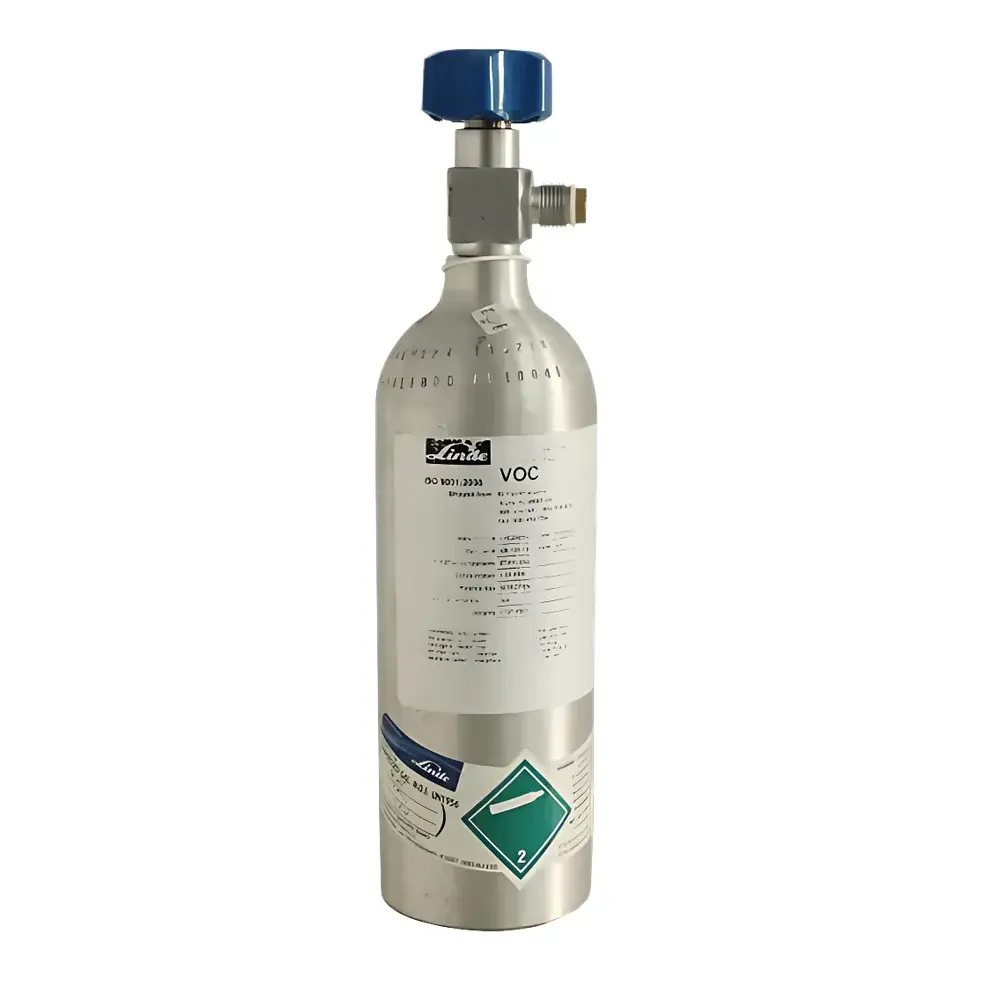
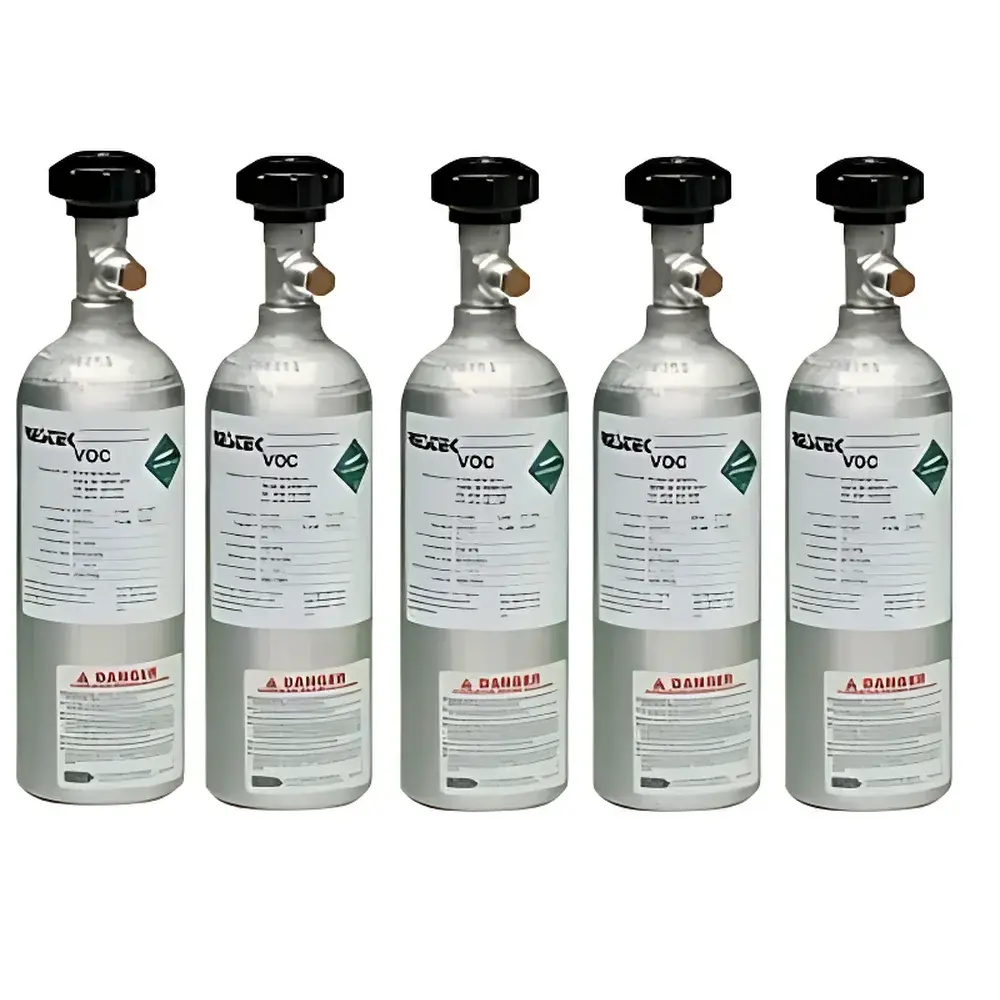
Linde Spectra TO-14A/TO-15 Certified VOC Standard Gas Mixtures
| Brand | Linde |
|---|---|
| Origin | USA |
| Manufacturer | Linde Gas (Spectra Specialty Gases) |
| Product Type | NIST-Traceable Certified Reference Material (CRM) |
| Cylinder | Aluminum Alloy, 8 × 24 cm, 104 L water volume |
| Pressure | 1800 psi (12.4 MPa) |
| Valve Interface | CGA-180 |
| Tare Weight | 0.7 kg |
| Certification | NIST-traceable gravimetric preparation |
| Uncertainty | Typically ±2% (k=2) per component |
| Concentration Options | 1 ppmv and 100 ppbv (v/v) |
| Matrix | Ultra-high-purity synthetic air (99.999% O₂/N₂ balance) |
| Compliance | EPA TO-14A, TO-15, ASTM D6420, ISO 16000-6, USP <621>, FDA 21 CFR Part 11–ready documentation |
| Shelf Life | 12 months from date of manufacture when stored upright at 20–25°C |
Overview
Linde Spectra TO-14A/TO-15 Certified VOC Standard Gas Mixtures are NIST-traceable certified reference materials (CRMs) engineered for calibration, verification, and method validation in ambient air monitoring laboratories. These gas standards are produced via gravimetric blending under ISO/IEC 17025-accredited conditions, ensuring metrological traceability to the National Institute of Standards and Technology (NIST) through primary mass measurements. Each cylinder is filled with ultra-high-purity synthetic air (O₂/N₂ balance, ≥99.999% purity) and precisely dosed with volatile organic compounds (VOCs) at certified concentrations—either 1 ppmv or 100 ppbv—enabling quantitative analysis across regulatory compliance workflows including U.S. EPA Methods TO-14A (GC-FID/ECD), TO-15 (GC-MS), and international equivalents such as ISO 16000-6 and ASTM D6420. The physical design—compact aluminum alloy cylinder (8 × 24 cm, 104 L water capacity, 1800 psi service pressure, CGA-180 valve)—ensures safe handling, long-term stability, and compatibility with standard air sampling instrumentation including canisters, sorbent tubes, and online GC systems.
Key Features
- NIST-traceable gravimetric certification with documented uncertainty budgets (k = 2) and full metrological chain-of-custody
- Lot-specific Certificate of Analysis (COA) including GC-FID and GC-MS chromatograms, retention times, peak areas, and component-by-component expanded uncertainties
- Comprehensive suite of EPA-compliant formulations: TO-14A (39-, 41-, and 43-component variants), TO-15 subsets (25- and 65-component), PAMS/ozone precursor blends (57 components), BTEX, BTEX/MTBE, sulfur-containing VOCs (5 components), chlorinated hydrocarbons (19 components), and internal standard mixes (3- and 4-component)
- Dual concentration options (1 ppmv and 100 ppbv) to support both high-concentration calibration and low-level method detection limit (MDL) verification
- Stabilized matrix gas: synthetic air with ≤1 ppbv total hydrocarbon background and verified absence of interfering species (e.g., ozone, NOₓ, SO₂)
- Robust aluminum cylinder construction with corrosion-resistant interior coating, enabling >12-month shelf life when stored upright at 20–25°C
- Unique serialized labeling and digital COA access via Linde Spectra’s secure portal for audit-ready GLP/GMP documentation
Sample Compatibility & Compliance
These standards are validated for use with EPA-compliant analytical platforms including SUMMA®-passivated canisters, Tenax®/Carbotrap™ sorbent tubes, and automated thermal desorption (ATD)–GC–MS/FID systems. All TO-14A and TO-15 mixtures meet the compositional and uncertainty requirements defined in U.S. EPA Compendium Method TO-14A (1999) and TO-15 (1999), as well as ISO 16000-6:2011 for indoor and ambient air VOC analysis. Each lot undergoes independent verification against reference spectra and retention indices per ASTM D6420–22. Documentation supports full compliance with 21 CFR Part 11 for electronic records and signatures, including audit trails for COA generation and revision history. Traceability statements align with ISO/IEC 17025:2017 Clause 6.6 and ILAC-P10:2022 for reference material producers.
Software & Data Management
Linde Spectra provides digital access to all COAs through a secure, password-protected web portal. Each cylinder’s unique serial number links to downloadable PDF COAs, GC chromatograms (in .cdf format), and metadata files compatible with LIMS integration (e.g., LabWare, Thermo Fisher SampleManager). Audit logs record COA issuance time, user identity, and download history—fully compliant with FDA 21 CFR Part 11 requirements for electronic records. Optional CSV export enables direct import into instrument calibration software (e.g., Agilent OpenLab CDS, Waters Empower) for automated calibration curve generation and QC flagging.
Applications
- Ambient air quality monitoring networks (EPA SLAMS, NCore, CASTNET)
- Regulatory compliance testing for industrial stack emissions and fugitive sources
- Method validation and ongoing precision/performance checks per EPA QA Handbook Volume II
- Calibration of portable GC-FID, GC-PID, and FTIR analyzers used in field surveys
- Development and verification of new GC–MS methods targeting emerging contaminants (e.g., fluorinated VOCs, oxygenated organics)
- Proficiency testing and interlaboratory comparison studies under ISO/IEC 17043
- Training and demonstration of analytical workflows in accredited environmental laboratories
FAQ
Are these standards certified for use in U.S. EPA reporting?
Yes—each lot is certified to meet the accuracy, uncertainty, and documentation requirements of EPA Methods TO-14A and TO-15, and is accepted by state implementation plans (SIPs) and regional monitoring programs.
What is the recommended storage condition?
Store upright at 20–25°C, away from direct sunlight and heat sources. Do not freeze or expose to temperatures above 50°C.
Can I use the same cylinder for both TO-14A and TO-15 applications?
Yes—provided the composition matches the required analyte list and concentration range; however, separate cylinders are recommended for primary calibration vs. continuing calibration verification to preserve integrity.
How is uncertainty determined for each component?
Expanded uncertainty (k = 2) is calculated per component using gravimetric weighing uncertainty, purity assay uncertainty, and stability data, following ISO Guide 98-3 (GUM) and EURACHEM/CITAC Guide CG4.
Is technical support available for method-specific application guidance?
Yes—Linde Spectra’s Applications Support Team provides free consultation on cylinder selection, dilution protocols, and GC method alignment for ambient air VOC analysis.







