
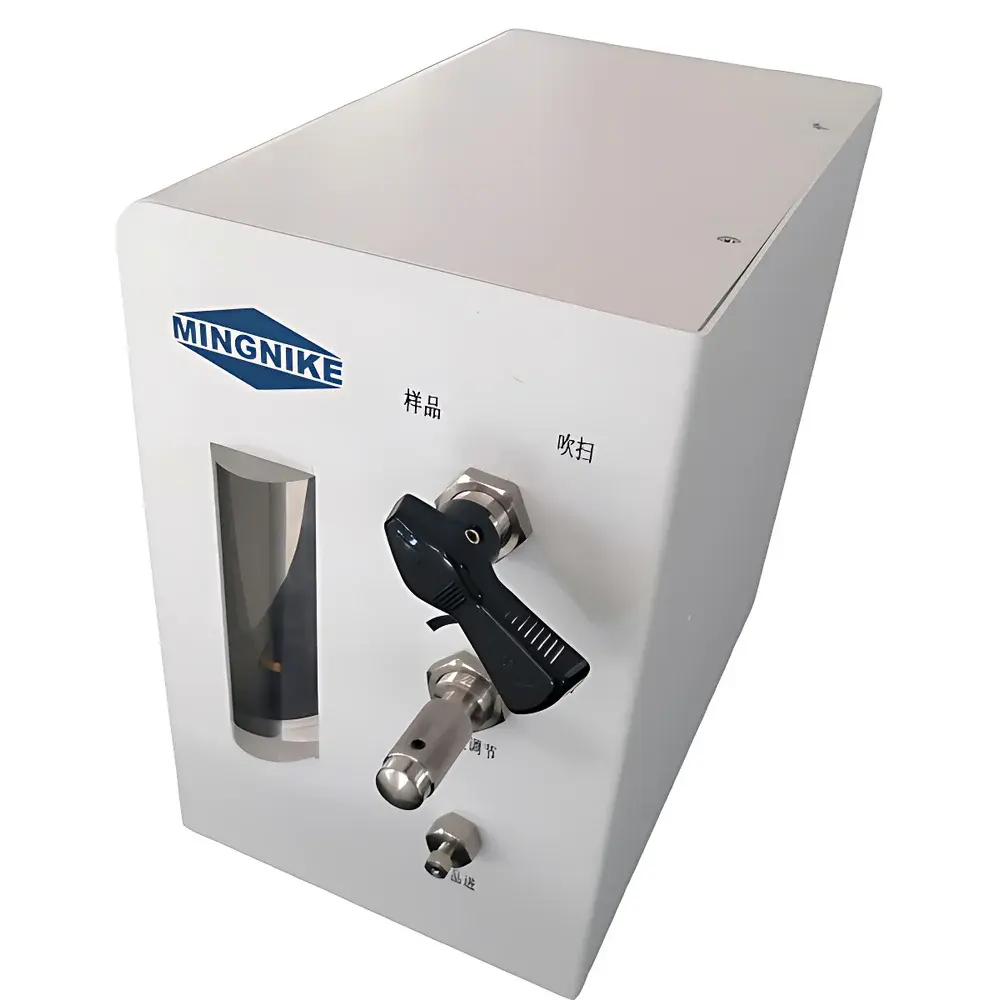
MNK MG220 High-Pressure Liquid Sampling System
| Brand | MNK |
|---|---|
| Origin | Beijing, China |
| Manufacturer Type | Authorized Distributor |
| Country of Manufacture | China |
| Model | MG220 |
| Pricing | Upon Request |
| Operating Pressure Range | 0.7–4 MPa |
| Drive Gas | Dry Air or Inert Gas (0.4 MPa) |
| Auxiliary Gas Flow Rate | 50–200 mL/min |
| Internal Tubing | 1/16″ SilcoTek-Passivated Stainless Steel |
| Valve Core Volume Options | 0.06–2 μL (Standard: 1 μL) |
| Dead Volume | Minimized (<10 μL typical) |
| Repeatability | RSD < 2% (n ≥ 6) |
| Dimensions (W×D×H) | 130 mm × 200 mm × 200 mm |
| Mounting | Direct installation above GC inlet port |
| Weight | ~1.5 kg |
| Surface Treatment | SilcoTek® SilcoNert® 2000 inert coating applied to entire fluid path |
Overview
The MNK MG220 High-Pressure Liquid Sampling System is an engineered interface designed for precise, reproducible introduction of pressurized liquid hydrocarbon samples into gas chromatography (GC) systems—particularly those equipped with heated vaporization inlets. It operates on the principle of controlled pressure-driven liquid displacement, where sample transfer occurs under regulated backpressure to maintain phase integrity and prevent flash vaporization prior to the inlet. Unlike conventional syringe-based or low-pressure loop injectors, the MG220 sustains system pressure from the sampling cylinder through the entire fluidic path—including valve, transfer line, and injection port—ensuring quantitative delivery of volatile, thermally labile, or highly reactive species such as liquefied petroleum gas (LPG), ethylene, propylene, butadiene, and mid-to-heavy hydrocarbons (C5–C40). Its architecture supports direct integration with Agilent GC platforms (e.g., 7890, 8890 series) and is compatible with other major GC manufacturers’ vaporizing inlets when configured with standard 1/16″ fittings and pressure-rated interfaces.
Key Features
- Full-fluid-path inertization using SilcoTek® SilcoNert® 2000 coating—reducing adsorption of sulfur-, oxygen-, and nitrogen-containing trace analytes (e.g., mercaptans, carbonyl sulfide, furans)
- Modular 1 μL standard injection valve core (optional 0.06–2 μL variants) optimized for trace impurity analysis in refinery streams and polymer-grade olefins
- Ultra-low dead volume design (<10 μL typical), validated by repeated n-hexane pulse testing with RSD < 2% across ≥6 injections
- Integrated particulate filtration (5 μm sintered stainless steel), automated purge cycles, and high-visibility borosilicate viewing window with LED backlighting for real-time phase observation
- Tool-free mounting bracket enabling mechanical alignment and secure fixation directly above GC inlet—installation or removal completed in ≤10 minutes without disassembling GC hardware
- Robust pressure containment: rated for continuous operation at 0.7–4 MPa (100–580 psi), with drive gas supply regulated at 0.4 MPa dry air or nitrogen
Sample Compatibility & Compliance
The MG220 is validated for use with liquid-phase hydrocarbon matrices requiring strict compositional fidelity during transfer—including LPG calibration standards, cracked feedstocks, synthetic rubber monomers (e.g., butadiene), and heavy naphtha fractions. Its inert surface chemistry meets ASTM D2429 and ISO 3170 requirements for hydrocarbon sampling integrity. The system supports GLP-compliant workflows when paired with GC data systems capable of audit-trail logging (e.g., OpenLab CDS, Chromeleon); all manual operations—including cylinder connection, purge initiation, and injection triggering—are timestamped and operator-annotated in compliant configurations. No internal elastomers or polymeric seals contact the sample stream, eliminating leachables and ensuring compliance with USP for extractables profiling in method validation.
Software & Data Management
The MG220 operates as a hardware-integrated peripheral with no embedded firmware or standalone software. All control logic resides within the host GC’s acquisition platform via TTL or relay-triggered I/O signals. Sequence files in Agilent OpenLab or Thermo Chromeleon may embed custom delay timers for purge duration, dwell time pre-injection, and post-injection venting—enabling full method automation. Raw pressure transducer outputs (if externally monitored) and auxiliary gas flow logs can be synchronized with chromatographic data via analog input channels. For 21 CFR Part 11 compliance, electronic records must originate from the GC’s validated software; the MG220 contributes instrument-level metadata (e.g., cylinder ID, injection count, last purge timestamp) via optional RS-232 or Modbus RTU interface modules (sold separately).
Applications
- Quantitative sulfur speciation in LPG and light naphthas per ASTM D5599 and UOP 759
- Trace oxygenate analysis (e.g., MTBE, ethanol) in gasoline blending components
- Residual catalyst poison monitoring (e.g., CO, H2S, NH3) in ethylene cracker effluents
- Compositional mapping of C5–C40 hydrocarbon cuts in distillation assays and simulated distillation (ASTM D2887)
- High-pressure calibration of online GC analyzers used in refinery process streams
- Method development for polar compound analysis (e.g., monoethylene glycol, diethylene glycol) in glycol dehydration units
FAQ
Is the MG220 compatible with cryogenic sample cylinders?
Yes—the system accepts standard 1/4″ NPT or CGA 350 connections and maintains thermal stability during transfer of samples stored at –40°C to +60°C, provided external insulation or heating tape is applied to the cylinder-to-valve interface.
Can it be used with hydrogen carrier gas?
The MG220’s SilcoNert®-coated stainless steel construction is compatible with hydrogen, but drive gas must remain inert (N2 or Ar) to avoid catalytic recombination risks in the valve actuation circuit.
What maintenance intervals are recommended?
Valve core replacement every 500 injections; SilcoTek® surface integrity verified annually via blank injection testing with sulfur-doped hexane; filter elements replaced after 200 cylinder changes or upon observed pressure drop >15%.
Does it support automated sequence injection in unattended operation?
Yes—when triggered via GC’s external event port, the MG220 executes fully repeatable injection cycles including pre-purge, sample draw, dwell, and post-injection flush without manual intervention.
How is leak integrity verified prior to analysis?
A two-point pressure hold test is implemented: (1) 3-minute hold at 4 MPa after cylinder pressurization; (2) 2-minute hold at 0.7 MPa after valve actuation—acceptable decay rate: ≤0.02 MPa/min per ASTM E2451.





