
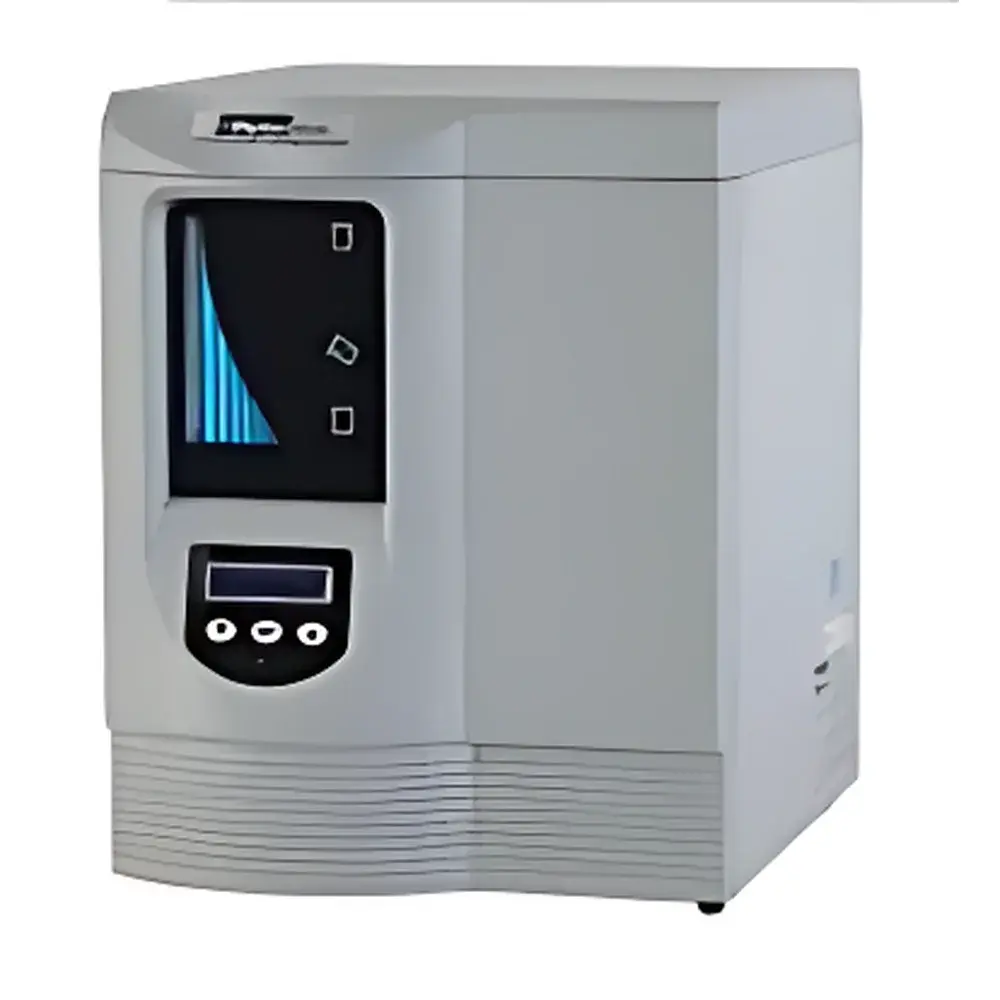
MNK PEM-Based Ultra-High-Purity Hydrogen Generator
| Brand | MNK |
|---|---|
| Origin | Beijing, China |
| Technology | Proton Exchange Membrane (PEM) Electrolysis |
| Hydrogen Purity | ≥99.99999% |
| Oxygen Impurity | ≤0.01 ppm |
| Moisture Content | ≤1.0 ppm |
| Output Pressure Options | 100 psig or 175 psig |
| Flow Rate Options | 510–1300 cc/min |
| Outlet Port | 1/4" NPT |
| Power Input | 100–230 VAC, 50/60 Hz |
| Dimensions | 17.1" H × 13.5" W × 21" D |
| Weight | 60 lbs |
| Palladium-Alloy Membrane Lifetime | 3-year warranty |
| System Warranty | 1 year |
Overview
The MNK PEM-Based Ultra-High-Purity Hydrogen Generator is an engineered solution for laboratories and research facilities requiring continuous, on-demand hydrogen gas with exceptional purity and operational reliability. Utilizing proton exchange membrane (PEM) electrolysis technology, the system splits deionized water into high-purity hydrogen and oxygen through a solid polymer electrolyte membrane under controlled DC current. Unlike alkaline or chemical hydride-based generators, PEM architecture eliminates liquid electrolyte handling, minimizes maintenance, and delivers inherently stable output across variable flow demands. The integrated palladium-alloy diffusion membrane further refines hydrogen to ≥99.99999% purity—meeting or exceeding stringent requirements for trace-level analytical instrumentation such as high-resolution gas chromatography (GC), pulsed polarography, semiconductor epitaxial growth (e.g., MOCVD), and nuclear physics experiments where even sub-ppb oxygen or moisture can compromise detector sensitivity or thin-film integrity.
Key Features
- Proton exchange membrane (PEM) electrolysis core ensures consistent, oil-free, and particle-free hydrogen generation without consumable chemicals or KOH solutions.
- Palladium-alloy purification membrane operates continuously without scheduled replacement or regeneration—designed for >10,000 hours of service life under nominal load conditions.
- No downstream filtration required: certified O₂ ≤0.01 ppm and H₂O ≤1.0 ppm at point-of-use, eliminating risk of filter breakthrough or pressure drop-induced flow instability.
- Programmable dual-pressure operation: selectable 100 psig or 175 psig outlet pressure to accommodate diverse instrument inlet specifications—from standard GC carrier gas manifolds to high-backpressure reactor feed systems.
- Integrated leak detection and automatic shutdown: real-time hydrogen concentration monitoring in cabinet ambient air triggers immediate power cutoff and audible/visual alarm per IEC 61508 SIL 2 functional safety principles.
- Space-optimized footprint: compact chassis (17.1″ × 13.5″ × 21″) occupies <1 ft² of benchtop area—ideal for crowded analytical labs or mobile laboratory platforms.
Sample Compatibility & Compliance
This generator supports direct integration with all major GC manufacturers’ carrier gas modules—including Agilent, Thermo Fisher, Shimadzu, and PerkinElmer—without flow restrictors or pressure regulators. It complies with ISO 8573-1:2010 Class 1 compressed gas quality standards for particulates, water, and oil content. For regulated environments, the system’s firmware supports audit-trail-capable event logging (start/stop cycles, pressure deviations, leak alarms), aligning with GLP and GMP documentation expectations. While not intrinsically rated for Class I Div 1 hazardous locations, it meets UL 61010-1 and CE EN 61000-6-3 electromagnetic compatibility requirements for laboratory use.
Software & Data Management
The generator operates in fully autonomous mode but includes optional RS-232/USB interface for remote status interrogation and configuration via ASCII command protocol. Logged parameters include runtime hours, total gas volume delivered, average flow rate, peak pressure events, and membrane temperature history—exportable as CSV for QC record retention. Firmware updates are performed offline using signed binary packages to maintain data integrity and prevent unauthorized modification, supporting FDA 21 CFR Part 11 compliance when deployed in pharmaceutical QC labs.
Applications
- Carrier and fuel gas supply for flame ionization detectors (FID), thermal conductivity detectors (TCD), and helium ionization detectors (HID) in GC systems requiring ultra-low background interference.
- Reducing atmosphere generation for electrochemical cell conditioning and voltammetric sensor calibration in trace metal analysis.
- Source gas for hydrogenation reactors in catalytic research and fine chemical synthesis where catalyst poisoning from residual O₂ must be avoided.
- Process gas in molecular beam epitaxy (MBE) and atomic layer deposition (ALD) toolsets demanding sub-ppb impurity control.
- Calibration gas blending systems where hydrogen serves as primary component in certified reference mixtures (CRM) for environmental monitoring analyzers.
FAQ
Is external cooling or ventilation required?
No—the unit relies on passive convection and internal heat-sink design; ambient lab temperature must remain between 15–30°C with ≥10 cm clearance on all sides.
What water quality is required for optimal membrane longevity?
Deionized water with resistivity ≥18.2 MΩ·cm and total organic carbon (TOC) <5 ppb is mandatory; integrated inline DI cartridge is recommended for extended operation.
Can the generator be mounted vertically or in a rack enclosure?
It is designed exclusively for horizontal benchtop orientation; rack mounting voids the warranty due to thermal management constraints.
Does the system support continuous 24/7 operation?
Yes—rated for uninterrupted duty cycle at ≤80% of maximum flow capacity; full-load operation requires 30-minute rest intervals every 8 hours to maintain long-term PEM stability.
How is hydrogen purity verified during commissioning?
Factory certification includes GC-TCD analysis per ASTM D7165, with test report provided; end-users may validate using calibrated laser-based moisture and oxygen analyzers traceable to NIST standards.



