
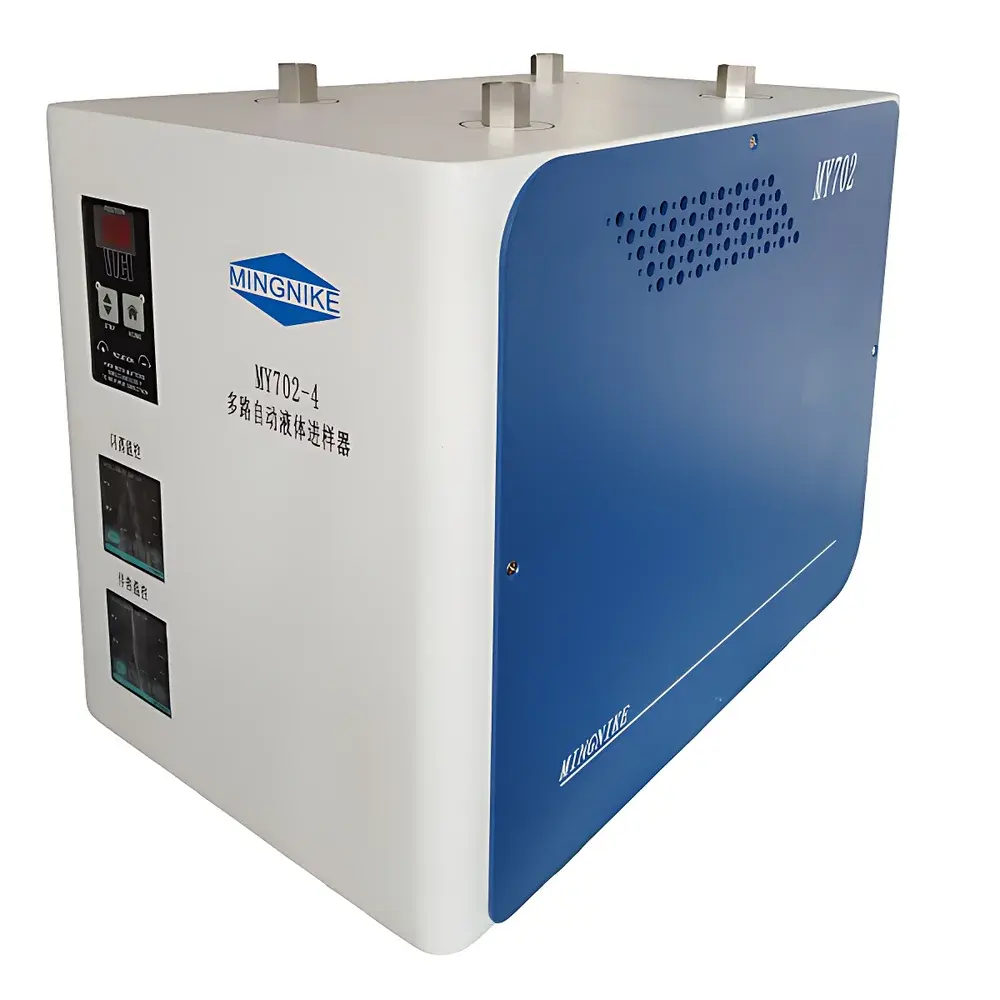
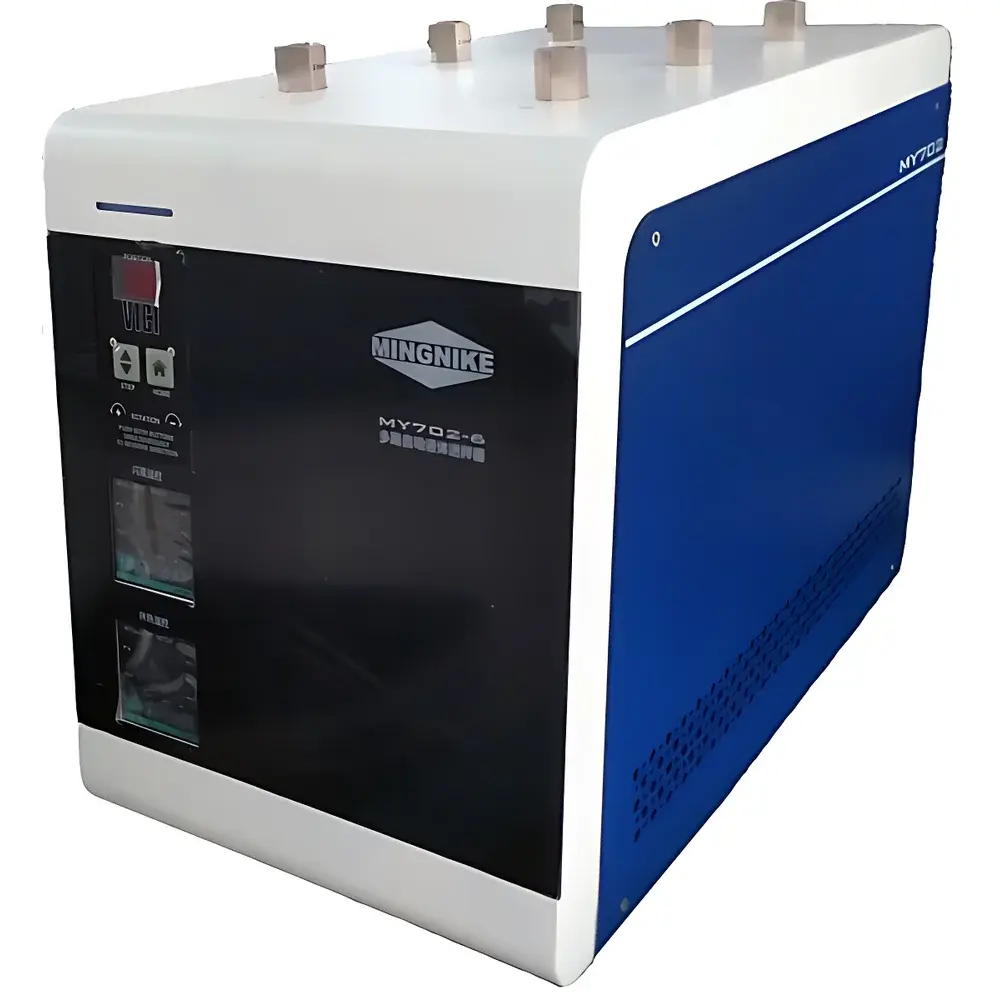
MNK MY702-4/6 Multi-Channel Automated Liquid Sample Injector for LPG and Pressurized Hydrocarbon Analysis
| Brand | MNK |
|---|---|
| Origin | Beijing, China |
| Model | MY702-4/6 |
| Maximum Flash Vaporization Temperature | 230 °C |
| Heating & Jacket Temperature Range | Ambient +5 °C to 230 °C |
| Temperature Control Accuracy | ±0.1 °C |
| Sample Ports | 4 or 6 positions + 1 purge gas channel |
| Inlet Fitting | M14×1.5 internal thread quick-connect |
| Tubing | 1/16″ SilcoTek-passivated stainless steel |
| Power Supply | 220 V, 50 Hz |
| Power Consumption | 100 W |
| Dimensions (4-port) | 400 × 255 × 300 mm |
| Net Weight | 20 kg |
| Compliance | Designed for ASTM D6667, ASTM D7164, ISO 8570, and USP <621> gas chromatographic workflows requiring trace sulfur and oxygenate analysis |
Overview
The MNK MY702-4/6 Multi-Channel Automated Liquid Sample Injector is an engineered solution for the precise, reproducible introduction of pressurized liquefied petroleum gas (LPG) and other volatile hydrocarbon liquids into gas chromatography (GC) systems. It operates on a controlled flash-vaporization principle: liquid samples stored in high-pressure sampling cylinders are rapidly depressurized and thermally vaporized within a heated, inert flow path, ensuring quantitative transfer of volatile and semi-volatile components—including reactive species such as hydrogen sulfide, mercaptans, carbonyl sulfide, and organic oxides—without adsorption or thermal degradation. The system is purpose-built for routine quality control and specification testing in refineries, petrochemical laboratories, and third-party testing facilities where compliance with ASTM D6667 (determination of total volatile sulfur in LPG), ASTM D7164 (sulfur compounds in light hydrocarbons), and ISO 8570 (gas chromatographic analysis of LPG) is mandatory.
Key Features
- Configurable 4-position or 6-position sample carousel with dedicated purge gas channel for system conditioning between injections
- Integrated flash-vaporization chamber with independent temperature control (ambient +5 °C to 230 °C) and ±0.1 °C stability, preventing condensation of mid-boiling analytes during transfer
- Full-path inertization using SilcoTek® Sulfinert® coating on all wetted surfaces—including 1/16″ stainless steel tubing, valves, and vaporization zones—to minimize surface adsorption of trace sulfur and oxygen-containing compounds
- M14×1.5 internal-thread quick-connect inlet ports compatible with standard LPG sampling cylinders; custom port configurations available upon request
- In-line particulate filtration upstream of the vaporization zone to protect precision metering valves and GC injection valves from particulate-induced clogging
- Bi-directional GC interface support: accepts TTL/relay triggers from major GC platforms (Agilent, Thermo Fisher, Shimadzu, PerkinElmer) and can initiate sequence-based autosampling via RS-232 serial communication
- Locally developed Windows-based control software with audit-trail-enabled method storage, run-time logging, and user-level access controls aligned with GLP and FDA 21 CFR Part 11 readiness
Sample Compatibility & Compliance
The MY702-4/6 accommodates liquid-phase samples stored in standard DOT-4BA or EN 1089-3 compliant steel cylinders at pressures up to 2.0 MPa. It supports representative sampling of propane, propylene, butane, isobutane, mixed C3/C4 streams, and reformulated gasoline blends containing ethanol or MTBE. All fluidic pathways meet ASTM E260 and ISO/IEC 17025 requirements for trace-level sulfur analysis. The system’s inert architecture and thermal management ensure data integrity for methods requiring detection limits below 0.1 ppm (v/v) sulfur, satisfying reporting thresholds in EPA Method 1664B, IP 570, and GB/T 11141. No external cryogenic trapping or secondary heating manifolds are required for routine application.
Software & Data Management
The proprietary MNK AutoInject Suite provides full instrument orchestration through a validated Windows GUI. Users define multi-sequence methods—including cylinder selection, vaporization ramp profiles, dwell times, purge cycles, and GC trigger logic—with timestamped parameter logging. All method changes, run executions, and system alerts are recorded in an immutable audit trail with operator ID and electronic signature capability. Raw control logs export in CSV format for integration with LIMS platforms. Software validation documentation (IQ/OQ protocols) and configuration change history templates are provided to support laboratory accreditation under ISO/IEC 17025:2017 and GMP Annex 11.
Applications
- Routine sulfur speciation in LPG per ASTM D6667 and ISO 8570
- Trace oxygenate quantification (e.g., methanol, ethanol, MTBE) in refinery feedstocks
- Hydrocarbon composition profiling of light naphtha and reformate streams
- Quality assurance of polymer-grade propylene per ASTM D2505
- Calibration verification of online GC analyzers using certified reference materials
- Method transfer between R&D and QC labs maintaining inter-laboratory reproducibility (RSD <1.2% for H₂S at 1 ppm level)
FAQ
Does the MY702-4/6 require modification of my existing GC system?
No—provided your GC is equipped with a gas sampling valve (e.g., Valco, Parker, or Agilent 7693-compatible valve), the injector interfaces via standard TTL or 24 V DC trigger signals. Optional valve installation and commissioning services are available.
Can the system handle samples with suspended particulates or hydrates?
Yes—the integrated 5 µm sintered stainless steel filter protects downstream components; however, samples must be pre-filtered to <10 µm if particulate load exceeds 5 mg/L to prevent filter saturation over extended sequences.
Is SilcoTek passivation sufficient for ultra-trace sulfur analysis below 50 ppt?
When combined with regular system bake-out (230 °C for 2 h post-run) and use of certified low-sulfur carrier gas (98.5% for H₂S and COS down to 20 ppt in matrix-matched calibrants.
What maintenance intervals are recommended for long-term operation?
Filter cartridges: replace every 200 injections or quarterly, whichever occurs first. SilcoTek-coated valves and tubing: inspect annually for coating integrity; recalibrate temperature sensors biannually per ISO/IEC 17025 clause 6.5.2.





