
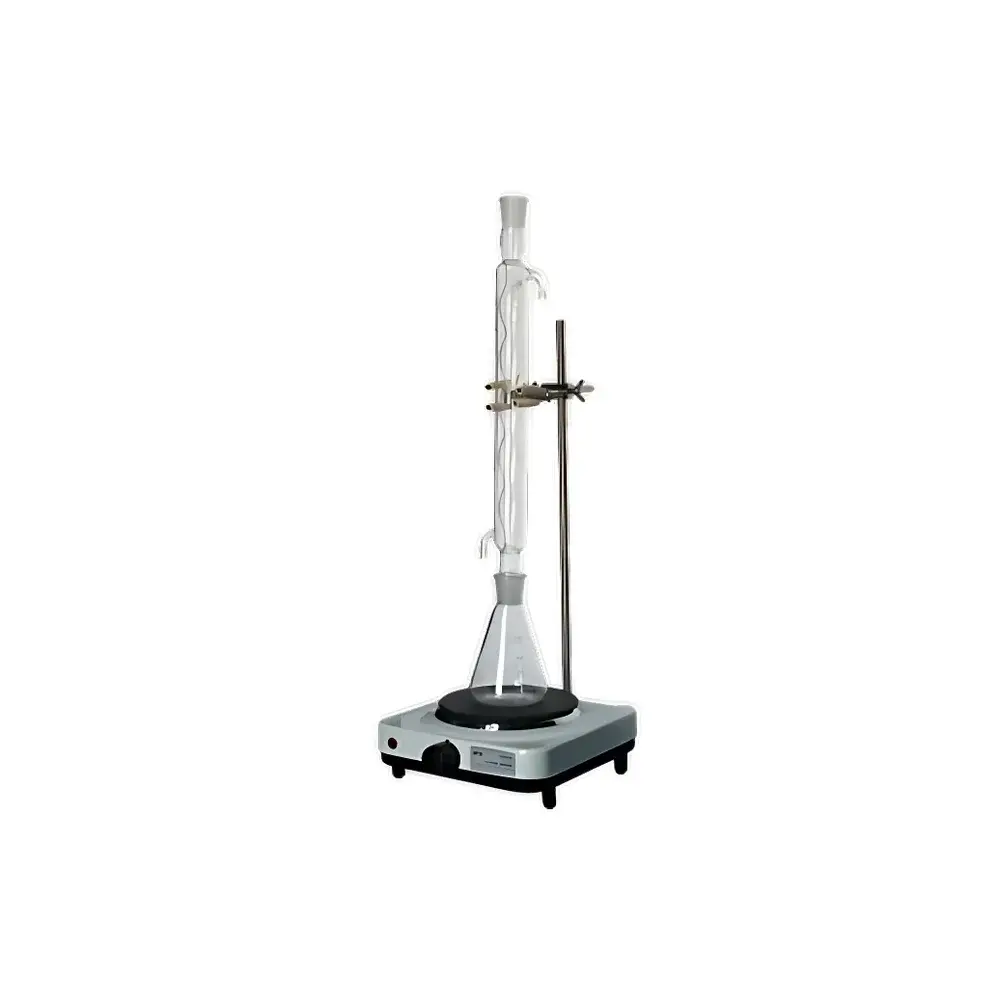
Shenkai SYP1027 Petroleum Acid Number and Acid Value Tester
| Brand | Shenkai |
|---|---|
| Origin | Shanghai, China |
| Model | SYP1027 |
| Standard Compliance | GB/T 258, GB/T 264, GB 7599 |
| Sample Vessel | 250 mL conical flask |
| Reflux Condenser | 300 mm spherical |
| Burette | 2 mL microburette, 0.02 mL graduation |
| Heater Power Range | 100–1000 W (adjustable) |
| Input Power | AC 220 V ±10%, 50 Hz ±1 Hz |
| Dimensions | 200 mm × 200 mm × 500 mm (L×W×H) |
| Weight | 10 kg |
Overview
The Shenkai SYP1027 Petroleum Acid Number and Acid Value Tester is a dedicated benchtop analytical instrument engineered for precise potentiometric or visual endpoint titration of acidic components in petroleum-based fluids. It operates on the principle of solvent extraction followed by standardized acid–base titration—specifically designed to comply with three key national standards: GB/T 258 (Acid Number Determination for Light Petroleum Products), GB/T 264 (Acid Value Determination for Petroleum Products), and GB 7599 (Acid Value Testing of In-Service Transformer Oil and Turbine Oil using Bromothymol Blue indicator). The system extracts acidic species from samples using ethanol as the extraction solvent under controlled reflux conditions, then quantifies total acidity via titration with standardized potassium hydroxide (KOH) in ethanol solution. This method yields results expressed as mg KOH/g (acid number) or mg KOH/100 mL (acid value), depending on sample density and regulatory context. The instrument’s architecture supports consistent thermal management, reproducible reflux kinetics, and accurate volumetric delivery—critical for achieving inter-laboratory comparability in refinery QC, power plant oil condition monitoring, and lubricant stability assessment.
Key Features
- Integrated adjustable heating module with continuous 100–1000 W power regulation, enabling precise control over reflux intensity across diverse sample viscosities and boiling points.
- Dedicated 250 mL borosilicate conical flask and 300 mm spherical reflux condenser optimized for efficient vapor condensation and minimal solvent loss during prolonged heating cycles.
- High-precision 2 mL microburette calibrated to 0.02 mL graduation, compliant with ISO 385 and ASTM E200 requirements for volumetric glassware used in titrimetric analysis.
- Stable mechanical support frame accommodating both flask and condenser alignment, ensuring leak-free reflux geometry and operator safety during extended operation.
- Compact footprint (200 × 200 × 500 mm) and lightweight design (10 kg) facilitate deployment in mobile labs, field service vehicles, or constrained QC environments without compromising structural rigidity.
Sample Compatibility & Compliance
The SYP1027 is validated for use with light distillates (e.g., gasoline, kerosene, diesel), residual fuels, lubricating oils, and in-service insulating oils—including transformer oil and turbine oil per GB 7599. Its methodology aligns with internationally recognized titration principles referenced in ASTM D974 (Standard Test Method for Acid Number of Petroleum Products by Color-Indicator Titration) and ASTM D664 (Potentiometric Titration Method). While not certified to ISO/IEC 17025 calibration requirements out-of-the-box, the instrument supports traceable calibration using NIST-traceable KOH standard solutions and certified reference materials (CRMs) for acid number. Laboratories implementing GLP or ISO 9001 quality systems may document operational qualification (OQ), preventive maintenance schedules, and analyst training records to meet internal audit expectations.
Software & Data Management
The SYP1027 is a manually operated, hardware-only platform with no embedded microprocessor or digital interface. All calculations—including acid number (mg KOH/g) or acid value (mg KOH/100 mL)—are performed externally using laboratory worksheets or LIMS-integrated spreadsheets. Users are responsible for recording raw burette readings, sample mass/volume, and titrant concentration according to their site-specific SOPs. For laboratories requiring electronic recordkeeping, the instrument is compatible with external data capture tools such as tablet-based ELN systems or validated Excel templates compliant with FDA 21 CFR Part 11 when paired with appropriate audit trail and electronic signature controls.
Applications
- Refinery quality control: Monitoring oxidation-induced acid formation during storage and distribution of gasoline and jet fuel.
- Power generation asset management: Assessing degradation of transformer oil to inform scheduled reconditioning or replacement per IEC 60296 guidelines.
- Lubricant formulation R&D: Evaluating additive package stability under accelerated aging protocols.
- Third-party testing laboratories: Delivering accredited test reports for contract analysis under CNAS accreditation scopes referencing GB/T 264 and GB/T 258.
- Marine fuel compliance verification: Screening for excessive organic acid content in marine diesel oil (MDO) and residual fuel oil (RFO) prior to bunkering.
FAQ
What standards does the SYP1027 explicitly support?
GB/T 258, GB/T 264, and GB 7599—covering light petroleum products, general petroleum products, and in-service electrical insulating oils.
Is the instrument suitable for automated titration?
No. The SYP1027 is a manual reflux-titration system; it does not include motorized burettes, pH electrodes, or endpoint detection electronics.
Can it be used with non-ethanol solvents?
The design and validation are specific to ethanol extraction per cited standards; substitution requires full method revalidation per ISO/IEC 17025 Clause 7.2.2.
What maintenance is required for long-term accuracy?
Regular cleaning of the condenser interior, verification of burette calibration against certified weights, and periodic heater output verification using a calibrated power meter.
Does the unit include titrant or reagents?
No. Potassium hydroxide in ethanol solution, bromothymol blue indicator, and reference standards must be sourced separately and stored per chemical safety guidelines.





