
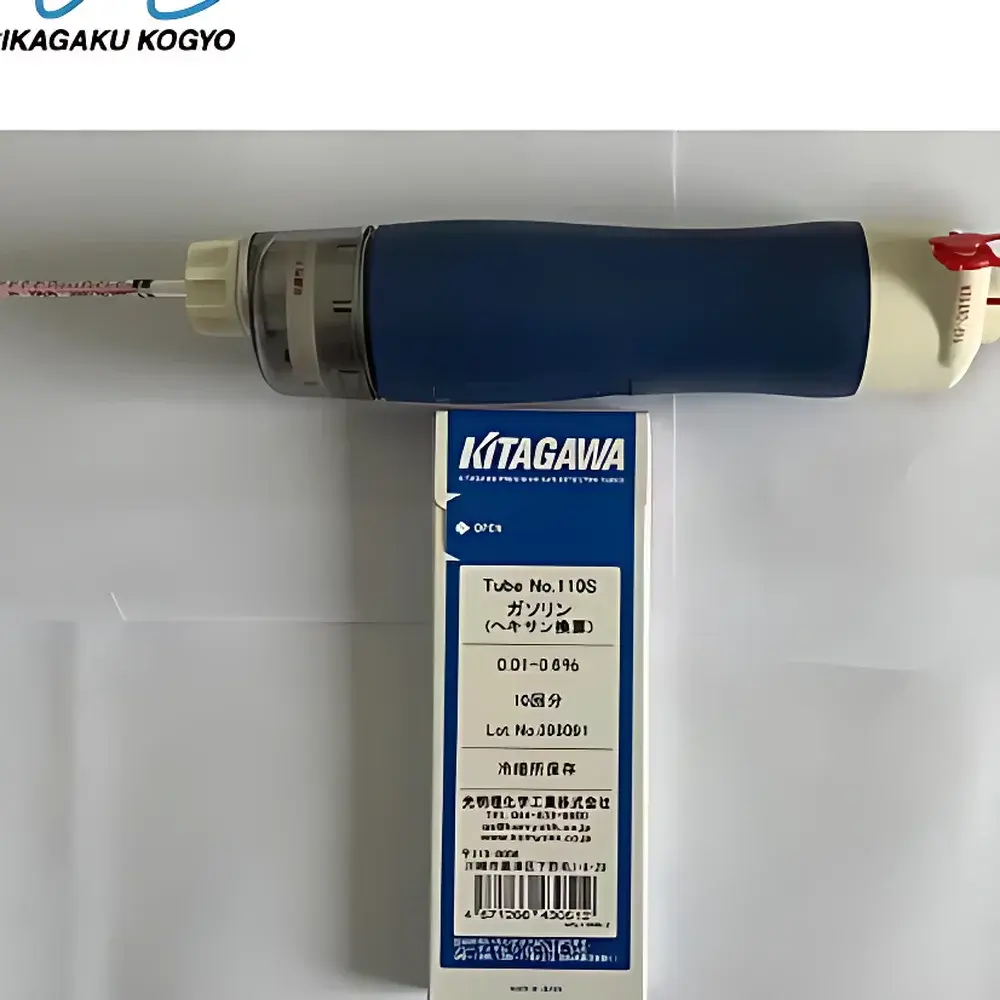
Kitagawa 251U Diesel Vapor Quick-Test Tube (for Portable Manual Pump AP-20 Series)
| Brand | Guangming Physical Chemistry |
|---|---|
| Origin | Beijing, China |
| Model | 251U |
| Detection Principle | Colorimetric Reaction with Pre-impregnated Reagent |
| Measurement Range (Standard 2-Stroke) | 1–30 ppm |
| Extended Range (4-Stroke) | 0.5–12.5 ppm |
| Sampling Volume | 200 mL (2 strokes) or 400 mL (4 strokes) |
| Response Time | 3 min (2 strokes) / 6 min (4 strokes) |
| Detection Limit | 0.3 ppm (4 strokes) |
| Color Transition | White → Pale Green |
| Operating Temperature | 0–40 °C (temperature correction required) |
| Compatible Pumps | AP-20, AP-20S, AP-1S, 400A, 400B |
| Calibration Gas | Undecane (C₁₁H₂₄) |
| Scale Reference | Calibrated for 2-stroke sampling (200 mL) |
| Temperature Correction Required | Yes (provided correction tables for both 2- and 4-stroke modes) |
Overview
The Kitagawa 251U Diesel Vapor Quick-Test Tube is a field-deployable, chemical colorimetric detection device engineered for rapid, on-site quantification of diesel vapor concentrations in ambient air or workplace environments. It operates on the principle of stoichiometric gas-phase reaction between diesel-range hydrocarbons (primarily C9–C15 aliphatics and aromatics) and a proprietary solid-phase reagent pre-loaded inside a sealed glass tube. Upon manual aspiration through a calibrated hand pump (e.g., AP-20), vapor molecules diffuse into the reagent bed and induce an irreversible, concentration-proportional color front progression—from white to pale green—along a linearly engraved scale. The length of the color change directly correlates to the integrated concentration-time exposure (ppm·min), enabling direct readout of average vapor concentration (ppm) when paired with defined sampling volume and duration. Designed for use without electricity, ignition sources, or laboratory infrastructure, the 251U complies with ISO 8573-1 Annex B and ASTM D5403 guidance for qualitative/semi-quantitative hydrocarbon vapor screening in occupational hygiene and emergency response contexts.
Key Features
- Single-use, factory-calibrated glass tube with laser-engraved linear scale and directional arrow marking for unambiguous installation
- Optimized reagent formulation for selective response to diesel-range saturated and unsaturated hydrocarbons (C9–C15), minimizing cross-sensitivity to methane, propane, or ethanol
- Two standardized sampling protocols: 2-stroke (200 mL, 3-min development) for 1–30 ppm range; 4-stroke (400 mL, 6-min development) for extended low-range detection down to 0.3 ppm
- Integrated temperature correction methodology validated across 0–40 °C, with published correction factors for both 2- and 4-stroke modes to ensure metrological traceability under variable field conditions
- Mechanically robust design compatible with multiple industry-standard manual pumps (AP-20, AP-20S, AP-1S, 400A, 400B), supporting repeatable 100 mL ±3% per stroke aspiration
- No external power, batteries, or consumables beyond the tube and pump—ideal for Zone 1/2 hazardous area use per IEC 60079-0
Sample Compatibility & Compliance
The 251U tube is validated for diesel fuel vapors generated from standard EN 590 or ASTM D975 grade fuels under static headspace or dynamic dilution conditions. It exhibits negligible interference from common co-contaminants including CO, CO2, NOx, SO2, and water vapor at typical ambient humidity levels (<80% RH). While not intended for regulatory compliance reporting per OSHA 29 CFR 1910.1200 or EU REACH Annex XVII, it meets the performance criteria for preliminary screening outlined in NIOSH Manual of Analytical Methods (NMAM) Method 2541 for hydrocarbon vapors. Each production lot undergoes batch calibration against certified undecane vapor standards traceable to NIST SRM 1849, with certificate of analysis supplied per tube batch.
Software & Data Management
As a passive, analog detection system, the 251U requires no firmware, drivers, or software integration. Field measurements are recorded manually in logbooks or digital forms compliant with ISO/IEC 17025 Clause 7.5.2 for non-automated data capture. For laboratories operating under GLP or GMP frameworks, documented use includes recording tube lot number, pump model/serial, ambient temperature, stroke count, observed color front position, applied temperature correction factor, and final reported concentration—all of which satisfy audit requirements for method transparency and result traceability. Optional digital templates (Excel/CSV) for temperature-corrected calculation are available upon request for quality assurance workflows.
Applications
- Routine leak detection at diesel storage tanks, transfer hoses, and refueling nozzles in refineries, depots, and marine terminals
- Occupational exposure assessment during maintenance of diesel-powered generators, compressors, and heavy equipment in confined spaces
- Emergency response triage following fuel spills or tank over-pressurization incidents to establish initial exclusion zones
- Verification of ventilation effectiveness in underground garages, tunnels, and engine test cells prior to personnel re-entry
- Pre-commissioning checks of vapor recovery systems and carbon adsorber beds servicing diesel handling infrastructure
FAQ
What calibration standard is used for the 251U tube?
Undecane (C11H24) is the primary calibration gas, selected for its representative volatility and molecular weight within the diesel hydrocarbon distribution. All lot-specific calibration curves are traceable to NIST SRM 1849.
Can the 251U be used for gasoline or kerosene vapor detection?
No. The reagent chemistry is optimized for diesel-range hydrocarbons. Gasoline (C4–C12) produces incomplete or non-linear color fronts; kerosene (C10–C16) may yield elevated bias due to higher boiling point components.
Is temperature correction mandatory?
Yes. Reaction kinetics are temperature-dependent. Uncorrected readings at 0 °C or 40 °C deviate by up to ±25% from true concentration. The provided correction tables must be applied to all field measurements.
How should expired tubes be disposed?
Discard as hazardous chemical waste per local regulations (UN 3240, PG III). Do not incinerate. Reagent residue contains transition metal catalysts requiring controlled landfill or thermal treatment.
Does the tube require pre-conditioning before use?
No. Tubes are sealed under inert atmosphere and stable for 24 months from manufacture date when stored at 15–25 °C in original packaging. Avoid direct sunlight and high-humidity storage.







