
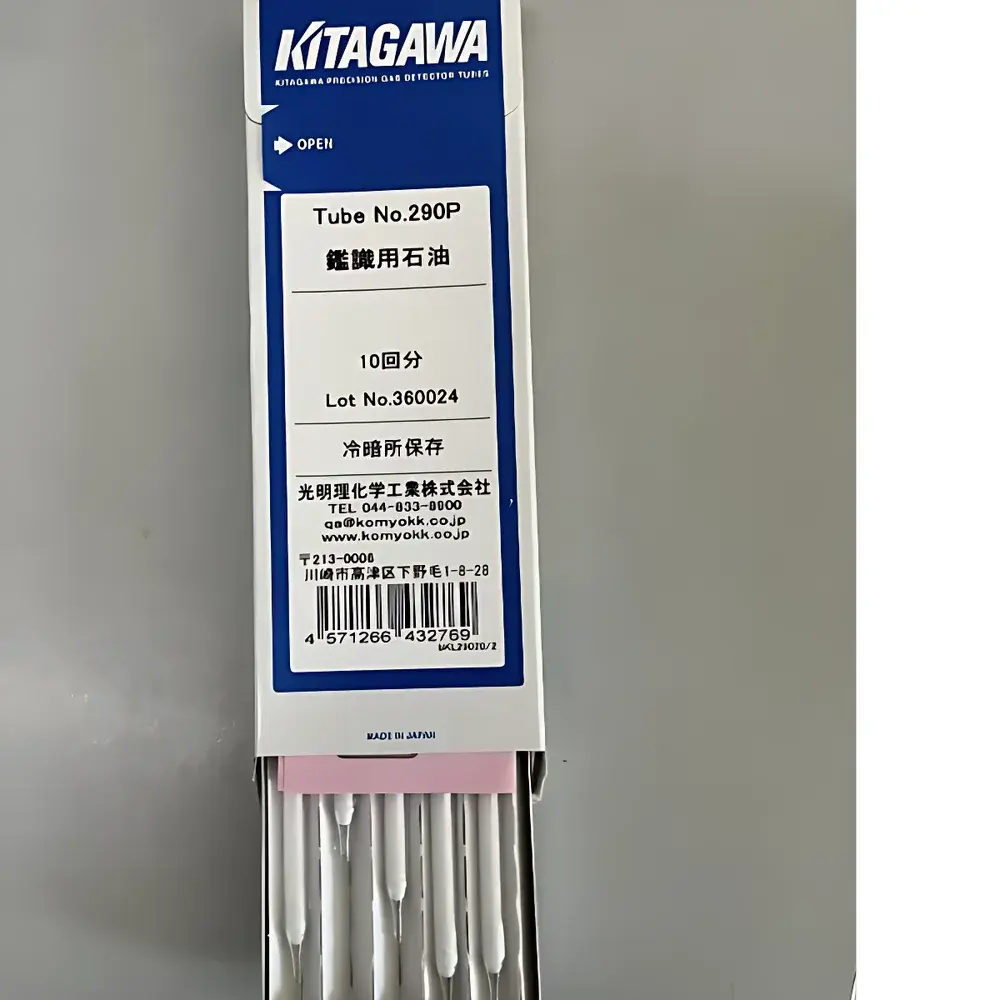
Kerosene and Gasoline Identification Detection Tube (Model 290Pǁ)
| Brand | Meikō Rika |
|---|---|
| Origin | Japan |
| Manufacturer Type | Authorized Distributor |
| Origin Category | Imported |
| Model | 290Pǁ |
| Price | USD 55 |
Overview
The Meikō Rika 290Pǁ Kerosene and Gasoline Identification Detection Tube is a field-deployable, colorimetric chemical test device engineered for rapid qualitative identification of low-boiling-point petroleum distillates—specifically gasoline, kerosene, and related aliphatic/aromatic hydrocarbon mixtures—at fire investigation scenes, environmental spill sites, or forensic field operations. Unlike traditional oil-film observation methods—which suffer from high subjectivity, volatility-induced false negatives, and inability to distinguish between fuel types—the 290Pǁ tube employs a selective chromogenic reaction with aromatic hydrocarbons (e.g., benzene, toluene, xylene), which remain thermally stable relative to lighter aliphatic fractions during post-ignition residue formation. This principle enables reliable detection even when volatile components (e.g., C4–C8 n-alkanes) have been significantly depleted by thermal degradation—a common limitation in fire debris analysis per ASTM E1387 and NFPA 921 guidelines.
Key Features
- Single-use, sealed glass ampoule with pre-loaded reagent system requiring no external power, calibration, or consumables beyond the tube itself
- Visual colorimetric endpoint: distinct, stable hue development (e.g., violet, magenta, or orange-red) within 60 seconds upon exposure to vapor-phase or liquid-phase hydrocarbon residues
- Differentiated response profiles: gasoline typically induces a rapid violet shift; kerosene yields a slower-developing magenta tone; diesel produces a muted orange-brown—enabling preliminary classification without chromatographic confirmation
- Designed for ambient temperature operation (−10 °C to +45 °C), with humidity tolerance up to 85% RH non-condensing
- Integrated breather filter prevents particulate ingress while permitting vapor diffusion—critical for soot-laden or ash-contaminated samples
- CE-marked and compliant with ISO 17025-aligned validation protocols for qualitative field screening devices used in accredited laboratories
Sample Compatibility & Compliance
The 290Pǁ tube responds to vapor-phase or swab-eluate extracts containing ≥50 ppm total aromatic hydrocarbons. It is validated for use on charred wood, concrete dust, carpet fibers, soil matrices, and metal surfaces commonly encountered at fire scenes. Cross-reactivity with non-petroleum aromatics (e.g., creosote, coal tar) is documented in the manufacturer’s technical bulletin and must be interpreted in context with scene history. The device meets Japanese JIS K 0107:2020 requirements for field chemical identification tools and supports chain-of-custody documentation under ISO/IEC 17025:2017 Clause 7.7. No FDA 21 CFR Part 11 or GLP compliance is claimed, as it is not a quantitative analytical instrument but a presumptive screening tool intended for triage prior to GC-MS or FTIR laboratory analysis.
Software & Data Management
The 290Pǁ operates independently of software or digital interfaces. Color interpretation relies on standardized reference charts included with each batch (traceable to NIST SRM 2806a for visible reflectance). Each tube lot is supplied with a Certificate of Conformance listing batch-specific expiration date, storage conditions (2–8 °C, dark), and shelf life (24 months unopened). Digital record-keeping is supported via integration into standard evidence management systems (e.g., Evidence.com, TraQSuite) through manual entry of tube lot number, sample ID, operator name, and observed color code (per included Pantone®-referenced guide). Audit trails are maintained per organizational SOPs—not embedded in firmware.
Applications
- Fire origin and cause determination: distinguishing accidental ignition sources (e.g., gasoline-fueled equipment) from incendiary use
- Environmental first-response screening at suspected fuel leak or illegal dumping sites
- Forensic triage in police investigations involving accelerant residue on clothing, footwear, or vehicle interiors
- Post-incident verification of decontamination efficacy on PPE or structural surfaces
- Training and proficiency testing for fire investigators under NFPA 1033 competency standards
FAQ
Can the 290Pǁ differentiate between unleaded and leaded gasoline?
No—lead content does not influence the aromatic-mediated color reaction. Differentiation requires elemental analysis (e.g., XRF or ICP-MS).
Is the tube suitable for water-contaminated samples?
Yes, provided the aqueous phase is separated or evaporated first; free water inhibits vapor-phase diffusion and may quench the reaction.
What is the shelf life after opening the foil pouch?
Use within 30 days if stored desiccated at 2–8 °C; resealing does not restore original stability due to moisture permeation.
Does this replace laboratory-based GC-MS analysis?
No—it is a presumptive test only. Positive results require confirmatory analysis per ASTM E1618 or ISO 13877 for legal admissibility.
Are there interferences from common cleaning solvents?
Yes—toluene, xylene, and acetone produce false positives; ethanol and isopropanol do not react. Field operators must document all potential solvent exposures prior to sampling.
Related Products







