
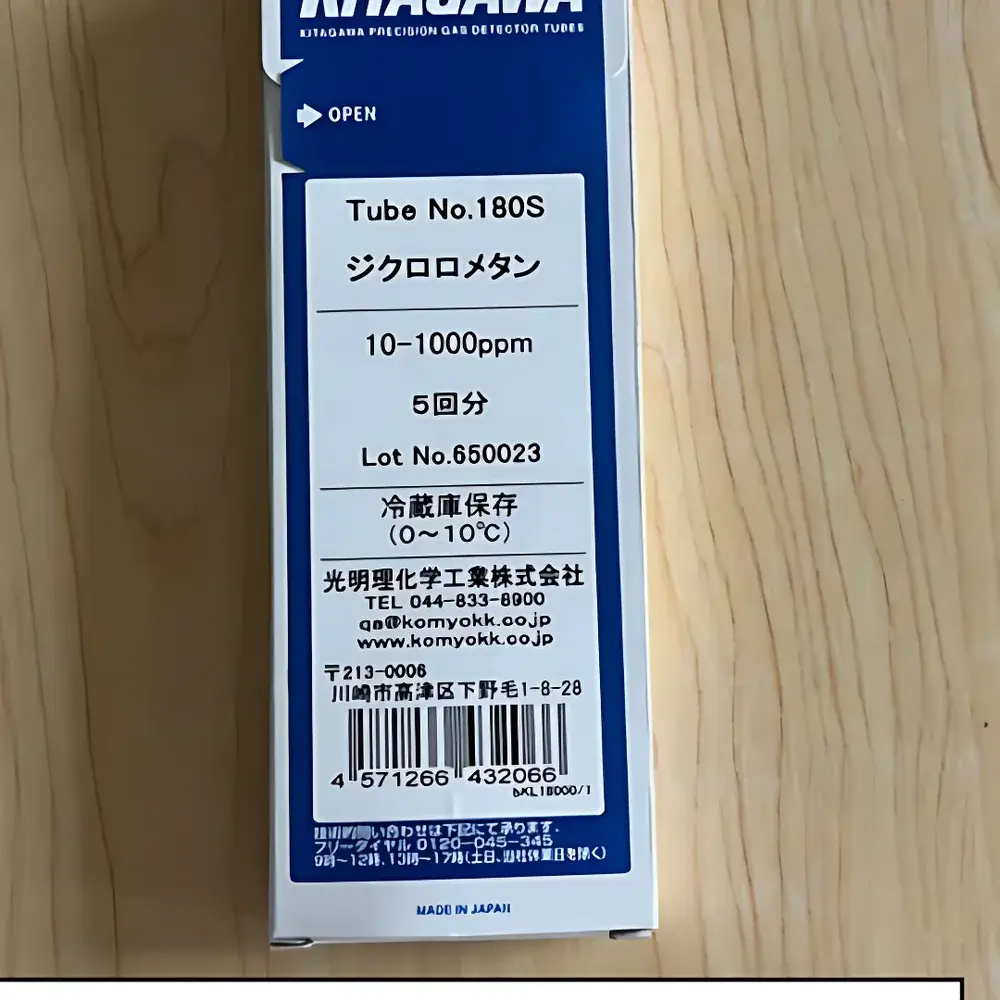
North Kawanishi Dichloromethane Gas Detection Tube Model 180S
| Brand | Meikou Rikagaku |
|---|---|
| Origin | Japan |
| Manufacturer Type | Authorized Distributor |
| Origin Category | Imported |
| Model | 180S |
| Detection Range | 30–1000 ppm (standard scale), 10–200 ppm (low-range scale) |
| Pack Size | 5 tubes per box, 2 boxes per set |
| Compatible Pump | AP-20 Hand Pump |
Overview
The North Kawanishi Dichloromethane Gas Detection Tube Model 180S is a chemically calibrated, single-use colorimetric indicator tube designed for rapid, on-site quantification of dichloromethane (DCM, CH₂Cl₂) vapor in ambient air. Engineered for field deployment in industrial hygiene, occupational safety, and emergency response scenarios, the 180S tube operates on the principle of length-of-stain colorimetric analysis — a well-established, ASTM D5402-compliant method for real-time gas concentration estimation. When air is drawn through the tube using the AP-20 dual-stroke hand pump, dichloromethane reacts selectively with immobilized reagents (primarily acid-catalyzed chromogenic agents) packed within the silica gel matrix, producing a sharp, stable color front. The distance traveled by the color front along the calibrated glass tube corresponds directly to the integrated concentration–time exposure (ppm·min), enabling direct visual readout of concentration in parts per million (ppm) under standardized sampling conditions (e.g., 100 mL at 100 mL/min). No power supply, calibration gas, or laboratory infrastructure is required — making it ideal for confined-space entry verification, leak surveys, solvent handling area monitoring, and post-spill assessment.
Key Features
- Two-scale dual-range design: Simultaneous reading capability for high-range (30–1000 ppm) and low-range (10–200 ppm) concentrations on a single tube — optimized for both routine workplace monitoring and acute exposure evaluation.
- High specificity to dichloromethane: Formulated reagent chemistry minimizes cross-sensitivity to common co-volatiles such as chloroform, acetone, or ethanol, verified per JIS K 0201 and ISO 8519 protocols.
- Robust borosilicate glass construction: Chemically inert tube body ensures dimensional stability, resistance to thermal shock, and compatibility with humid or mildly acidic atmospheres.
- Pre-calibrated linear stain length response: Each batch undergoes gravimetric and dynamic calibration against NIST-traceable dichloromethane reference standards; certificate of analysis provided with every lot.
- GLP-aligned documentation support: Batch-specific expiration date, manufacturing date, and calibration traceability data printed on tube label and accompanying datasheet.
Sample Compatibility & Compliance
The 180S detection tube is validated for use in clean, non-condensing air matrices at temperatures between 10–40 °C and relative humidity ≤85 % RH. It is not intended for use in oxygen-deficient, explosive (ATEX Zone 0/1), or highly particulate-laden environments without upstream filtration (e.g., PTFE membrane pre-filter). Performance meets requirements of OSHA Method PV2121 (for DCM), NIOSH Manual of Analytical Methods (NMAM) Chapter 2507, and Japanese Industrial Standard JIS K 0201:2022 for colorimetric gas detector tubes. Tubes are supplied sterile-packed and individually sealed in aluminum laminate sleeves to preserve reagent integrity until first use. Shelf life: 24 months from manufacture date when stored at 15–25 °C in dark, dry conditions.
Software & Data Management
As a passive, analog measurement device, the 180S requires no software interface or digital connectivity. However, quantitative results are fully compatible with enterprise EHS management platforms via manual entry or barcode-assisted logging (each tube features a unique batch ID and model code). For audit readiness, users may document readings using standardized forms aligned with ISO 45001 clause 9.1.2 (monitoring and measurement) and maintain records per OSHA 1910.1200(h) hazard communication requirements. Optional digital log templates (Excel/CSV) and SOPs for GLP-conforming field use are available upon request from authorized distributors.
Applications
- Occupational exposure assessment during degreasing, paint stripping, pharmaceutical synthesis, and adhesive application processes.
- Routine area monitoring in printing facilities, automotive refinishing bays, and polymer processing lines where DCM is used as a processing solvent.
- First-responder screening during chemical transportation incidents or warehouse spills involving halogenated solvents.
- Verification of local exhaust ventilation (LEV) effectiveness prior to worker re-entry after maintenance.
- Complementary tool for validating fixed-system alarm thresholds or calibrating electrochemical sensors in multi-layered gas safety programs.
FAQ
What is the recommended sampling volume and flow rate for accurate results?
A fixed volume of 100 mL must be drawn at a uniform rate of 100 mL/min using the AP-20 hand pump — deviations exceeding ±10 % significantly affect stain length reproducibility.
Can the same tube be reused after initial sampling?
No. The 180S is a single-use, irreversible indicator tube; re-use compromises chemical stoichiometry and introduces carryover bias.
How does temperature affect measurement accuracy?
Readings taken outside the 10–40 °C range require correction using the temperature compensation chart provided in the instruction leaflet (JIS K 0201 Annex B).
Is this tube compliant with FDA or EPA regulatory methods?
While not designated as an EPA Reference Method, the 180S is accepted for compliance screening under OSHA 1910.1200 and EU REACH Annex XVII reporting frameworks when used per manufacturer instructions and documented with full chain-of-custody.
What is the shelf life, and how should unused tubes be stored?
24 months from date of manufacture; store upright in original packaging at 15–25 °C, protected from light and moisture — do not refrigerate or freeze.







