
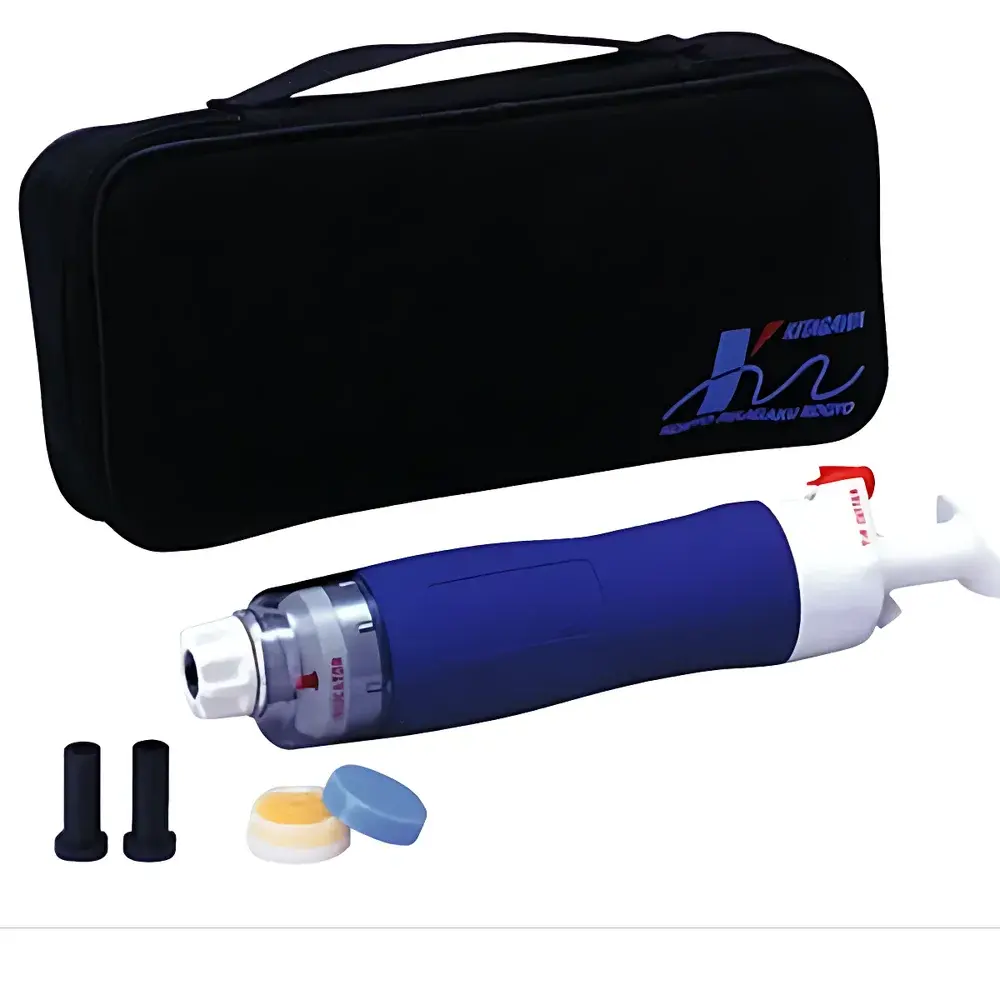
Kokusan AP-20 Manual Gas Sampling Pump
| Brand | Kokusan |
|---|---|
| Origin | Japan |
| Model | AP-20 |
| Sampling Volumes | 50 mL / 100 mL (dual-position plunger) |
| Integrated Timer | spring-actuated mechanical timer with red visual indicator |
| Built-in Glass Cutter | stainless steel blade embedded in pump body |
| Waste Glass Collector | sealed, removable chamber for broken glass ends |
| Certification | ISO 9001:2008, EN 1231:1998, US Design Patent D467,334 S, SEI Certified |
Overview
The Kokusan AP-20 Manual Gas Sampling Pump is a precision-engineered, hand-operated sampling device designed exclusively for quantitative aspiration of ambient or workplace air through colorimetric gas detection tubes. It operates on the principle of positive displacement via a calibrated dual-stroke piston mechanism housed within an airtight cylinder assembly. Each full stroke—whether set to the 50 mL or 100 mL position—generates a defined volume of negative pressure, drawing sample gas at a controlled flow rate through the detection tube. This volumetric displacement method ensures high reproducibility and traceable sampling volumes critical for compliance with industrial hygiene protocols. The AP-20 is not a general-purpose vacuum pump; it is purpose-built for single-use, fixed-volume sampling in accordance with standardized tube-based gas analysis methods outlined in ISO 8518, ASTM D3919, and JIS K 0111.
Key Features
- Dual-Volume Calibration: Selectable 50 mL or 100 mL sampling strokes—mechanically constrained by internal stop positions to eliminate operator-induced volume error.
- Integrated Mechanical Timer: A spring-loaded, red-tinted analog timer automatically deploys upon plunger actuation, providing visual confirmation of sampling duration without external timekeeping devices. Designed for repeatable timing across multiple sequential draws.
- Built-in Glass Cutter: Precision-machined stainless steel cutting edge located at the pump’s upper housing enables clean, consistent severing of detection tube ends—eliminating cross-contamination risk from third-party cutters and ensuring uniform tube insertion depth.
- Sealed Waste Glass Chamber: Removable, impact-resistant polymer reservoir captures fragmented glass tips post-cutting, preventing laceration hazards and supporting safe disposal in accordance with OSHA 1910.138 and EU Directive 2006/42/EC.
- Leak-Tight Construction: All wetted components—including piston seal, cylinder bore, and tube interface—are manufactured to ISO 2768-mK tolerances. Validated leak rate < 0.5 mL/min at −50 kPa per EN 1231 Annex B.
Sample Compatibility & Compliance
The AP-20 is compatible with all standard 4–6 mm outer diameter glass detection tubes conforming to DIN 1947-3 and ISO 8518. Its rigid, non-compressible sampling path prevents tube deformation during aspiration—maintaining laminar flow and minimizing backpressure-induced deviation. The device meets EN 1231:1998 requirements for manual sampling pumps used in occupational exposure assessment, including mechanical durability (10,000+ cycles), temperature stability (−10 °C to +50 °C), and chemical resistance to common solvents (e.g., acetone, ethanol, hexane). ISO 9001:2008 certification covers design control, production traceability, and calibration documentation. US Design Patent D467,334 S protects its ergonomic handle geometry and integrated timer deployment mechanism.
Software & Data Management
The AP-20 is a fully mechanical, battery-free instrument with no embedded electronics or digital interfaces. As such, it requires no firmware updates, cybersecurity validation, or electronic audit trails. All operational parameters—including stroke count, volume selection, and timer activation—are manually recorded by the user in field logbooks or LIMS-integrated paper forms. This analog architecture ensures uninterrupted functionality in intrinsically safe (ATEX Zone 0/1) environments, electromagnetic interference (EMI)-prone industrial settings, and locations lacking stable power infrastructure. For laboratories operating under FDA 21 CFR Part 11 or GLP/GMP frameworks, manual entries must be contemporaneous, legible, and signed—consistent with Annex 11 principles for non-automated systems.
Applications
- Occupational health monitoring of CO, H₂S, NO₂, SO₂, NH₃, Cl₂, and VOCs in refineries, wastewater treatment plants, and manufacturing facilities.
- Rapid response screening during chemical spill incidents or confined space entry pre-testing (per OSHA 1910.146).
- Indoor air quality surveys in schools, hospitals, and office buildings using detector tubes compliant with ISO 16000-23.
- Educational laboratory instruction on gas diffusion kinetics, stoichiometric reaction visualization, and volumetric sampling methodology.
- Field validation of fixed continuous monitors where grab sampling is required for calibration verification or alarm investigation.
FAQ
Does the AP-20 require calibration before use?
No—its volume accuracy is factory-set via mechanical stops and verified per ISO 8518 Annex C. Users should perform a visual inspection of the piston seal and timer function prior to each shift.
Can the AP-20 be used with plastic-bodied detection tubes?
No. It is engineered exclusively for rigid glass tubes (4–6 mm OD) meeting ISO 8518 dimensional specifications. Plastic tubes may deform under suction, compromising flow rate and analytical accuracy.
Is the waste glass chamber autoclavable?
No. The polymer chamber is rated for chemical disinfection only (e.g., 70% isopropyl alcohol wipe); autoclaving will distort its sealing geometry and void EN 1231 compliance.
What maintenance is required?
Annual replacement of the nitrile piston seal (Kokusan P/N AP-SEAL-20) and biannual cleaning of the glass cutter edge with lint-free cloth dampened with ethanol.
Does the red timer meet NIST-traceable timing standards?
The timer is a qualitative indicator—not a metrological instrument. Its ±1.5 s tolerance at 25 °C satisfies EN 1231 timing guidance but is not NIST-traceable; users requiring certified timing must employ external Class I stopwatch per ISO/IEC 17025.
Related Products







