
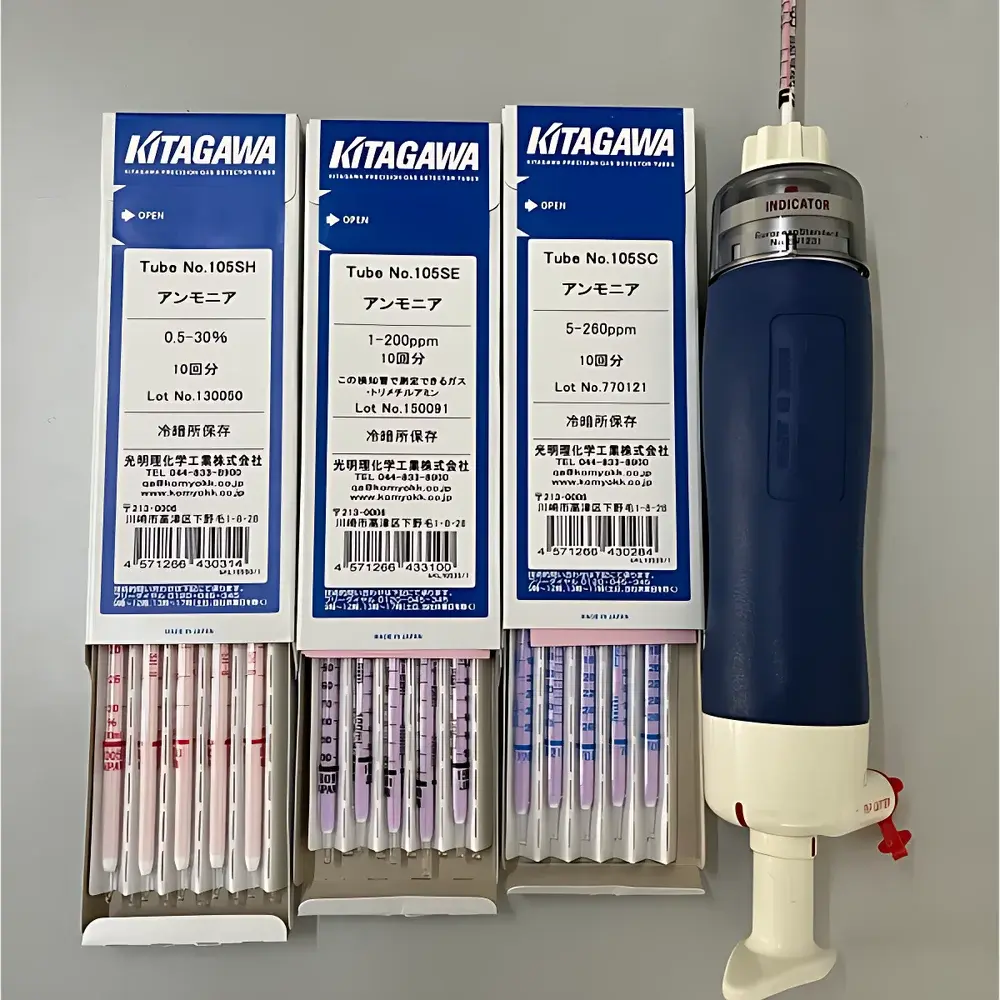
Kitaoka Quick-Read Tetrachloroethylene Gas Detection Tubes Model 135SA & 135SB
| Brand | Meiko Rikka |
|---|---|
| Origin | Japan |
| Manufacturer Type | Authorized Distributor |
| Origin Category | Imported |
| Models | 135SA, 135SB |
| Price | Upon Request |
Overview
The Kitaoka Quick-Read Tetrachloroethylene (PCE) Gas Detection Tubes — Models 135SA and 135SB — are calibrated, single-use colorimetric sampling devices engineered for rapid, on-site quantification of tetrachloroethylene vapor in ambient air. Based on the well-established length-of-stain principle, these tubes utilize a chemically impregnated silica gel reagent bed that undergoes a stoichiometric oxidation reaction with PCE in the presence of lead dioxide (PbO₂) and sulfuric acid under controlled flow conditions. The resulting color front advances linearly along a pre-etched scale, with the stain length directly proportional to the integrated concentration–time exposure (ppm·min). No power source, calibration gas, or laboratory infrastructure is required — only the AP-20 manual piston pump (sold separately) and adherence to standardized sampling volume and timing protocols. Designed for field deployment in industrial hygiene, occupational safety, environmental emergency response, and regulatory compliance verification, these detection tubes deliver trace-level sensitivity and operational robustness under variable ambient conditions.
Key Features
- Two complementary measurement ranges: Model 135SA covers 5–150 ppm (printed scale) and 10–300 ppm (temperature-corrected); Model 135SB provides high-sensitivity detection from 1–10 ppm and 0.2–2.0 ppm.
- Stable shelf life of 24 months when stored refrigerated at 0–10°C; reagent integrity verified via batch-specific expiration date and lot-controlled manufacturing per JIS K 0117.
- Minimal environmental interference: humidity has no measurable effect on stain development; validated performance across 0–40°C operating temperature range with built-in correction table for accurate ppm-to-mg/m³ conversion.
- Defined sampling protocol: fixed 50 mL or 100 mL draw volume using AP-20 pump; 2-minute reaction time per 100 mL; visual endpoint detection without subjective interpretation.
- Lowest detectable concentration: 1 ppm (at 100 mL draw), meeting OSHA PEL and ACGIH TLV monitoring requirements for short-term exposure assessment.
Sample Compatibility & Compliance
These tubes are specifically calibrated for tetrachloroethylene (C₂Cl₄, CAS No. 127-18-4) in clean, non-condensing air matrices. Cross-sensitivity studies indicate positive interference from chlorinated hydrocarbons including vinyl chloride, trichloroethylene, 1,2-dichloroethane, chlorine gas, and hydrogen chloride — all of which may produce elevated readings. Users must document co-contaminant presence and apply appropriate correction factors or select alternative analytical methods where multi-analyte environments are suspected. The detection system complies with ISO 8519:2021 (Workplace air — Measurement of chemical agents — Colorimetric detector tubes) and supports GLP-aligned field data collection when used with auditable pump calibration logs and chain-of-custody documentation.
Software & Data Management
As a passive, analog measurement system, the 135SA/135SB tube requires no software integration or digital interface. However, quantitative results are fully compatible with laboratory information management systems (LIMS) and electronic health & safety reporting platforms via manual entry or barcode-assisted logging (each tube features a unique lot number for traceability). For audit readiness, users are advised to retain original tubes, completed sampling worksheets, AP-20 calibration certificates, and temperature/pressure correction records — all supporting FDA 21 CFR Part 11–compliant data integrity practices in regulated manufacturing settings.
Applications
- OCCUPATIONAL HYGIENE: Real-time monitoring near dry-cleaning facilities, metal degreasing lines, and solvent recovery units to verify compliance with OSHA 29 CFR 1910.1006 and EU Directive 2017/2398.
- EMERGENCY RESPONSE: Rapid hazard assessment during PCE spills, container breaches, or ventilation failures — enabling immediate engineering controls and worker evacuation decisions.
- INDUSTRIAL QUALITY CONTROL: Verification of residual solvent levels in cleaned components prior to coating, welding, or assembly processes.
- ENVIRONMENTAL SITE ASSESSMENT: Preliminary screening of soil vapor intrusion pathways and indoor air quality in buildings adjacent to former dry-cleaning sites.
- REGULATORY FIELD VERIFICATION: Supporting EPA Method TO-15 and ASTM D5466-compliant screening protocols where qualitative/semi-quantitative triage precedes GC-MS confirmation.
FAQ
What is the minimum detectable concentration for Model 135SB?
The lower limit of detection is 0.2 ppm when sampling 100 mL of air, verified per manufacturer’s validation report (Lot-Specific LOD Certificate included with each box).
Do I need to correct for barometric pressure?
Yes — reported ppm values must be multiplied by the ratio of standard atmospheric pressure (1013 hPa) divided by local measured pressure (hPa) to ensure metrological equivalence.
Can these tubes be reused?
No — each tube is a single-use, sealed reagent system. Reuse compromises accuracy, violates ISO 8519 procedural requirements, and voids traceability.
Is temperature correction mandatory?
Yes — readings taken outside 20°C require application of the provided temperature correction table; uncorrected values introduce systematic bias exceeding ±12% at 0°C or 40°C.
How should expired tubes be disposed?
Discard as hazardous chemical waste per local regulations (UN 3265, Class 8 Corrosive); do not incinerate or drain into sewer systems due to PbO₂ content.
Related Products







