
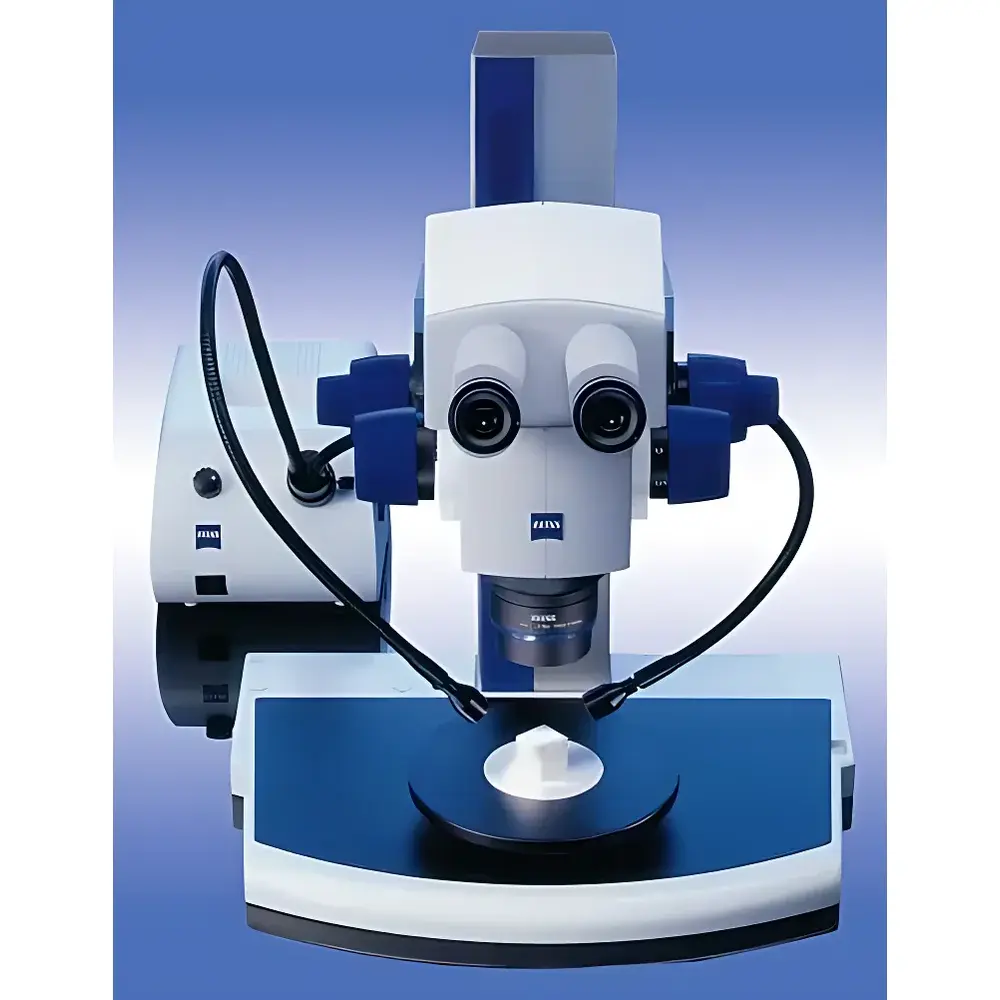
ZEISS SteREO Discovery.V8 Research-Grade Stereo Microscope
| Brand | ZEISS |
|---|---|
| Origin | Germany |
| Model | SteREO Discovery.V8 |
| Total Magnification Range | 3×–300× |
| Zoom Ratio | 1:8 |
| Optical Design | Common Main Objective (CMO) |
| Ergonomic Design | Yes |
| Illumination Options | Reflected, Transmitted, Oblique, Ring Light, Polarized |
| Imaging Compatibility | Digital Camera, C-Mount Adapter, Image Analysis Software |
| Working Distance | Up to 110 mm (at lowest magnification) |
| Field of View | Up to 74 mm (at 3×) |
| Compliance | ISO 9001, CE, RoHS |
Overview
The ZEISS SteREO Discovery.V8 is a high-performance research-grade stereo microscope engineered for precision macro-to-micro observation across scientific, industrial, and forensic laboratories. Based on the Common Main Objective (CMO) optical principle—widely recognized as the gold standard in modern stereomicroscopy—the system delivers exceptional resolution, flatness of field, chromatic fidelity, and depth of focus without parallax-induced distortion. Unlike Greenough-type designs, the CMO architecture employs a single shared objective lens and dual parallel optical paths, ensuring true stereoscopic imaging with consistent magnification scaling and superior image registration. This design enables accurate morphological assessment, quantitative measurement, and reproducible documentation under variable illumination conditions. The SteREO Discovery.V8 is purpose-built for applications demanding long working distances (up to 110 mm), large specimen handling, and stable optical performance over extended operational cycles—making it suitable for routine quality control, failure analysis, microassembly verification, and non-destructive evaluation in regulated environments.
Key Features
- CMO optical pathway delivering diffraction-limited resolution, minimal chromatic aberration, and high contrast across the full 3×–300× magnification range
- 1:8 continuous zoom system with calibrated magnification readout and repeatable positioning for comparative studies
- Ergonomically optimized stand configuration—including tiltable binocular tube, adjustable interpupillary distance, and modular arm options—to reduce operator fatigue during prolonged use
- Modular illumination platform supporting incident brightfield, transmitted Koehler, oblique, ring LED, and polarization contrast—each independently controllable and intensity-tunable
- Integrated mounting interfaces compliant with ZEISS Axiocam digital cameras, motorized focus drives, and motorized zoom modules for automated workflows
- Robust mechanical construction using temperature-stable aluminum alloys and precision-ground optical rails to maintain alignment stability under laboratory environmental fluctuations
Sample Compatibility & Compliance
The SteREO Discovery.V8 accommodates specimens ranging from intact circuit boards and polymer composites to biological tissue sections, forensic evidence samples, and heritage artifacts—without requiring sectioning or conductive coating. Its extended working distance supports manipulation tools (e.g., micromanipulators, soldering probes) beneath the objective. The system complies with ISO 9001 manufacturing standards and carries CE marking per EU Directive 2014/30/EU (EMC) and 2014/35/EU (LVD). All electronic components meet RoHS 2011/65/EU requirements. When configured with ZEISS ZEN software and audit-trail-enabled hardware (e.g., motorized stage, encoded zoom), the platform supports GLP/GMP-aligned documentation workflows and satisfies traceability requirements outlined in FDA 21 CFR Part 11 for regulated pharmaceutical and medical device testing laboratories.
Software & Data Management
ZEISS ZEN Core software provides native integration for image acquisition, measurement annotation (length, angle, area, particle count), multi-focus stacking, and report generation in PDF or CSV formats. The software supports DICOM export for cross-platform compatibility with hospital PACS systems and includes built-in calibration routines traceable to NIST-certified standards. Optional ZEN Blue edition adds advanced features including spectral unmixing for birefringence quantification (relevant to protein crystallography and polymer phase analysis), automatic defect detection via machine learning templates, and secure user role management with password-protected method libraries. All image metadata—including magnification, illumination mode, exposure time, and objective ID—is embedded in TIFF headers and preserved through archival transfers.
Applications
- Materials Science: Fracture surface topography analysis, coating uniformity assessment, porosity quantification in additive-manufactured metals, and interfacial characterization of fiber-reinforced composites
- Semiconductor & Microelectronics: Post-etch inspection of wafer-level packaging, bond pad alignment verification, solder joint integrity evaluation, and contamination mapping on bumped dies
- Medical Device Manufacturing: Dimensional verification of catheter lumens, O-ring cross-section morphology, pacemaker housing seam inspection, and biocompatible polymer surface texture analysis
- Pharmaceutical Development: Polymorph identification via birefringence imaging, crystallization kinetics monitoring, excipient particle size distribution, and tablet coating thickness uniformity assessment
- Forensic Science: Fiber diameter measurement, hair medullary pattern classification, gunshot residue morphology, and trace powder particle morphology correlation with source databases
- Cultural Heritage Conservation: Pigment stratigraphy mapping, varnish degradation layer segmentation, parchment fiber orientation analysis, and adhesive residue identification using polarized light contrast
FAQ
What is the maximum usable working distance at minimum magnification?
At 3× magnification, the SteREO Discovery.V8 provides a working distance of up to 110 mm—sufficient to accommodate manipulators, pipettes, or custom sample holders.
Can this system be integrated into an automated production line?
Yes—via optional motorized zoom, focus, and stage modules, coupled with ZEISS ZEN Connect API for PLC synchronization and trigger-based image capture.
Is the optical path compatible with fluorescence observation?
While not a dedicated fluorescence platform, the CMO design supports third-party LED fluorescence illuminators with appropriate filter cubes; however, signal-to-noise ratio is optimized for reflected-light contrast techniques rather than low-light fluorescence.
Does ZEISS provide validation documentation for GxP environments?
Yes—IQ/OQ protocols, calibration certificates traceable to national metrology institutes, and software validation packages are available upon request for regulated users.
How does the SteREO Discovery.V8 differ from the V20 model?
The V8 emphasizes mechanical robustness, manual ergonomics, and broad illumination flexibility; the V20 prioritizes higher magnification ceilings (up to 1000×), motorized automation, and deeper software integration—making the V8 ideal for hands-on analytical labs, while the V20 targets high-throughput automated QA/QC settings.





