
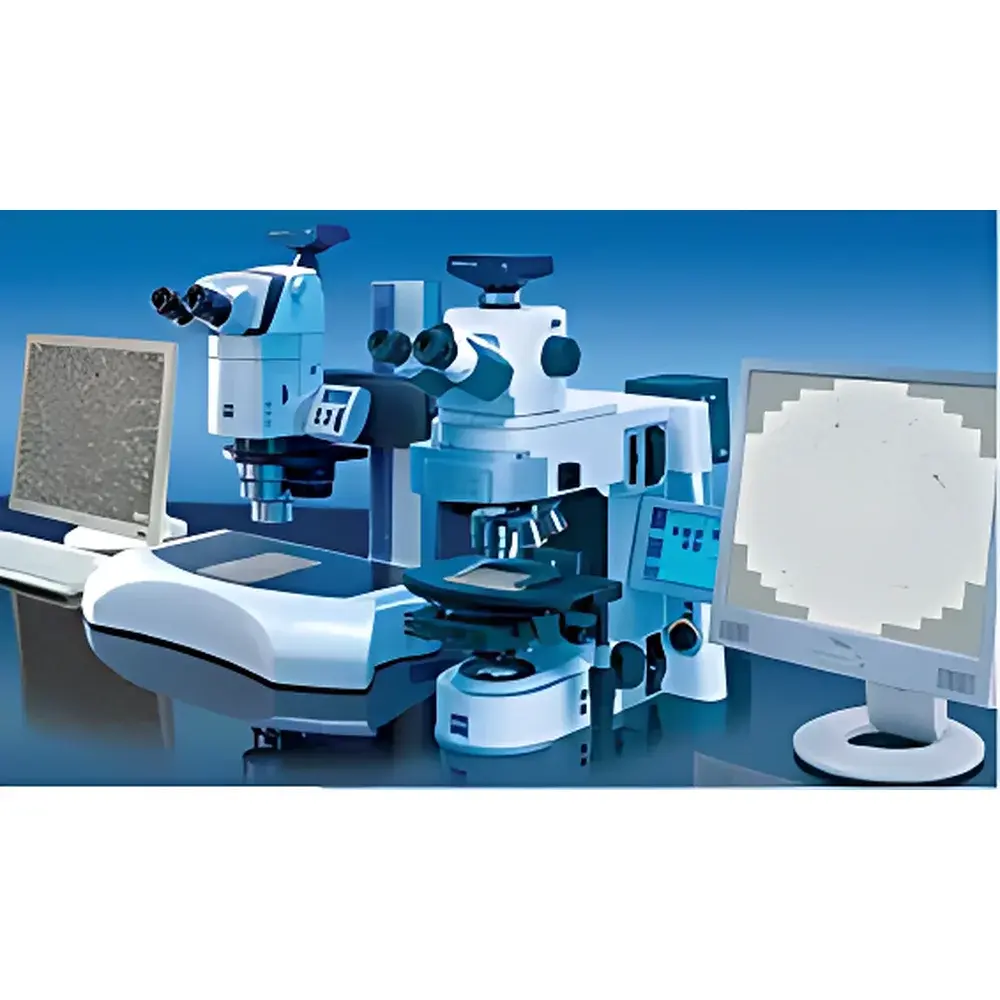
ZEISS Particle Analyzer Automated Oil Contamination and Wear Debris Analysis System
| Brand | ZEISS |
|---|---|
| Origin | Germany |
| Model | Particle Analyzer |
| Particle Detection Range | 1 µm – 1000 µm |
| Compliance Standards | ISO 4406, NAS 1638, GB/T 14039, SAE AS749D, GJB 420A/B, DL/T 1096, JBT 9737.1 |
| Sample Preparation Method | Membrane filtration (50 mm diameter) |
| Imaging Technology | High-resolution optical microscopy with automated tile scanning and morphological classification |
| Software Features | Automated particle recognition, size/shape parameter extraction (equivalent circular diameter, aspect ratio, roundness), statistical distribution analysis, multi-standard grading, audit trail support |
| Regulatory Alignment | Designed for GLP/GMP environments |
Overview
The ZEISS Particle Analyzer is an advanced, fully automated oil contamination and wear debris analysis system engineered for precision condition monitoring of industrial lubricants and hydraulic fluids. Unlike conventional laser-based particle counters that provide only volumetric or projected-area counts, this system employs high-magnification optical microscopy coupled with intelligent image analysis to deliver morphologically resolved particle data — including individual particle images, size distributions, aspect ratios, roundness, and material-classified identification (metallic vs. non-metallic). Its core measurement principle relies on standardized membrane filtration (50 mm diameter), followed by automated stage navigation, focus stacking, and multi-field mosaic imaging — ensuring statistically representative sampling across the entire filter surface. The system directly addresses the ISO 4406 and NAS 1638 contamination grading frameworks while extending analysis into root-cause diagnostics: distinguishing between fatigue spalls, cutting wear, sliding wear, corrosion products, and environmental contaminants such as silica or fiber. This capability transforms routine oil analysis from a pass/fail compliance check into a predictive maintenance enabler.
Key Features
- Integrated optical platform: ZEISS upright materials microscope with motorized XYZ stage, high-NA objectives (up to 100×), and LED Köhler illumination optimized for contrast-rich particle imaging.
- Automated tile-scan acquisition: Full 50 mm filter coverage via programmable grid navigation, with real-time autofocus and exposure optimization per field.
- Morphology-driven classification engine: Machine learning–assisted segmentation distinguishes ferrous/non-ferrous metals, oxides, polymers, fibers, and water droplets — eliminating false positives from condensation or emulsified moisture.
- Multi-parameter quantification: Outputs include particle count per ISO/NAS size bins, cumulative and differential size distributions, length-width histograms, aspect ratio profiles, and circularity indices.
- Calibration traceability: Pre-installed NIST-traceable calibration slides and auto-validation routines ensure measurement consistency across instruments and laboratories.
- Modular hardware architecture: Supports optional polarization filters, darkfield illumination, and fluorescence modules for enhanced material differentiation.
Sample Compatibility & Compliance
The Particle Analyzer accepts all standard oil types used in critical rotating and hydraulic equipment: mineral- and synthetic-based lubricants, turbine oils, transformer (insulating) oils, gear oils, aviation fuels (Jet A-1, JP-8), water-glycol and phosphate ester hydraulic fluids, and polymer solutions. It complies with international standards governing particulate contamination assessment — including ISO 4406:2022 (fluid cleanliness codes), NAS 1638 Class Code, GB/T 14039 (China national standard), SAE AS749D (aerospace fluid cleanliness), GJB 420A/B (military hydraulic fluid specifications), and DL/T 1096 (power industry transformer oil testing). All analytical workflows adhere to Good Laboratory Practice (GLP) requirements, with full electronic audit trails, user access controls, and electronic signature support aligned with FDA 21 CFR Part 11 for regulated industries.
Software & Data Management
ZEISS ParticleAnalyzer Software v3.x provides a validated, secure desktop environment for acquisition, processing, reporting, and long-term data archiving. The software features role-based user permissions, configurable report templates (PDF/Excel), batch processing queues, and trend analysis dashboards. Raw image datasets are stored in TIFF format with embedded EXIF metadata (magnification, exposure, stage coordinates, filter ID). Each analysis session generates a structured XML log containing instrument configuration, calibration status, operator ID, timestamp, and full particle-by-particle attribute tables. Data export supports LIMS integration via ASTM E1384-compliant HL7 messaging or direct SQL database push. Audit trail records capture all user actions — including parameter edits, result overrides, and report generation events — with immutable timestamps and digital signatures.
Applications
This system serves as a primary diagnostic tool in asset-intensive sectors where unplanned downtime carries high operational risk. In aerospace MRO facilities, it validates hydraulic fluid cleanliness pre-flight and correlates wear debris morphology with bearing raceway damage patterns. Power generation plants deploy it for transformer oil surveillance, identifying cellulose degradation particles versus metallic wear from tap changers. Wind turbine operators use it to detect early-stage gearbox wear before vibration signatures emerge. Marine propulsion systems leverage its ability to distinguish salt crystal contamination from cylinder liner scuffing debris. In semiconductor manufacturing, it verifies purity of dielectric cooling fluids used in EUV lithography tools. Beyond oil, the platform analyzes insoluble particulates in pharmaceutical suspensions, battery electrolytes, and polymer melt streams — wherever morphological fidelity informs process control decisions.
FAQ
What particle detection principle does the ZEISS Particle Analyzer use?
It uses high-resolution optical microscopy combined with automated digital image analysis — not laser obscuration or light scattering — enabling morphological characterization alongside counting.
Can the system differentiate between ferrous and non-ferrous wear particles?
Yes. Using integrated brightfield/darkfield imaging, reflectance contrast, and optional polarization, the software classifies particles by material origin with >92% accuracy against reference libraries.
Is method validation documentation available for regulatory submissions?
Yes. ZEISS provides IQ/OQ/PQ protocols, system suitability test procedures, and validation reports compliant with ISO/IEC 17025 and ASTM D7690.
How does the system handle water droplets or air bubbles during analysis?
Water droplets are excluded via refractive index filtering and dynamic focus profiling; air bubbles are rejected based on edge curvature and lack of internal texture.
Does the software support custom contamination grading rules?
Yes. Users may define proprietary size bins, weighting factors, and pass/fail logic — with version-controlled rule sets archived alongside raw data.






