
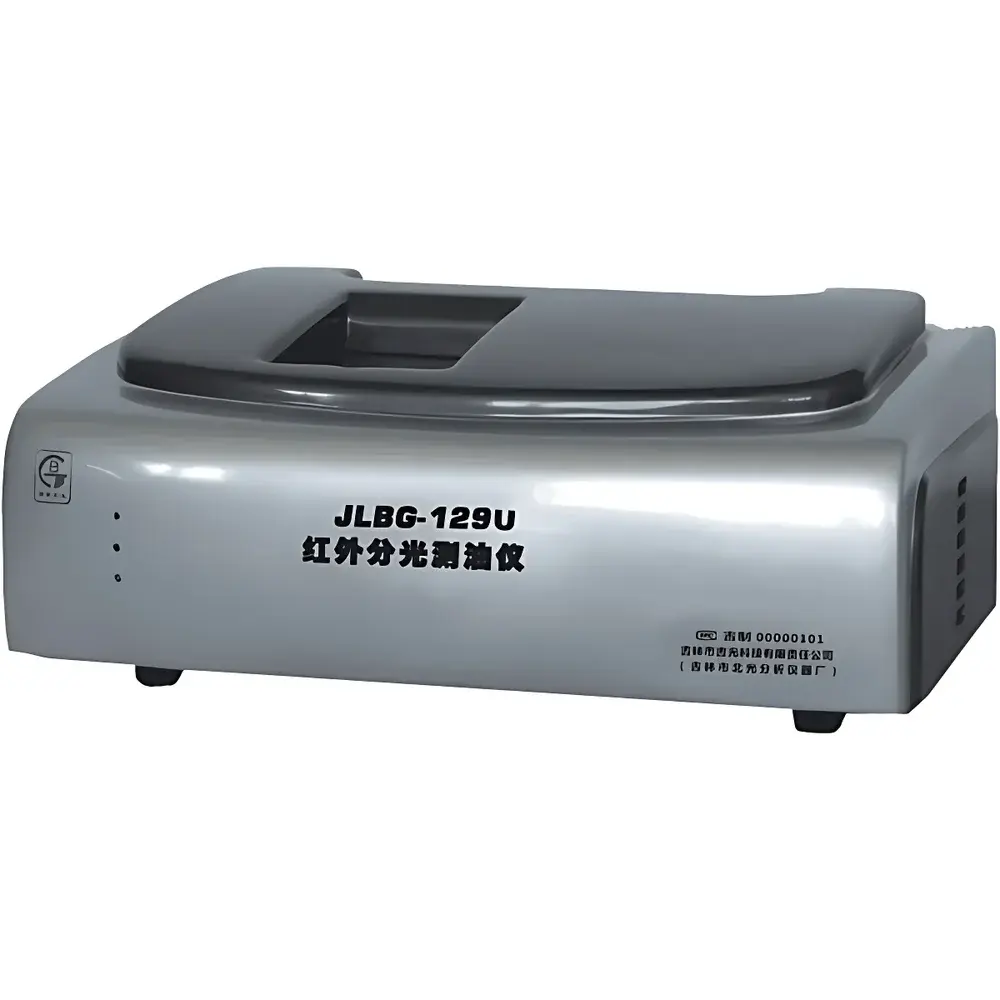
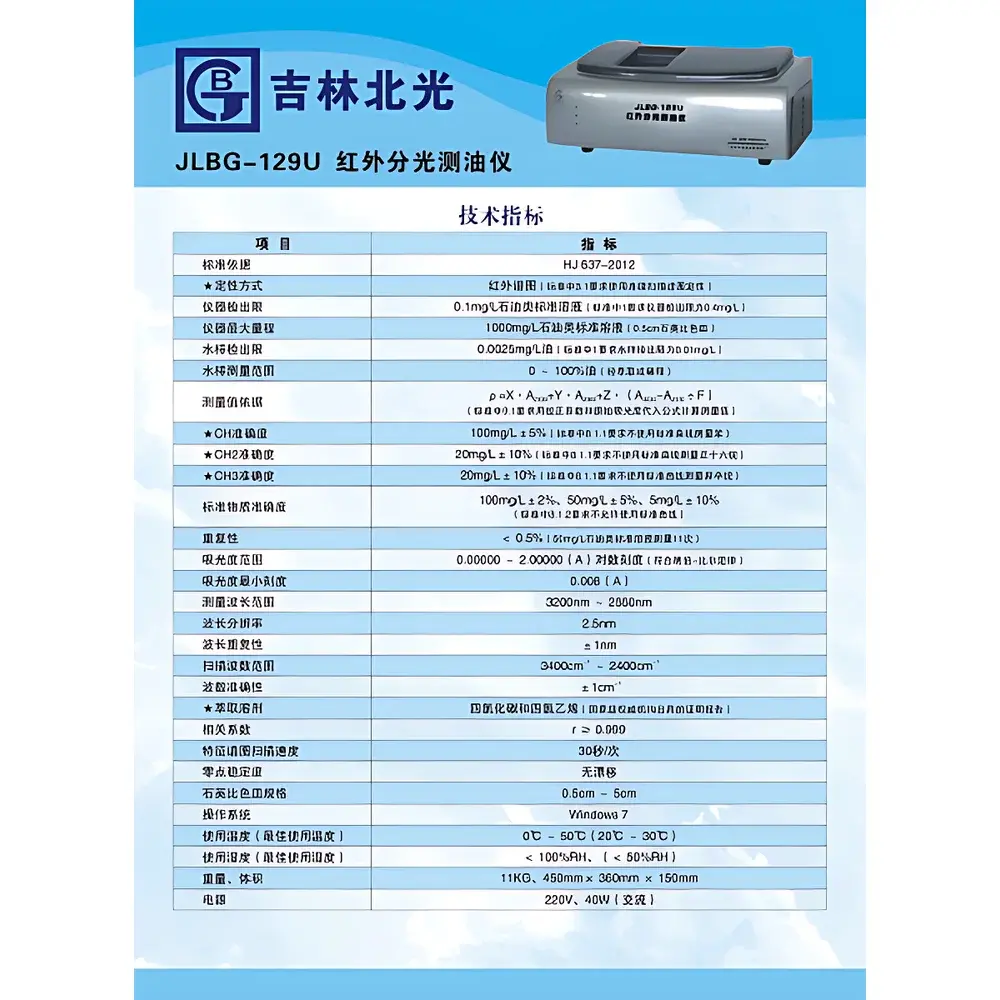
Beiguang JLBG-129U Infrared Spectrophotometric Oil Content Analyzer
| Brand | Beiguang |
|---|---|
| Origin | Jilin, China |
| Manufacturer Type | Authorized Distributor |
| Product Origin | Domestic (China) |
| Model | JLBG-129U |
| Instrument Type | Laboratory Benchtop Analyzer |
| Measurement Principle | Fourier Transform Infrared (FTIR) Spectrophotometry |
| Measurement Range | 0 mg/L – 100% oil (w/w or v/v, matrix-dependent) |
| Detection Limit | 0.2 mg/L (as petroleum hydrocarbons in water) |
| Accuracy | ±10% (relative error vs. certified reference materials) |
| Spectral Resolution | 0.1 ppm (mass concentration resolution at 4 cm⁻¹ spectral resolution) |
| Analysis Cycle Time | 75 seconds per sample |
Overview
The Beiguang JLBG-129U Infrared Spectrophotometric Oil Content Analyzer is a laboratory-grade instrument engineered for precise quantification of total petroleum hydrocarbons (TPH) and aromatic hydrocarbon fractions in aqueous environmental samples. It operates on the principle of mid-infrared absorption spectroscopy—specifically targeting characteristic vibrational bands at 2930 cm⁻¹ (CH₂ asymmetric stretch), 2960 cm⁻¹ (CH₃ asymmetric stretch), and 3030 cm⁻¹ (aromatic C–H stretch)—in full-spectrum scanning mode. Unlike non-dispersive infrared (NDIR) instruments, the JLBG-129U acquires continuous absorbance spectra across the 2800–3100 cm⁻¹ region, enabling both quantitative analysis and qualitative spectral verification. This capability ensures robust discrimination between true petroleum hydrocarbons and interferents such as alcohols (e.g., methanol, ethanol), ketones, or chlorinated solvents—critical for regulatory compliance with HJ 637–2012 and emerging revisions under China’s Ministry of Ecology and Environment (MEE). The system supports dual solvent compatibility (tetrachloroethylene and legacy carbon tetrachloride protocols), aligning with international phase-out timelines under the Montreal Protocol while maintaining backward compatibility during method transition.
Key Features
- Full-spectrum FTIR acquisition (4 cm⁻¹ resolution) with real-time spectral display—enabling interference identification and spectral validation per HJ 637–2012 Section 7.2.
- Dual-solvent extraction pathway support: compliant with both tetrachloroethylene (PERC)-based workflows (MEE-recommended replacement) and carbon tetrachloride (CTC) protocols (for legacy data continuity).
- Direct calculation engine implementing the HJ 637–2012 Equation (9.1): ρ = X·A2930 + Y·A2960 + Z·(A3030 − A3030/F), eliminating reliance on single-component calibration curves and mitigating matrix-induced bias in heterogeneous oil mixtures.
- Optomechanically stabilized monochromator using precision worm-gear drive—reducing wavelength drift to <0.05 cm⁻¹ over 8-hour operation, critical for long-term reproducibility in multi-batch monitoring.
- Verified instrumental detection limit of 0.2 mg/L (measured against NIST-traceable petroleum hydrocarbon standards), satisfying the derived instrument-level LOD requirement of 0.4 mg/L specified in HJ 637–2012 for 1000 mL sample / 25 mL extract / 4 cm pathlength configurations.
- Aromatic-specific quantification validated per HJ 637–2012 Section 8.1.1: accurate response to 100 mg/L benzene and toluene standards at 3030 cm⁻¹, ensuring reliable assessment of high-toxicity, high-volatility fractions in industrial effluents.
Sample Compatibility & Compliance
The JLBG-129U is validated for use with liquid-phase extracts from surface water, groundwater, wastewater, and leachate matrices following EPA Method 1664 (modified), ISO 9377-2:2000, and China’s HJ 637–2012. It complies with MEE Technical Guidelines for Petroleum Hydrocarbon Monitoring (2021 Edition) and supports audit-ready documentation for GLP environments. While not FDA 21 CFR Part 11-certified out-of-the-box, its data export architecture (CSV, XML, PDF reports) enables integration into validated LIMS platforms meeting ISO/IEC 17025:2017 requirements for testing laboratories. All spectral raw data are stored with timestamped metadata, including operator ID, solvent lot number, cuvette pathlength, and ambient temperature—facilitating traceability during regulatory inspections.
Software & Data Management
The embedded Windows-based control software provides spectral visualization, peak annotation, baseline correction, and automatic band integration. Quantitative results are generated exclusively via the HJ 637–2012 algorithm—no user-adjustable curve-fitting or polynomial regression modules are present, preventing method deviation. Audit logs record all parameter changes, calibration events, and report generations with immutable timestamps. Data export supports UTF-8 encoded CSV for statistical analysis in R or Python, and structured XML for interoperability with enterprise environmental data management systems (EDMS). Firmware updates are delivered via signed USB firmware packages, preserving cryptographic integrity.
Applications
- Regulatory monitoring of petroleum hydrocarbons in municipal and industrial wastewater discharge points (per GB 8978–1996 and local emission standards).
- Groundwater remediation site assessment, including plume delineation and treatment efficacy verification.
- Refinery, petrochemical, and steel mill effluent characterization—with emphasis on aromatic fraction quantification for hazard classification.
- Environmental laboratory accreditation (CNAS, CMA) where full-spectrum transparency and method fidelity are mandatory for proficiency testing.
- Research applications requiring spectral fingerprinting of weathered oils, biodiesel blends, or microplastic-associated hydrocarbons.
FAQ
Why does this instrument not support standard curve calibration?
HJ 637–2012 explicitly prohibits empirical calibration curves for petroleum hydrocarbon analysis due to structural heterogeneity across real-world samples. The JLBG-129U implements only the statutory calculation formula, ensuring legal defensibility in enforcement contexts.
Can the instrument distinguish benzene from other hydrocarbons?
Yes—its high-fidelity spectral resolution at 3030 cm⁻¹ enables selective quantification of aromatic C–H stretch, validated against 100 mg/L benzene and toluene standards per HJ 637–2012 Section 8.1.1.
Is tetrachloroethylene (PERC) fully supported without hardware modification?
Yes—the optical path and solvent handling module are pre-configured for PERC’s refractive index and absorption profile; no recalibration or alignment is required when switching from CTC.
What is the basis for the 0.2 mg/L detection limit claim?
This is an experimentally verified instrumental LOD: the lowest concentration of NIST SRM 2781 (petroleum hydrocarbon standard) consistently yielding signal-to-noise ≥3 across ≥10 replicate measurements under defined extraction conditions.
Does the worm-gear monochromator require periodic maintenance?
No scheduled lubrication or adjustment is required; the sealed, self-aligning worm-gear assembly is rated for >50,000 scan cycles with <0.1% wavelength repeatability drift over two years under ISO 17025 environmental controls.
Related Products







