
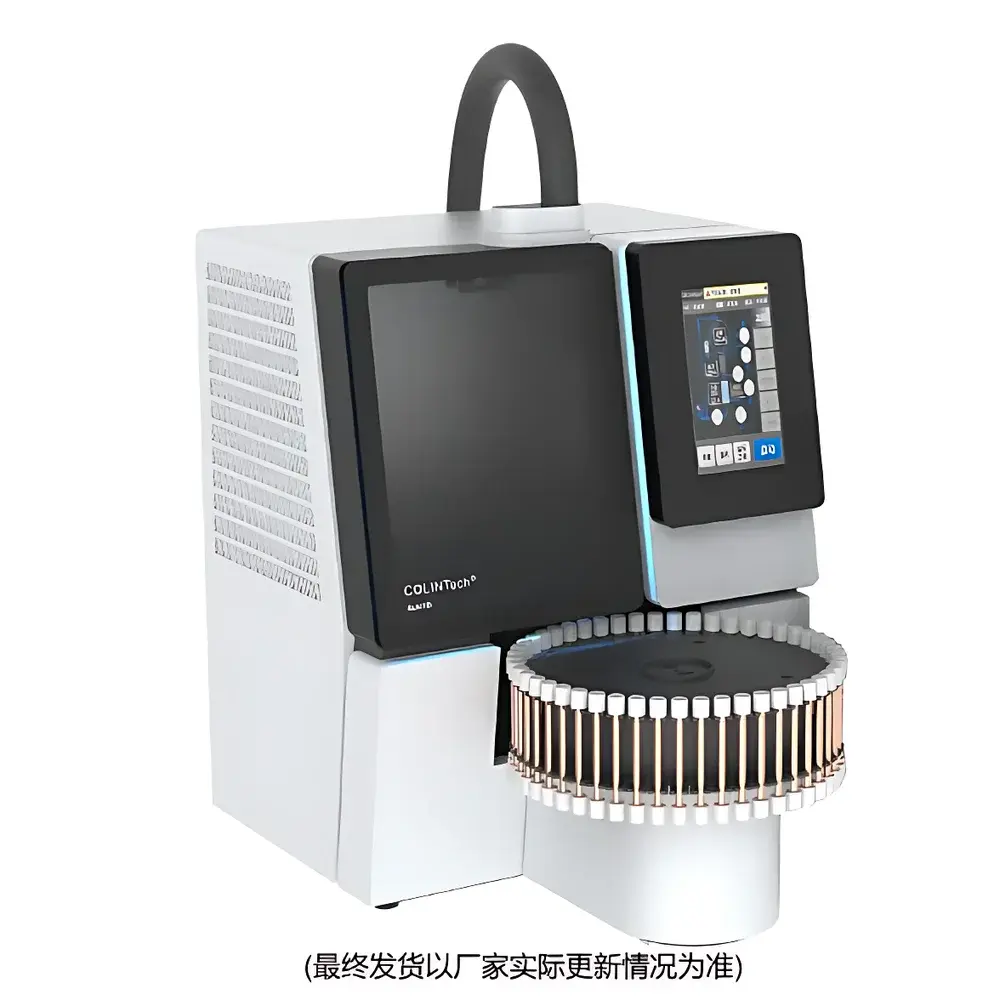
ColinTech AutoTD A Automated Thermal Desorber
| Brand | ColinTech |
|---|---|
| Origin | Sichuan, China |
| Manufacturer Type | Original Equipment Manufacturer (OEM) |
| Product Category | Domestic |
| Model | AutoTD A |
| Instrument Type | Dual-Stage Thermal Desorber |
| Automation Level | Fully Automated |
| Primary Desorption Temperature Range | 50–400 °C |
| Secondary Desorption Temperature Range | −40–400 °C |
| Valve Injection Zone Temperature Range | 50–300 °C |
| Transfer Line Temperature Range | 50–300 °C |
| Cryo-Trap Temperature Range | −40–400 °C |
| Temperature Control Accuracy | < ±0.1 °C |
| Desorption Recovery Rate | 99.5% |
| Sample Capacity | 50 positions |
| Method Storage | 10 user-defined methods |
| Sample Recovery Function | Yes (≥90% recovery efficiency) |
| Leak Test & Moisture Purge | Automatic |
| Cap Handling | Automated cap removal and resealing |
| Optional Accessories | Electronic Pressure Control (EPC), Electronic Flow Control (EFC) |
Overview
The ColinTech AutoTD A is a fully automated, dual-stage thermal desorber engineered for high-throughput, trace-level volatile organic compound (VOC) and semi-volatile organic compound (SVOC) analysis in environmental, forensic, occupational health, and materials testing laboratories. It operates on the principle of thermally driven analyte release from sorbent tubes followed by cryofocusing and rapid transfer to gas chromatography (GC) or GC–mass spectrometry (GC–MS) systems. The instrument employs two independent thermal desorption stages: primary desorption heats the sample tube uniformly via patented 360° cylindrical heating technology—ensuring complete, reproducible analyte release without channeling or thermal gradient artifacts; secondary desorption utilizes a precisely controlled cryo-trap (−40 °C to 400 °C) coupled with hot-gas flash desorption, delivering narrow, symmetrical chromatographic peaks and sub-ng sensitivity. Its architecture supports unattended operation over extended periods, making it suitable for compliance-driven workflows requiring GLP/GMP traceability and regulatory method adherence (e.g., EPA TO-17, ASTM D6196, ISO 16017-1).
Key Features
- Patented 360° circumferential tube heating for uniform thermal energy distribution and quantitative desorption across all sorbent bed depths.
- Dual-stage desorption with independently programmable temperature zones: primary furnace (50–400 °C), cryo-trap (−40–400 °C), valve manifold (50–300 °C), and transfer line (50–300 °C).
- Automated 50-position sample carousel with integrated cap handling—cap removal, desorption, recapping, and tube indexing performed without manual intervention.
- Onboard automatic leak verification and moisture purge cycles prior to each run, minimizing baseline drift and carryover risk.
- Integrated sample recovery capability: target analytes can be reconcentrated into original or new tubes for reanalysis, calibration verification, or archival—recovery efficiency ≥90%.
- Electronic pressure and flow control (optional EPC/EFC modules) enable precise carrier gas regulation, critical for retention time stability and method transfer between instruments.
- Method library supporting up to 10 stored protocols; sequence-based batch processing with customizable hold times, ramp rates, and cooling steps.
- Temperature control accuracy better than ±0.1 °C across all zones—essential for inter-laboratory reproducibility and ISO/IEC 17025-compliant validation.
Sample Compatibility & Compliance
The AutoTD A accommodates standard 6 mm OD × 89 mm length stainless steel or quartz sorbent tubes (e.g., Tenax TA, Carbopack B/C, Carboxen 1000), as well as multi-bed configurations per EPA TO-17 specifications. It complies with key regulatory frameworks governing VOC analysis, including U.S. EPA Methods TO-11A, TO-14A, and TO-17; ISO 16017-1 for indoor air; and ASTM D6196 for ambient air monitoring. All thermal zones meet IEC 61000-4 electromagnetic compatibility standards. Data integrity features—including audit-trail-enabled method editing, user access levels, and timestamped run logs—support alignment with FDA 21 CFR Part 11 requirements when paired with compliant LIMS or GC data systems.
Software & Data Management
The instrument is operated via a dedicated Windows-based control interface supporting real-time temperature monitoring, method sequencing, and event logging. All parameters—including setpoints, actual temperatures, valve actuation timestamps, and pressure/flow readings—are recorded at 1 Hz resolution and exported in CSV or ASCII format for post-processing. The software allows creation of audit-ready reports containing system suitability checks (e.g., blank response, recovery spikes, carryover assessment) and supports IQ/OQ documentation templates aligned with ISO/IEC 17025 and GxP laboratory accreditation requirements.
Applications
- Environmental monitoring: ambient air, stack emissions, soil headspace, and indoor air quality (IAQ) studies per EPA and EU directives.
- Forensic toxicology and arson investigation: detection of accelerants (e.g., gasoline, kerosene markers) in fire debris samples.
- Materials emissions testing: VOC screening of automotive interiors, building products, and packaging per ISO 12219 and VDA 278.
- Pharmaceutical residual solvent analysis: trace-level quantification in drug substances and excipients following ICH Q3C guidelines.
- Occupational hygiene: personal and area sampling for OSHA- and NIOSH-listed compounds (e.g., benzene, formaldehyde, styrene).
FAQ
Can the AutoTD A be interfaced with third-party GC or GC–MS systems?
Yes—it provides standardized analog and digital I/O ports (RS-232, Ethernet, dry contact triggers) compatible with all major GC vendors (Agilent, Thermo Fisher, Shimadzu, PerkinElmer) and supports both split and splitless injection modes.
What sorbent tube types are validated for use with this instrument?
The system is validated for single- and multi-bed tubes meeting ASTM D6196 and EPA TO-17 specifications, including Tenax TA, Carbopack B/C, Carboxen 1000, and graphitized carbon black (GCB) combinations.
Does the instrument support method validation according to ISO/IEC 17025?
Yes—its temperature stability (<±0.1 °C), automated leak/moisture checks, full parameter logging, and audit-trail-capable software facilitate method validation, uncertainty estimation, and proficiency testing reporting.
Is remote monitoring and control possible?
Remote desktop access and secure VPN-based operation are supported through the host PC; however, no native cloud platform is embedded—the system is designed for local network integration within regulated lab IT infrastructure.
How is carryover minimized during high-concentration sample analysis?
Carryover mitigation is achieved through integrated bake-out cycles (up to 400 °C for trap and lines), automated blank runs, and optional inert surface treatments on critical flow paths.
Related Products





