
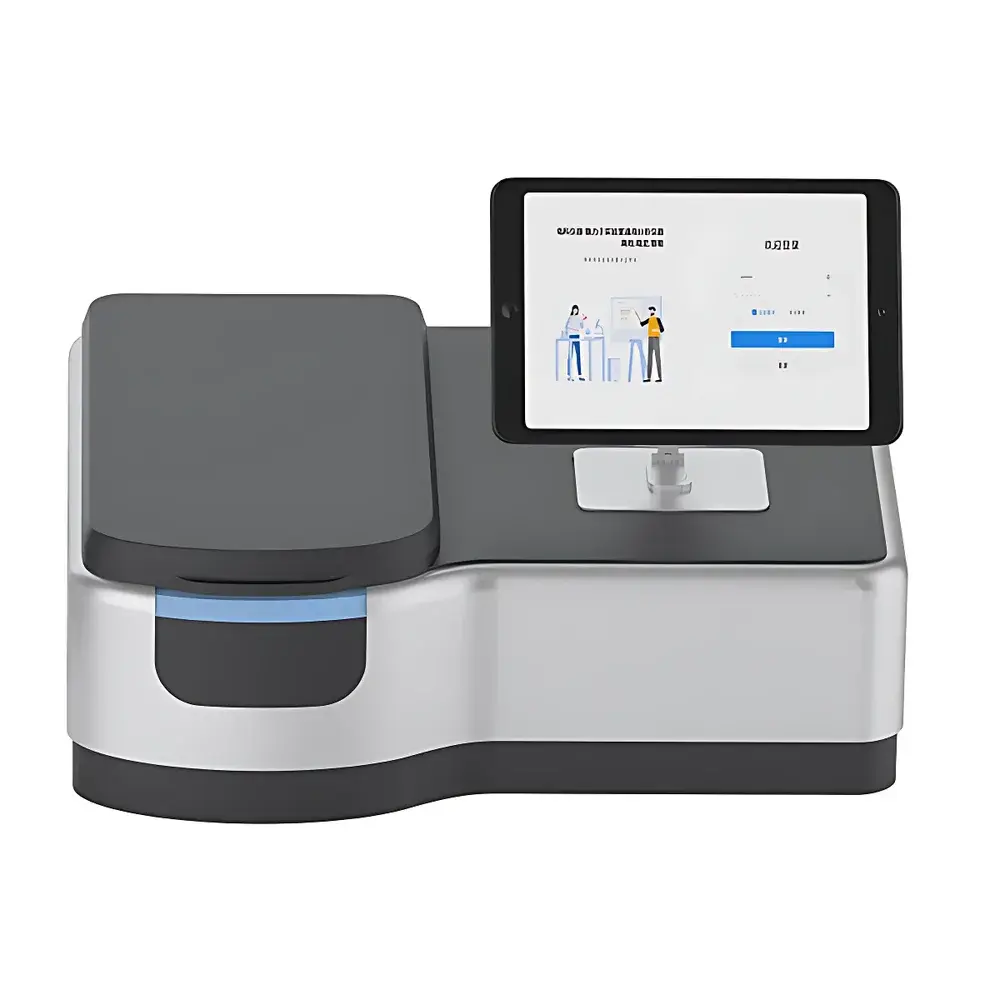
Luban Instruments M900 Dual-Beam UV-Vis Spectrophotometer with Xenon Lamp
| Brand | Yoke |
|---|---|
| Origin | Shanghai, China |
| Manufacturer Type | Direct Manufacturer |
| Instrument Architecture | Dual-Beam |
| Detector Type | Photodiode Array (PDA) |
| Wavelength Range | 190–1100 nm |
| Automation Level | Automatic Wavelength Scanning |
| Display | 11-inch 2.8K Resolution Tablet PC |
| Optical System | Dual-beam with Integrated Reference Detector |
| Light Source | Pulsed Xenon Lamp |
| Photometric Range | –4 to +4 Abs |
| Photometric Resolution | 0.00001 Abs |
| Spectral Bandwidth | 1 nm |
Overview
The Luban Instruments M900 is a high-performance dual-beam ultraviolet-visible (UV-Vis) spectrophotometer engineered for precision absorbance, transmittance, and reflectance measurements across the full spectral range of 190–1100 nm. Utilizing a pulsed xenon lamp as its broadband light source, the M900 eliminates the need for lamp replacement during routine operation and ensures stable spectral output without warm-up delay—critical for laboratories requiring rapid, repeatable analysis across diverse sample types. Its dual-beam optical architecture continuously monitors and corrects for source intensity drift and environmental fluctuations by splitting the beam into sample and reference paths, each measured simultaneously by a high-density photodiode array (PDA) detector. This design delivers exceptional baseline stability and photometric accuracy, with a resolution of 0.00001 Abs and a photometric range spanning –4 to +4 Abs—enabling reliable quantification of highly concentrated or dilute analytes in compliance with ISO 6425, ASTM E275, and USP spectrophotometric validation guidelines.
Key Features
- Dual-beam optical configuration with integrated reference-channel monitoring for real-time compensation of lamp intensity drift and ambient thermal effects.
- Pulsed xenon lamp providing continuous spectral coverage from deep UV (190 nm) to near-infrared (1100 nm), eliminating spectral discontinuities associated with deuterium/halogen lamp switching.
- 11-inch 2.8K-resolution tablet PC interface with intuitive multi-language support (auto-switching between English and Chinese), Bluetooth-enabled wireless connectivity, and responsive touch-based navigation.
- Advanced real-time diagnostics: system self-check at startup, dynamic error logging, and automated alerting via email or SMS upon detection of optical misalignment, detector saturation, or calibration deviation.
- High-fidelity data acquisition with 1 nm spectral bandwidth and sub-millisecond wavelength scanning speed, supporting kinetic studies with time resolution down to 100 ms per spectrum.
Sample Compatibility & Compliance
The M900 accommodates a broad spectrum of sample formats through its modular accessory ecosystem—including automatic 8-position cuvette changers, temperature-controlled cell holders (±0.1 °C stability), integrating spheres for diffuse reflectance and total transmittance, variable-pathlength cells (0.1–100 mm), and adjustable-angle solid-sample stages for anisotropic material characterization. All optical components comply with RoHS Directive 2011/65/EU and CE marking requirements. Software firmware supports audit trail generation, electronic signature capability, and user-access-level controls aligned with FDA 21 CFR Part 11 and EU Annex 11 for regulated environments. Routine performance verification follows NIST-traceable standards (e.g., SRM 930e for photometric accuracy, SRM 2034 for wavelength calibration).
Software & Data Management
The embedded software platform provides native support for all standard UV-Vis measurement modes: photometric mode (A/T/%T), quantitative analysis (single/multi-point calibration, equation-based concentration calculation), kinetic assays, full-spectrum scanning, multi-wavelength quantitation, 3D contour mapping (wavelength × time × absorbance), and dedicated nucleic acid/protein analysis workflows (including A260/A280 ratio, extinction coefficient-based quantification, and buffer blank subtraction). Data export is compatible with CSV, TXT, and JCAMP-DX formats; raw spectra and metadata are stored with timestamp, operator ID, instrument serial number, and environmental sensor readings (ambient temperature/humidity). Local backup and network synchronization options ensure GLP-compliant data integrity and long-term archival.
Applications
The M900 serves as a core analytical tool in pharmaceutical QC labs for assay validation and excipient interference screening; in academic research for enzyme kinetics, ligand-binding studies, and nanoparticle plasmon resonance characterization; in environmental testing for COD, nitrate, phosphate, and heavy metal speciation; and in food & beverage QA for colorimetric pigment quantification and adulterant detection. Its robustness in handling turbid suspensions, colored matrices, and low-volume microsamples—enabled by optional fiber-optic probes and reflection accessories—extends utility beyond conventional cuvette-based analysis.
FAQ
Does the M900 require lamp alignment or manual wavelength calibration during routine use?
No. The pulsed xenon lamp operates without mechanical alignment, and the built-in holmium oxide and neutral density reference standards enable automated wavelength and photometric calibration prior to each measurement sequence.
Is the tablet interface replaceable or upgradable in the field?
Yes—the 11-inch tablet is a modular component secured via standardized M.2 interface and can be replaced or upgraded without optical recalibration.
Can the M900 be integrated into a LIMS environment?
Yes. It supports ASTM E1384-compliant data exchange protocols and offers optional OPC UA server integration for seamless bidirectional communication with enterprise laboratory information management systems.
What is the maximum sampling rate for kinetic measurements?
Up to 10 spectra per second under fixed-wavelength mode, or 1 spectrum every 100 ms across a 200-nm scan range with 1-nm step resolution.
Are method files exportable between M900 units?
Yes—all methods, including custom calibration curves, kinetic parameters, and report templates, are stored in portable .mth binary format and fully interoperable across identical firmware versions.




