
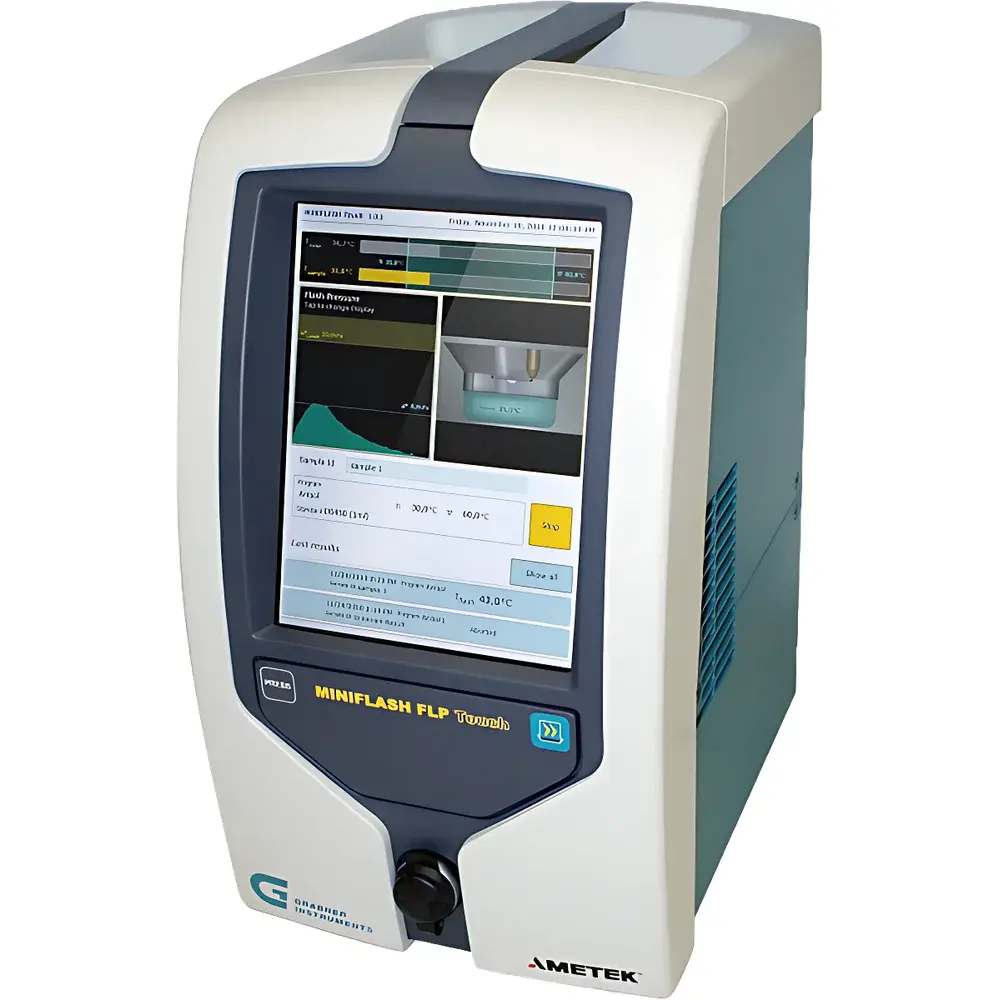
Grabner MiniFlash Touch FLP/FLPH Automated Flash Point Tester with Color Touchscreen
| Brand | Grabner |
|---|---|
| Origin | Austria |
| Model | MiniFlash Touch FLP / FLPH |
| Detection Method | Continuously Closed Cup (CCCP) / Modified Continuously Closed Cup (MCCCFP) |
| Temperature Range | 0–200°C (FLP) / 0–400°C (FLPH) |
| Sample Volume | 1–2 mL |
| Compliance | ASTM D6450, ASTM D7094, ASTM D93, EN ISO 2719, EN ISO 3679, EN ISO 3680, ISO 13736, IP 170, USP <467>, GLP/GMP-ready |
| Interface | USB, Ethernet, LIMS, PC, Remote Control via LAN/WAN |
| Power Supply | 100–230 V AC, 50/60 Hz, 150 W or 12 V DC (8 A) for field use |
| Dimensions | 253 × 368 × 277 mm |
| Weight | 12 kg |
Overview
The Grabner MiniFlash Touch FLP/FLPH is an automated, fully compliant flash point tester engineered for precision, safety, and regulatory traceability in petroleum, chemical, pharmaceutical, and transportation safety laboratories. It operates on Grabner’s proprietary Continuously Closed Cup (CCCP) principle—now standardized as ASTM D7094 (Modified Continuously Closed Cup Flash Point Test Method). Unlike open-cup or traditional closed-cup methods requiring manual ignition and large sample volumes, the MiniFlash Touch detects flash point by monitoring transient pressure spikes within a hermetically sealed 7-mL aluminum test cup during high-energy electric arc ignition. This non-invasive, flameless detection mechanism eliminates vapor loss, prevents operator exposure to hazardous vapors, and ensures full compliance with OSHA, ATEX, and IECEx safety guidelines. The instrument’s Peltier-based thermoelectric heating and cooling system enables rapid thermal ramping (up to 15°C/min) and precise temperature control (±0.1°C), supporting repeatable measurements across its full operational range—from sub-ambient conditions (with optional external chiller) up to 400°C. Its architecture meets stringent GLP and GMP requirements, including user-level access control, electronic audit trails, and raw data immutability—all essential for FDA 21 CFR Part 11–compliant environments.
Key Features
- Proprietary CCCP/MCCCFP methodology per ASTM D7094 and ASTM D6450—validated for statistical equivalence to ASTM D93 (Pensky-Martens), EN ISO 2719, and ISO 13736
- True closed-system operation: no lid opening, no flame exposure, zero sample evaporation or light-end loss
- Ultra-low sample consumption: only 1–2 mL per test—critical for high-value, hazardous, or limited-availability samples (e.g., biodiesel blends, fragrance concentrates, post-use lubricants)
- Integrated combustion curve analysis: real-time graphical display of pressure vs. temperature profiles to identify trace flammable contaminants (e.g., diesel in lube oil, methanol in FAME)
- Go/No-Go mode and programmable dilution curves for rapid pass/fail screening and fuel contamination quantification
- Full remote operation via Ethernet or Wi-Fi: compatible with LIMS, ELN, and centralized lab management systems
- Robust portable design (12 kg, battery-powered option) certified for field deployment—including military applications (U.S. Navy, NATO)
- Automated cleaning cycle and self-diagnostic routines ensure long-term method integrity and minimal maintenance downtime
Sample Compatibility & Compliance
The MiniFlash Touch supports diverse sample matrices beyond conventional hydrocarbons—including polar solvents (ethanol, IPA, glycerol), biofuels (FAME, B100, hydrotreated esters), emulsions, viscous residues (asphalt, sludge), semi-solids (greases, filter cakes), and multicomponent waste streams. Its wide dynamic range and adaptive thermal control accommodate volatile low-flash materials (e.g., gasoline-contaminated diesel) and high-boiling fractions (e.g., residual fuel oils) without method reconfiguration. Regulatory alignment extends across global transport and classification frameworks: EN ISO 3679 (flash point for classification of flammable liquids) and EN ISO 3680 (flash point for determination of fire hazard in transport) are natively embedded. In pharmaceutical manufacturing, it satisfies USP residual solvent testing requirements and supports ICH Q5C stability protocols. All test sequences generate timestamped, digitally signed reports with full metadata (operator ID, calibration status, environmental conditions), satisfying ISO/IEC 17025 accreditation criteria.
Software & Data Management
Running on a dedicated Microsoft Windows® platform, the MiniFlash Touch software provides intuitive touchscreen navigation, multilingual UI support (EN/DE/FR/ES), and seamless integration with enterprise IT infrastructure. Method templates are preconfigured for all major standards—including ASTM D7094, EN ISO 3679, and custom Go/No-Go thresholds—and can be locked under administrator privileges to prevent unauthorized modification. Data export options include CSV, PDF, XML, and direct SQL database push. Audit trail functionality logs every user action (login/logout, method edit, result override) with immutable timestamps and digital signatures. The system supports role-based permissions (Administrator, Analyst, Reviewer) and automatic backup to network drives or cloud storage. For regulated environments, full 21 CFR Part 11 compliance is achieved via electronic signature workflows, biometric or token-based authentication, and encrypted local database storage.
Applications
- Petroleum refining & distribution: rapid verification of distillate purity, detection of low-flash contaminants in jet fuel (ASTM D1655), diesel (ASTM D975), and marine fuels (ISO 8217)
- Biodiesel quality assurance: flash point monitoring during transesterification, catalyst removal, and blend homogeneity assessment per ASTM D6751 and EN 14214
- Lubricant condition monitoring: quantification of fuel dilution in engine oils using programmable dilution curves—enabling predictive maintenance and failure root-cause analysis
- Chemical R&D & QC: flash point screening of solvent blends, polymer intermediates, and specialty formulations where sample scarcity or toxicity limits conventional testing
- Regulatory compliance testing: UN TDG, ADR/RID, IMDG Code, and IATA classifications for shipment of flammable goods
- Pharmaceutical manufacturing: residual solvent analysis in APIs and excipients per ICH Q3C guidelines
- Waste characterization: flash point determination of unknown hydrocarbon mixtures, industrial sludges, and recovered solvents per EPA SW-846 Method 1010A
FAQ
How does the MiniFlash Touch achieve higher reproducibility than Pensky-Martens testers?
Its continuously sealed measurement chamber eliminates atmospheric interference, while Peltier-based temperature control delivers ±0.1°C stability and eliminates thermal lag—resulting in ASTM D7094 repeatability of ±3.8°C versus ±4.1°C for ASTM D93 Procedure A.
Can it test samples below ambient temperature?
Yes—when paired with an external recirculating chiller, the FLPH variant maintains stable sub-zero ramping down to –20°C, enabling accurate flash point determination of highly volatile refrigerants or ethyl ether.
Is method validation documentation available for regulatory submissions?
Grabner provides full IQ/OQ/PQ protocols, ASTM round-robin performance data, and ISO 17025-accredited validation reports upon request—supporting FDA, EMA, and MHRA audit readiness.
Does it support unattended batch testing?
With the optional 8-position auto-sampler (MiniFlash FLA/FLAH), up to eight samples can be processed sequentially with full method parameter retention and individual report generation—total cycle time ≤2 minutes.
How is data integrity ensured during network transmission?
All Ethernet communications use TLS 1.2 encryption; LIMS exports are digitally signed and checksum-verified; local database employs AES-256 encryption with hardware-enforced key management.






