
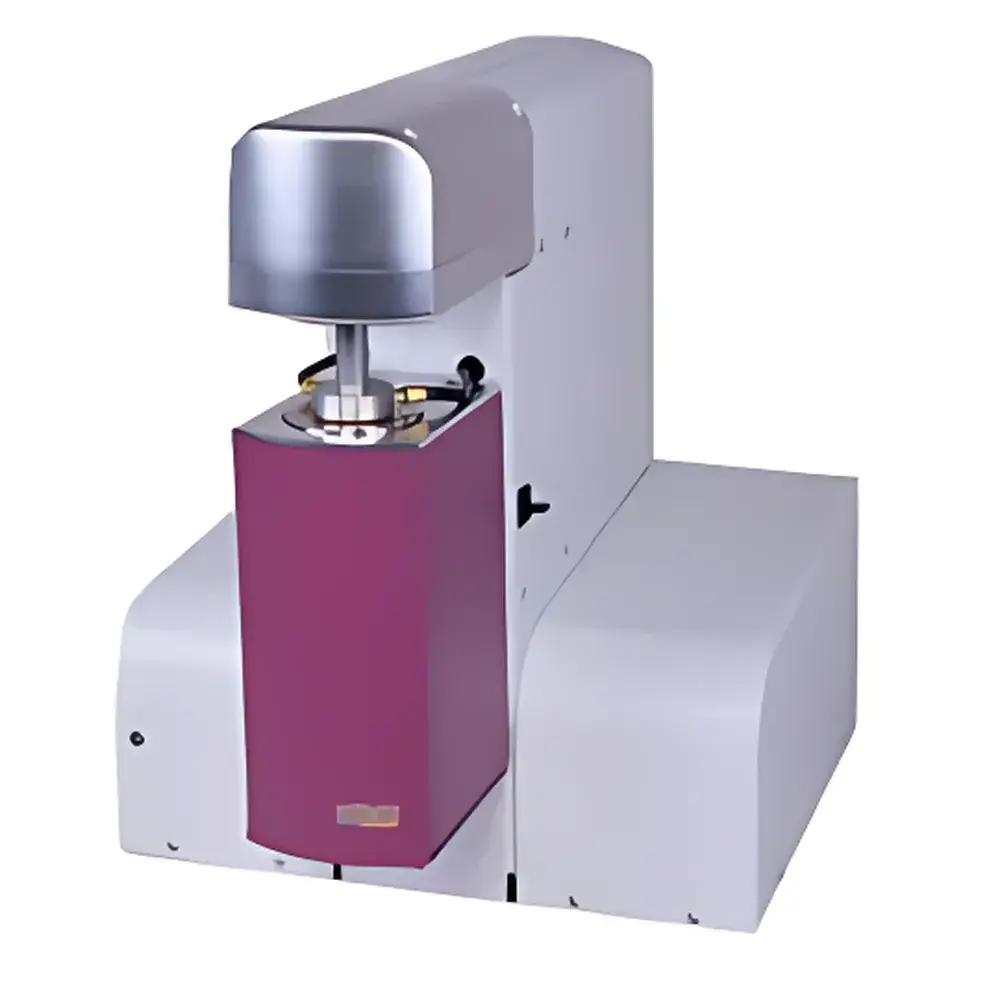
Scinco TGA N-1000/1250/1500 Thermogravimetric Analyzer
| Brand | Scinco |
|---|---|
| Origin | USA |
| Model | TGA N-1000 / TGA N-1250 / TGA N-1500 |
| Temperature Range | Ambient to 1000°C / 1250°C / 1500°C |
| Balance Sensitivity | 0.1 µg |
| Maximum Sample Mass | 400 mg |
| Heating Rate | 0.1–300 °C/min (N-1000/N-1250) or 0.1–60 °C/min (N-1500) |
| Cooling Method | Water-cooled furnace housing |
| Gas Control | 4-channel automated gas switching valve |
| Simultaneous Analysis Compatibility | FT-IR and Quadrupole Mass Spectrometry (EGA-ready) |
| Sample Capacity | Single-sample vertical configuration |
| Compliance | Designed for GLP/GMP environments with audit-trail-capable software |
Overview
The Scinco TGA N-1000/1250/1500 is a high-precision thermogravimetric analyzer engineered for quantitative measurement of mass change as a function of temperature or time under controlled atmospheric conditions. Operating on the fundamental principle of dynamic thermogravimetry, the instrument employs a high-stability vertical microbalance system coupled with a programmable furnace to monitor real-time mass loss or gain during thermal treatment. This enables precise characterization of decomposition kinetics, thermal stability, moisture/volatile content, oxidation behavior, filler loading, and compositional analysis across polymers, ceramics, pharmaceuticals, catalysts, and inorganic materials. The system supports complex multi-step thermal protocols—including sequential heating, cooling, and isothermal holds—making it suitable for both routine quality control and advanced research applications requiring reproducible, traceable thermal data.
Key Features
- Ultra-high-resolution microbalance with 0.1 µg sensitivity, ensuring detection of minute mass changes even in low-mass samples (e.g., thin films or nanocomposites).
- Three configurable furnace variants: N-1000 (up to 1000°C), N-1250 (up to 1250°C), and N-1500 (up to 1500°C), each optimized for thermal stability and uniformity across their respective operating ranges.
- Programmable heating rates from 0.1 to 300 °C/min (N-1000/N-1250) or 0.1 to 60 °C/min (N-1500), enabling both rapid screening and high-resolution kinetic profiling.
- Integrated water-cooling system for rapid furnace cooldown—reducing turnaround time between experiments while protecting sensitive electronics and maintaining long-term calibration integrity.
- Vertical sample geometry with rigid support structure minimizes convection-induced noise and ensures baseline stability during extended isothermal measurements.
- Four-gas automated switching module allows seamless transition among inert (N₂, Ar), oxidative (air, O₂), or reactive atmospheres without manual intervention—critical for comparative degradation studies and ASTM E1131-compliant testing.
- Modular coupling interface compatible with Fourier-transform infrared (FT-IR) spectrometers and quadrupole mass spectrometers (QMS) for evolved gas analysis (EGA), supporting real-time identification of volatile species released during thermal events.
Sample Compatibility & Compliance
The TGA N-series accommodates standard platinum or alumina crucibles (up to 400 mg nominal capacity) and supports diverse sample forms—including powders, granules, fibers, thin films, and small solid pieces—without modification. Its design conforms to key international standards including ASTM E1131 (standard test method for determining weight loss by thermogravimetry), ISO 11358 (plastics — thermogravimetry of polymers), and USP (residual solvents). Data acquisition and reporting modules comply with FDA 21 CFR Part 11 requirements when configured with electronic signatures and audit-trail logging, making the system suitable for regulated pharmaceutical and medical device laboratories operating under GLP or GMP frameworks.
Software & Data Management
Controlled via Scinco’s TA.Windows™ platform, the system provides intuitive experiment setup, real-time visualization of mass vs. temperature/time curves, and synchronized environmental parameter tracking (gas flow, purge status, furnace temperature). All raw data—including balance output, thermocouple readings, and gas switching timestamps—are stored in vendor-neutral ASCII formats for third-party analysis. Built-in analytical tools support derivative thermogravimetry (DTG), peak deconvolution, kinetic modeling (e.g., Ozawa-Flynn-Wall, Kissinger), and multi-curve overlay comparison. Software logs user actions, method parameters, and instrument diagnostics to support full traceability and audit readiness.
Applications
- Determination of polymer degradation onset temperature and char yield (ASTM D3850)
- Quantification of moisture, solvent residues, and filler content in composite materials
- Thermal stability assessment of battery cathode/anode materials under air or argon
- Decomposition pathway analysis of pharmaceutical APIs and excipients
- Oxidation kinetics of metals and alloys (e.g., Fe, Ni-based superalloys)
- Carbon black content in rubber compounds (ISO 6964)
- Residue analysis in ashing protocols for environmental and food safety testing
FAQ
What temperature calibration standards are supported?
The system supports calibration using certified reference materials such as nickel, copper, and calcium oxalate monohydrate per ISO 11358 Annex A.
Can the instrument perform isothermal mass-loss monitoring over extended durations?
Yes—software-defined isothermal holds up to 99 hours are fully supported with continuous mass recording at user-selectable intervals.
Is remote operation possible?
TA.Windows™ supports secure LAN/WAN connectivity; remote access requires firewall configuration and IT-approved authentication protocols.
How is atmosphere purging validated during method execution?
Gas flow rate, pressure differential, and switching sequence are logged in real time; optional mass flow controllers enable closed-loop purge verification.
Does the system meet requirements for regulatory submissions?
When deployed with validated software configuration, electronic signature modules, and documented IQ/OQ/PQ protocols, the TGA N-series meets documentation standards for FDA, EMA, and PMDA submissions.



