
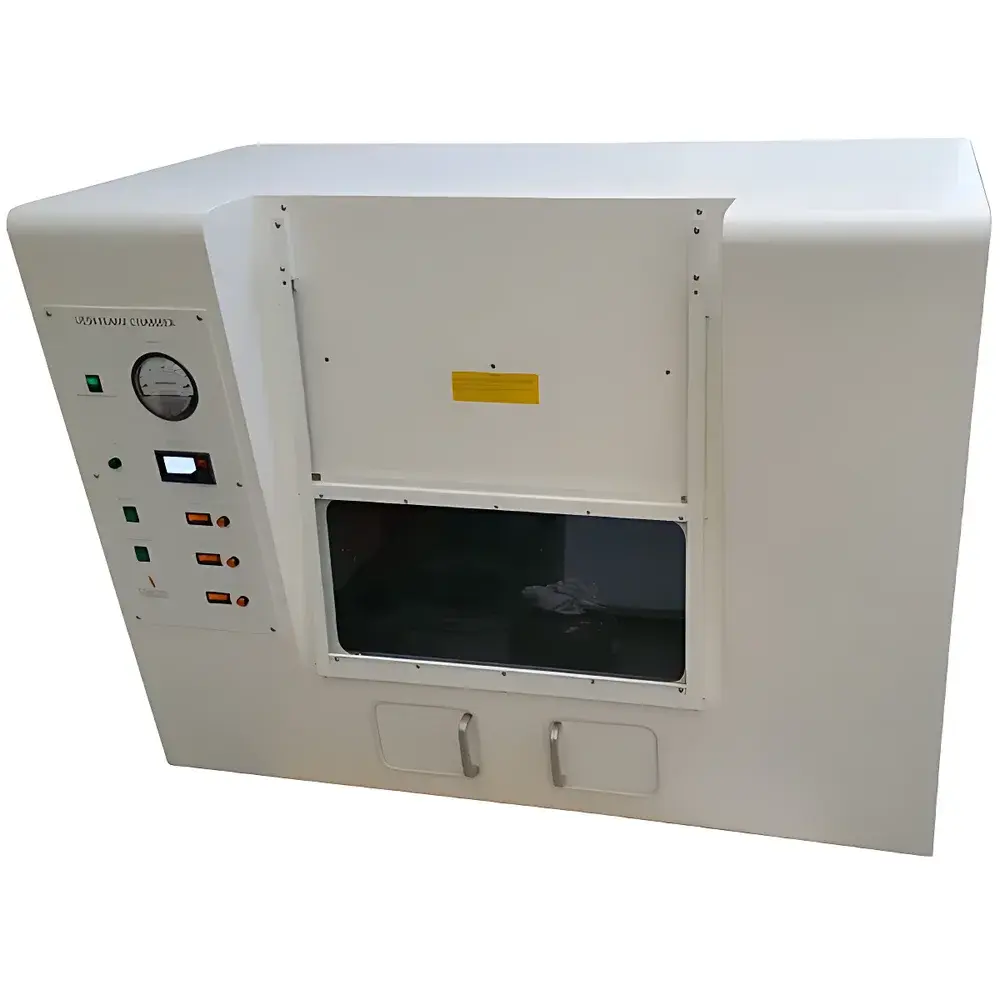
Concept UL94 Flammability Test Chamber
| Brand | Concept |
|---|---|
| Origin | United Kingdom |
| Model | UL94 FLAMMABILITY CHAMBER |
| Chamber Volume | >1 m³ |
| Noise Level | 62.5 dB(A) |
| Burner Angle Adjustment | 0°, 20°, 45° |
| Compliant Standards | UL 94, IEC 60695-11-10/20, ASTM D635, ISO 1210, ISO 9772, BS 2782 Method 140A/140B |
| Gas Supply | 98% methane |
| Operating Ambient Temperature | 10–35 °C |
| Electrical Supply | 115–230 V AC, single-phase |
Overview
The Concept UL94 Flammability Test Chamber is a precision-engineered combustion test system designed to evaluate the burning behavior of polymeric materials under standardized ignition conditions. It operates on the principle of controlled flame application—using a calibrated Bunsen-type burner—to assess key fire performance parameters including afterflame time, afterglow time, and whether dripping occurs with or without ignition of cotton indicator. The chamber supports both vertical (V-0, V-1, V-2, 5V) and horizontal (HB) specimen orientations as defined in UL 94, enabling classification of material flammability for regulatory compliance in electronics, automotive, aerospace, and construction sectors. Its >1 m³ corrosion-resistant chamber volume ensures stable thermal environment and adequate oxygen replenishment during repeated tests—critical for reproducibility across sequential trials. The system is not configured for radiant panel testing (e.g., ASTM E1321), but fully satisfies all flame exposure protocols specified in UL 94 and harmonized international standards.
Key Features
- Corrosion-resistant stainless steel test chamber with internal volume exceeding 1 m³, engineered to maintain consistent airflow and thermal stability during extended test sequences.
- Low-noise extraction system (62.5 dB(A)) featuring a centrifugal fan and adjustable back-draft damper to ensure safe fume removal while minimizing acoustic interference in laboratory environments.
- Large tempered glass observation window offering unobstructed visual access to specimen behavior during flame application and post-ignition phases.
- Precision burner assembly compliant with ASTM D5025, incorporating wing-tip design and motorized or manual angle adjustment (0°, 20°, 45°) for accurate alignment per test method requirements.
- Ergonomic service port and wide-balanced sliding door enabling full operator access for specimen mounting, burner positioning, and routine maintenance without tool dependency.
- Integrated control panel with three independent digital timers (for flame-on time, afterflame time, and afterglow time), calibrated gas flow meter, solenoid-controlled gas valve with status LED indicators, analog pressure gauge, and interior illumination.
- Modular configuration supporting optional benchtop installation or elevated support frame for improved ergonomics and integration into multi-instrument test bays.
Sample Compatibility & Compliance
The chamber accommodates rigid and semi-rigid plastic specimens up to 125 mm × 13 mm × specified thickness (typically 1.5 mm, 3.0 mm, or 6.0 mm per UL 94), as well as thin films and foams per ISO 9773 and ISO 9772. Specimen holders are supplied with standardized clamping mechanisms meeting dimensional tolerances outlined in UL 94 Annex A and IEC 60695-11-10 Clause 7. All mechanical and thermal performance criteria—including burner tip temperature profile, gas flow rate accuracy (±5% of nominal), and flame height repeatability—are verified against manufacturer’s calibration protocol traceable to NPL (UK) reference standards. The system meets essential safety and electromagnetic compatibility (EMC) requirements per CE marking directives and is routinely validated in GLP-compliant laboratories for use in regulatory submissions to notified bodies under EU Construction Products Regulation (CPR) and RoHS.
Software & Data Management
While the base configuration operates via hardware-based digital controls, optional firmware upgrades enable RS-232 or USB data logging for timestamped recording of timer events, gas valve actuation, and ambient temperature. Exported CSV files are compatible with LIMS platforms and support audit-ready documentation for FDA 21 CFR Part 11–aligned workflows when paired with electronic signature modules. Calibration records—including gas flow verification logs and burner thermocouple validation reports—are stored locally and can be exported for internal quality audits or external accreditation reviews (e.g., ISO/IEC 17025).
Applications
This chamber is deployed extensively in R&D laboratories and QC departments to qualify flame-retardant additives, validate polymer formulations, and support material selection for printed circuit board substrates, wire insulation, connector housings, and battery enclosures. It serves as a primary test platform for certification to UL Recognition, CSA Component Acceptance, and TÜV Rheinland Flame Class ratings. In academic research, it facilitates comparative studies on char formation kinetics, heat release thresholds, and synergistic effects of halogen-free flame retardants. Its adaptability to multiple standards enables cross-referenced reporting required by multinational OEMs maintaining global supply chain compliance programs.
FAQ
Does this chamber support UL 94 5V rating tests?
Yes—the chamber includes dedicated fixtures and timing protocols for both 5VA and 5VB classifications per UL 94 Section 7, including the mandatory five-flame application sequence and drip ignition assessment.
Is methane the only acceptable fuel gas?
The system is calibrated and validated for 98% pure methane; propane or butane may be used only after full revalidation per ASTM D5025 Annex B and documented deviation approval from the accredited test lab’s quality manager.
Can test data be exported for regulatory submission?
Raw timer outputs and gas control logs are exportable via serial interface; full 21 CFR Part 11 compliance requires integration with validated third-party data acquisition software and electronic signature infrastructure.
What maintenance intervals are recommended?
Burner tip cleaning and gas line inspection are advised before each test series; annual calibration of flow meters and timer modules is required for ISO/IEC 17025 accreditation.
Is the chamber suitable for ISO 4589-2 oxygen index testing?
No—oxygen index determination requires a separate apparatus (e.g., Concept LOI Analyzer) with precise O₂/N₂ blending capability and vertical sample holder geometry not integrated into this UL94-specific platform.



