
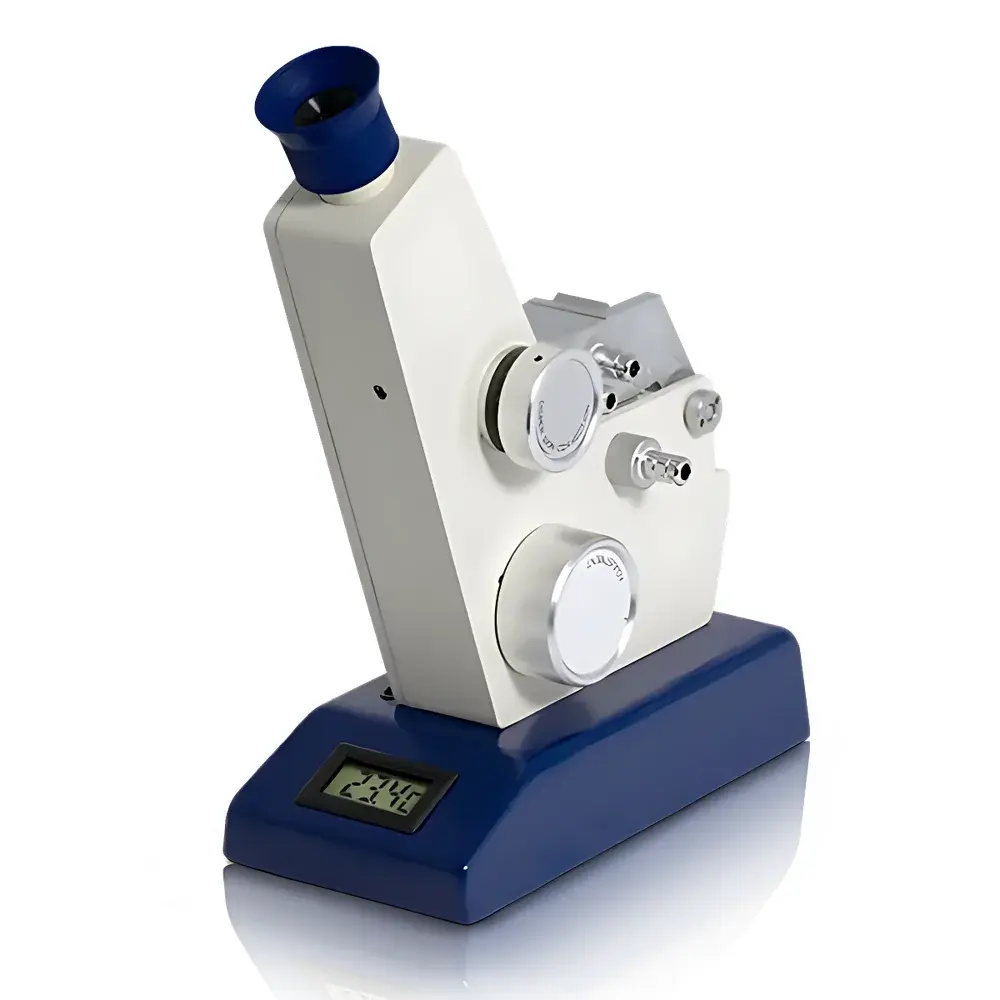
Krüss AR4 Abbe Refractometer
| Brand | Krüss |
|---|---|
| Origin | Germany |
| Model | AR4 Abbe Refractometer |
| Type | Benchtop Refractometer |
| Digital Display | Yes |
| Measurement Range | 1.3000–1.7000 nD, 0–95 %Brix |
| Accuracy | ±0.0002 nD, ±0.1 %Brix |
| Scale Division | 0.0005 nD, 0.25 %Brix |
| Light Source | 589 nm LED (Lifespan >100,000 h) |
| Temperature Measurement Range | −40 to +120 °C (Digital Thermometer) |
| Power Supply | 110/220 V AC (Switchable) |
| Dimensions | 10 × 27 × 19 cm |
| Weight | 2.5 kg |
| Calibration Standard | ASTM D1218 compliant calibration plate |
| Prism Temperature Control | Integrated thermal coupling to external thermostat (external chiller/heater required) |
Overview
The Krüss AR4 Abbe Refractometer is a precision benchtop optical instrument engineered for accurate and repeatable measurement of refractive index (nD) and soluble solids concentration (%Brix) across liquid, semi-solid, and viscous samples. Based on the classical Abbe principle—first introduced by Ernst Abbe in 1869—the instrument relies on total internal reflection at the interface between a high-refractive-index glass prism and the sample. The critical angle of this interface is directly correlated to the sample’s refractive index, which is optically resolved via a calibrated scale and viewed through an eyepiece or digital display. Unlike digital handheld units, the AR4 maintains full compliance with traditional Abbe optical geometry, ensuring traceability to internationally recognized reference methods. Its fixed 589 nm sodium-D line-equivalent LED illumination provides stable, drift-free spectral output with >100,000 h lifetime—eliminating lamp replacement and wavelength variability inherent in older tungsten or sodium-vapor sources. While the AR4 does not integrate an active Peltier temperature controller, its prism block features standardized thermal ports compatible with external circulation thermostats (e.g., Huber, Julabo), enabling precise temperature stabilization per ISO 2859-1 and ASTM D1218 requirements.
Key Features
- Benchtop Abbe configuration with dual-prism optical path (illuminating and measuring prisms), optimized for high angular resolution and minimal parallax error
- Digital display integrated with analog scale viewfinder—enabling simultaneous visual verification and electronic readout
- ASTM D1218-compliant calibration plate included for routine verification and GLP-aligned instrument qualification
- Thermally coupled prism assembly with standardized 6 mm quick-connect ports for integration with external thermostatic circulators
- Robust aluminum-magnesium alloy chassis (2.5 kg mass) providing mechanical stability and thermal inertia during extended measurements
- Adjustable ocular focus and scale alignment mechanism for operator-specific ergonomics and long-term optical consistency
- Universal power supply (110/220 V AC, 50/60 Hz) with EMI-filtered input for laboratory-grade electrical noise immunity
Sample Compatibility & Compliance
The AR4 accommodates a broad spectrum of industrial and research samples—including aqueous solutions, syrups, essential oils, polymer melts, pharmaceutical suspensions, and opaque or pigmented liquids—without requiring dilution or filtration. Solid and highly viscous specimens are measured using standard contact fluid (e.g., bromonaphthalene or silicone oil), as specified in ISO 1042 and USP . The instrument’s optical design inherently rejects interference from sample coloration, turbidity, or minor surface contamination—a key advantage over single-beam digital refractometers. For regulated environments, the AR4 supports audit-ready operation when paired with validated external temperature control systems and documented calibration procedures aligned with ISO/IEC 17025, FDA 21 CFR Part 11 (when used with compliant data logging software), and GMP/GLP quality systems. Traceability is maintained through NIST-traceable refractive index standards and manufacturer-provided uncertainty budgets.
Software & Data Management
The AR4 operates as a standalone optical instrument with no embedded microprocessor or native USB/RS-232 interface. However, its digital display output can be captured via third-party vision systems or connected to PC-based data acquisition platforms using TTL-compatible analog voltage outputs (optional accessory module). When deployed in regulated settings, laboratories commonly integrate the AR4 into validated workflows using LIMS-compatible thermoregulation controllers and manual entry into ELN systems with dual-operator verification. Full compliance with 21 CFR Part 11 is achievable through procedural controls—including controlled access to calibration plates, timestamped logbooks, and independent review of temperature-stabilization records—rather than instrument-level electronic signatures.
Applications
- Quality control of sugar content in beverages, fruit juices, and confectionery (0–95 %Brix)
- Concentration monitoring in pharmaceutical syrup formulations and excipient solutions
- Refractive index profiling of organic solvents and petrochemical fractions (nD 1.3000–1.7000)
- In-process verification of polymerization degree in resins and adhesives
- Raw material identity testing in food and feed production (e.g., honey adulteration screening)
- Wastewater analysis for dissolved organic load estimation via correlation with nD
- Research-grade characterization of nanofluids, colloidal dispersions, and ionic liquid mixtures
FAQ
Does the AR4 include an integrated temperature control system?
No—the AR4 lacks built-in Peltier or resistive heating/cooling. It is designed for use with externally regulated thermostatic baths or recirculating chillers connected via its standardized thermal ports.
Can the AR4 measure solid samples directly?
Solids require optical coupling using a high-refractive-index contact liquid (e.g., nD ≥ 1.66). The procedure follows ISO 1042 and includes surface preparation, fluid application, and critical angle alignment verification.
Is the 589 nm LED source compliant with ISO 2211 for refractometry?
Yes—the narrow-band 589 ± 0.5 nm LED meets the spectral purity and stability requirements defined in ISO 2211:2022 for Abbe-type instruments.
What calibration standards are recommended for routine verification?
Krüss-supplied ASTM D1218-compliant calibration plates (nD = 1.4890, 1.5230, and 1.5670) are provided; additional NIST-traceable sucrose solutions may be used for %Brix validation.
How is measurement uncertainty determined for the AR4?
Total uncertainty derives from contributions of scale resolution (±0.0005 nD), temperature stability (±0.1 °C → ±0.0001 nD/°C), and operator repeatability (typically ±0.0001 nD under controlled conditions), yielding a combined standard uncertainty of ≤ ±0.0002 nD.





