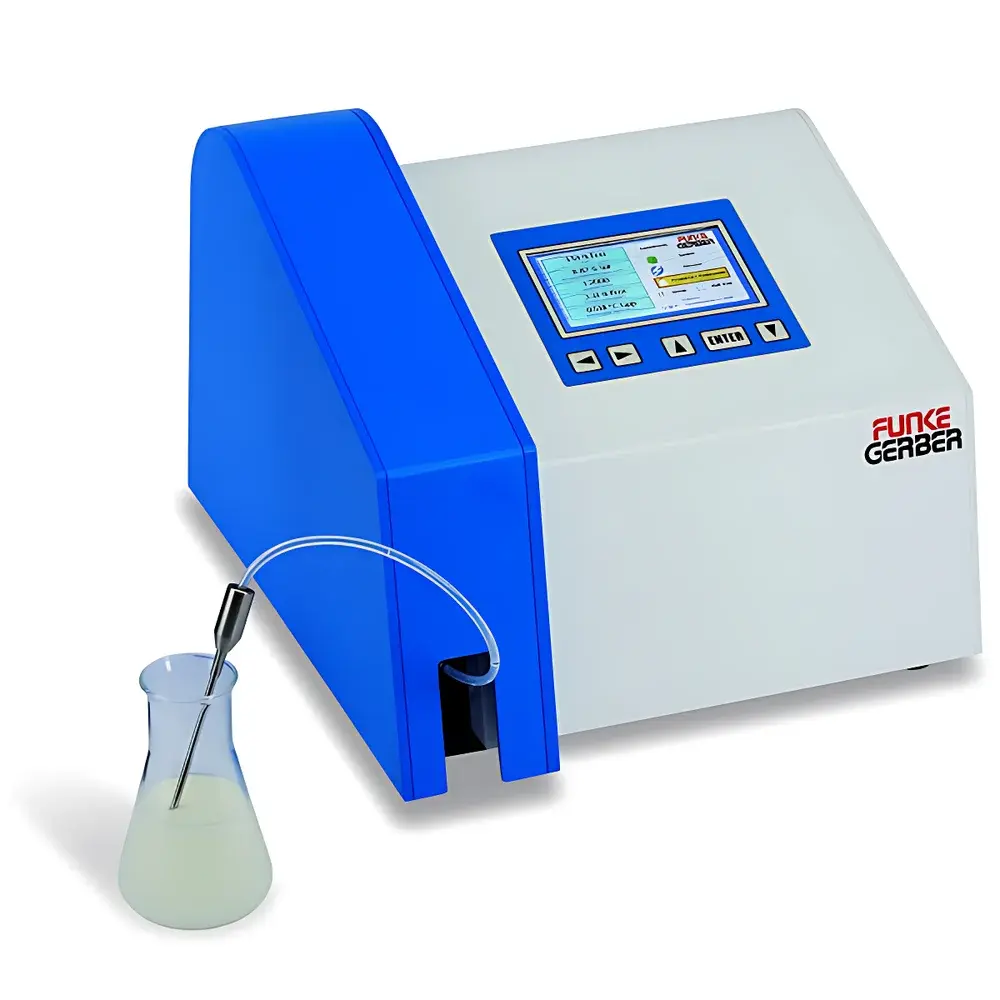
Gerber LactoFlash Dairy Analyzer
| Brand | Gerber |
|---|---|
| Origin | Germany |
| Model | LactoFlash |
| Automation | Fully Automatic |
| Analysis Speed | 120 samples/hour |
| Measurement Range | Fat 0.01–30.00% |
| Density | ≥0.0001 g/cm³ resolution |
| Freezing Point Depression | ±0.001 °C resolution |
| Repeatability | ±0.02–±0.2% depending on analyte and concentration range |
| Accuracy | ±0.01% for fat, protein, lactose, and non-fat solids |
| Sample Volume | 12–20 mL (adjustable) |
| Power Supply | 230 V / 115 V, 50/60 Hz, 60 W |
| Dimensions | 30 × 24 × 33 cm (W×H×D) |
| Weight | 5 kg |
| Interface | RS-232 serial port |
| Compliance | Designed to support ISO 9001-aligned QA workflows and routine GLP-compliant dairy testing |
Overview
The Gerber LactoFlash Dairy Analyzer is a fully automated, benchtop near-infrared (NIR) and mid-infrared (MIR) transmission spectrometer engineered for rapid, non-destructive quantification of key compositional parameters in raw, pasteurized, and standardized bovine milk. Operating on the principle of multi-wavelength absorbance spectroscopy calibrated against reference wet-chemistry methods (e.g., AOAC 989.10 for fat, Kjeldahl for protein), the LactoFlash delivers traceable, reproducible results without reagents or sample preparation. Its optical architecture integrates dual-beam referencing and temperature-stabilized detectors to minimize drift during high-throughput operation—critical for daily quality control in dairy collection centers, processing plants, and regulatory laboratories. The system is designed for integration into continuous workflow environments where compliance with ISO 5725 (accuracy and precision of measurement methods) and ISO/IEC 17025 (competence of testing laboratories) is required.
Key Features
- Fully automated analysis cycle: single-button initiation, integrated peristaltic sampling, self-cleaning fluidics, and auto-zeroing between samples
- Throughput of up to 120 samples per hour—optimized for shift-based dairy intake operations
- Simultaneous quantification of fat, protein, lactose, non-fat solids (NFS), density, and freezing point depression in <15 seconds per sample
- Adjustable sample volume (12–20 mL) accommodates viscosity variations across seasonal and breed-specific milk batches
- RS-232 serial interface enables direct connection to LIMS, ERP systems, or local PCs for real-time data export and audit trail generation
- Onboard A/B two-point calibration routine with user-accessible reference standards; no external service engineer required for routine recalibration
- Compact footprint (30 × 24 × 33 cm) and low power draw (60 W) allow deployment in mobile labs or space-constrained receiving bays
Sample Compatibility & Compliance
The LactoFlash accepts homogenized or non-homogenized raw milk, skimmed milk, standardized blends, and reconstituted powders—provided samples are free of gross particulates or air bubbles that may interfere with optical path integrity. It complies with European Commission Regulation (EC) No 853/2004 for dairy hygiene and supports method validation per ISO 14501 (milk fat determination) and ISO 8968-1 (milk protein by Kjeldahl reference). While not FDA 21 CFR Part 11–certified out-of-the-box, its data logging architecture—including timestamped result files, operator ID tagging, and immutable audit logs—can be configured to meet GLP and GMP documentation requirements when deployed with validated IT infrastructure.
Software & Data Management
The embedded firmware provides intuitive menu navigation via tactile membrane buttons and a backlit LCD display. Raw spectral data and processed results are exportable in CSV format via RS-232; optional PC software (Gerber DairyLink Suite) adds trend charting, statistical process control (SPC) charts (X̄/R, Cpk), batch reporting, and PDF certificate generation. All exported datasets include metadata: sample ID, operator code, calibration status, instrument serial number, ambient temperature, and measurement timestamp—enabling full traceability under ISO/IEC 17025 clause 7.7.
Applications
- Dairy farm gate payment grading based on fat/protein premiums and penalties
- In-process verification during standardization and homogenization stages
- Raw material release testing prior to pasteurization or UHT treatment
- Non-conformance investigation following sensory or microbiological deviations
- Supporting ISO 22000 food safety management system documentation
- Research applications requiring high-frequency compositional profiling across lactation cycles or feed trials
FAQ
What reference methods are used to validate the LactoFlash calibration models?
Calibration models are developed and periodically verified against AOAC Official Methods (e.g., 989.10 for fat, 991.20 for protein) and ISO-standard wet chemistry protocols using certified reference materials (CRMs) from IRMM and NIST.
Can the LactoFlash analyze goat, sheep, or buffalo milk?
Yes—though factory calibrations are optimized for bovine milk, custom multivariate calibration models can be developed for alternative species upon submission of representative reference sample sets.
Is preventive maintenance required, and what does it involve?
Annual optical alignment verification and fluidic system inspection are recommended; these procedures are documented in the technical manual and do not require proprietary tools or OEM service contracts.
How is data integrity ensured during power interruption or system reboot?
All measurements are written to non-volatile memory before display; unsaved results persist across cold restarts, and the internal clock maintains accurate timestamps independent of host PC connectivity.
Does the instrument support remote diagnostics or firmware updates?
Firmware updates are performed via USB flash drive; remote diagnostics are not supported natively but can be enabled through third-party secure VPN configurations compliant with IEC 62443-3-3.