
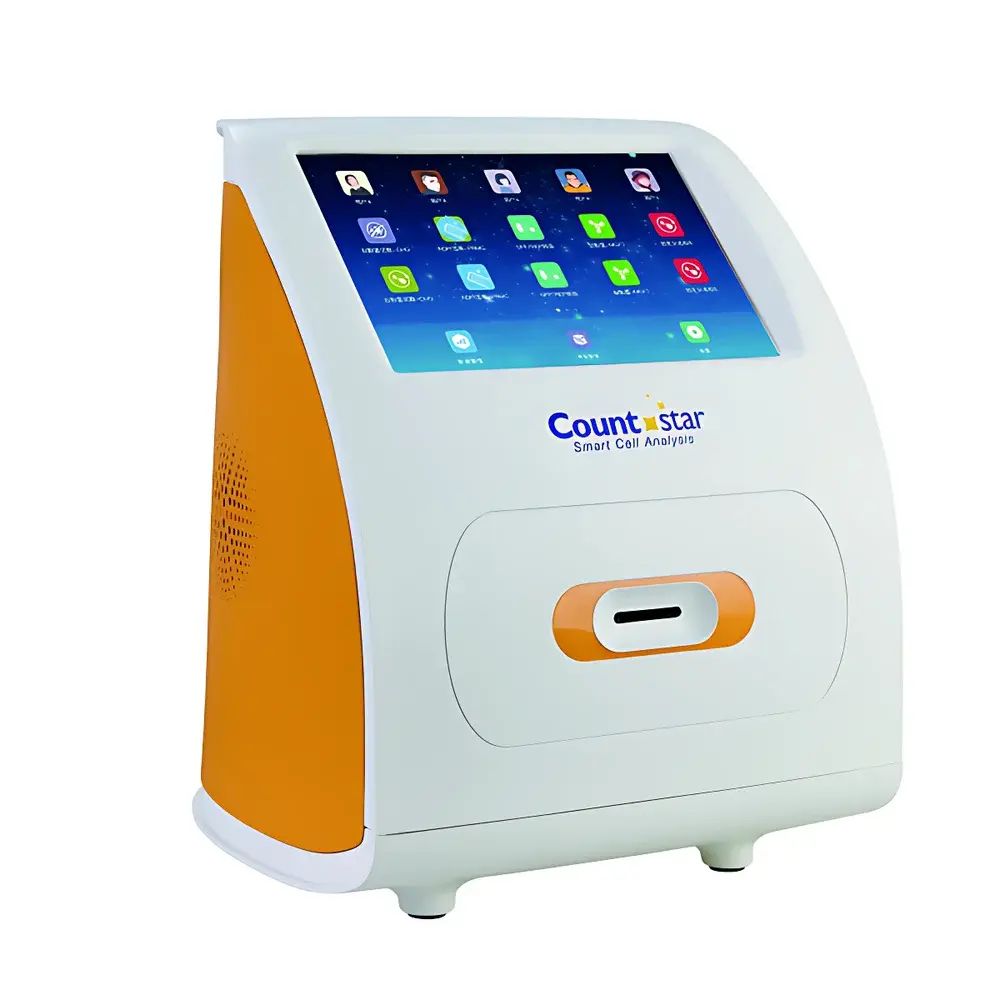
Countstar Mira FL Fluorescent Cell Analyzer
| Brand | Countstar |
|---|---|
| Origin | Shanghai, China |
| Model | Mira FL |
| Detection Time | 20–50 s |
| Cell Concentration Range | 1×10⁴–3×10⁷ cells/mL |
| Sample Volume | 20 µL |
| Throughput | 5 samples per run |
| Detectable Cell Diameter | 1–180 µm |
Overview
The Countstar Mira FL Fluorescent Cell Analyzer is an integrated, benchtop cell analysis platform engineered for precision, reproducibility, and workflow efficiency in academic, biopharmaceutical, and clinical research laboratories. It employs dual-channel fluorescence microscopy combined with high-resolution brightfield imaging to quantify viable and non-viable cells using AO/PI (acridine orange/propidium iodide) dual-stain methodology — a DNA-intercalating assay compliant with ISO 20391-1:2018 (Biotechnology — Cell counting — Part 1: General guidance) and widely adopted in GLP-compliant cell culture QC. Unlike flow cytometry, the Mira FL captures full-field static images of each sample, enabling morphological validation, cluster resolution, and post-acquisition reanalysis. Its optical architecture integrates patented fixed-focus optics and variable optical magnification — eliminating mechanical refocusing and ensuring consistent depth-of-field across the entire 1–180 µm cell size range without user calibration.
Key Features
- Patented optical zoom technology enabling accurate imaging and segmentation of cells from 1 µm (e.g., small lymphocytes, exosomes) to 180 µm (e.g., fused myotubes, large adherent cells in suspension), without switching objectives or manual focus adjustment.
- AI-powered image analysis engine trained on >10⁶ annotated cell images; supports robust segmentation of irregular, aggregated, or heterogeneous populations including MSCs, RAW264.7 macrophages, zebrafish blastomeres, and primary PBMCs.
- Dual-fluorescence detection channels: excitation/emission optimized for AO (Ex: 488 nm / Em: 525/30 nm) and PI (Ex: 532 nm / Em: 600LP), with spectral separation minimizing crosstalk and enabling reliable viability discrimination independent of red blood cell contamination.
- Integrated trypan blue exclusion assay mode compliant with USP sterility testing guidelines and commonly referenced in ATCC and ECACC cell banking protocols.
- Ergonomic touchscreen interface with preloaded, parameter-optimized application modules (e.g., “HEK293 Transfection”, “MSC Expansion”, “PBMC Viability”) — all configured to meet ISO 20391-2:2019 analytical verification requirements for repeatability and intermediate precision.
Sample Compatibility & Compliance
The Mira FL accepts standard 20 µL capillary-loaded slides compatible with both adherent and suspension cultures. It supports mammalian, insect, and fish-derived cell lines (e.g., CHO, HEK293, MCF-7, RAW264.7, zebrafish embryos), primary isolates (PBMCs, T cells, dendritic cells), and stem/progenitor populations. All AO/PI staining protocols align with ASTM E2877-22 (Standard Guide for Viability Assessment of Mammalian Cells Using Fluorescent Nucleic Acid Stains). The system’s optical stability and AI-based segmentation reduce operator-dependent variability, supporting audit readiness under FDA 21 CFR Part 11 when paired with optional secure user authentication and electronic signature modules.
Software & Data Management
The embedded Countstar Analysis Suite v4.x provides full traceability: timestamped acquisition logs, version-controlled analysis algorithms, and configurable audit trails meeting GLP/GMP documentation standards. Data storage capacity exceeds 128 GB onboard, organized by experiment type, date, and custom keywords. Export formats include PDF (QC-ready reports with histograms and growth curves), Excel (.xlsx with raw counts, viability %, mean diameter, clumping index), and TIFF/PNG (original and annotated images). Integrated dilution calculator supports ISO 17025-aligned preparation workflows. All exported data retain metadata required for regulatory submissions — including instrument ID, operator ID, calibration status, and environmental timestamps.
Applications
- Transfection efficiency quantification: Dual-channel GFP/RFP fluorescence detection enables direct comparison with flow cytometry results (r² > 0.99 vs. CytoFLEX in side-by-side HEK293 transfection studies), with added morphological context for identifying false positives arising from debris or autofluorescence.
- Stem cell expansion monitoring: Tracks dynamic shifts in mean cell diameter distribution and clumping rate across passages — critical indicators of differentiation onset or stress-induced aggregation in MSC cultures.
- Viral vector production support: Rapid assessment of host cell viability pre- and post-transduction supports process optimization in AAV and lentiviral manufacturing, aligned with ICH Q5A(R2) guidance on cell substrate characterization.
- Primary cell QC: Accurate enumeration of low-abundance, fragile cells (e.g., cryopreserved PBMCs) without centrifugation-induced loss or shear damage inherent in flow-based systems.
FAQ
What regulatory standards does the Mira FL comply with for cell counting in GMP environments?
The system supports compliance with ISO 20391-1/-2, ASTM E2877-22, and USP , and its software architecture accommodates 21 CFR Part 11 requirements when deployed with role-based access control and electronic signatures.
Can the Mira FL distinguish between live/dead cells in samples containing erythrocytes or cellular debris?
Yes — AO/PI binds selectively to nuclear DNA, excluding enucleated RBCs and non-nucleated debris from quantification, unlike trypan blue which stains both dead nucleated cells and RBCs.
Is calibration required before each use?
No — the fixed-focus optical design and factory-calibrated illumination ensure consistent performance across runs; only periodic verification using NIST-traceable microsphere standards is recommended per ISO 20391-2.
Does the AI algorithm require user training or custom model building?
No — the neural network is pre-trained on diverse morphologies and requires no user-supervised learning; it adapts automatically to new cell types via transfer learning during routine use.
How is data integrity maintained during long-term storage?
All datasets are stored with immutable metadata hashes; the system generates SHA-256 checksums for every exported file to verify authenticity and prevent tampering during archival or regulatory review.



