
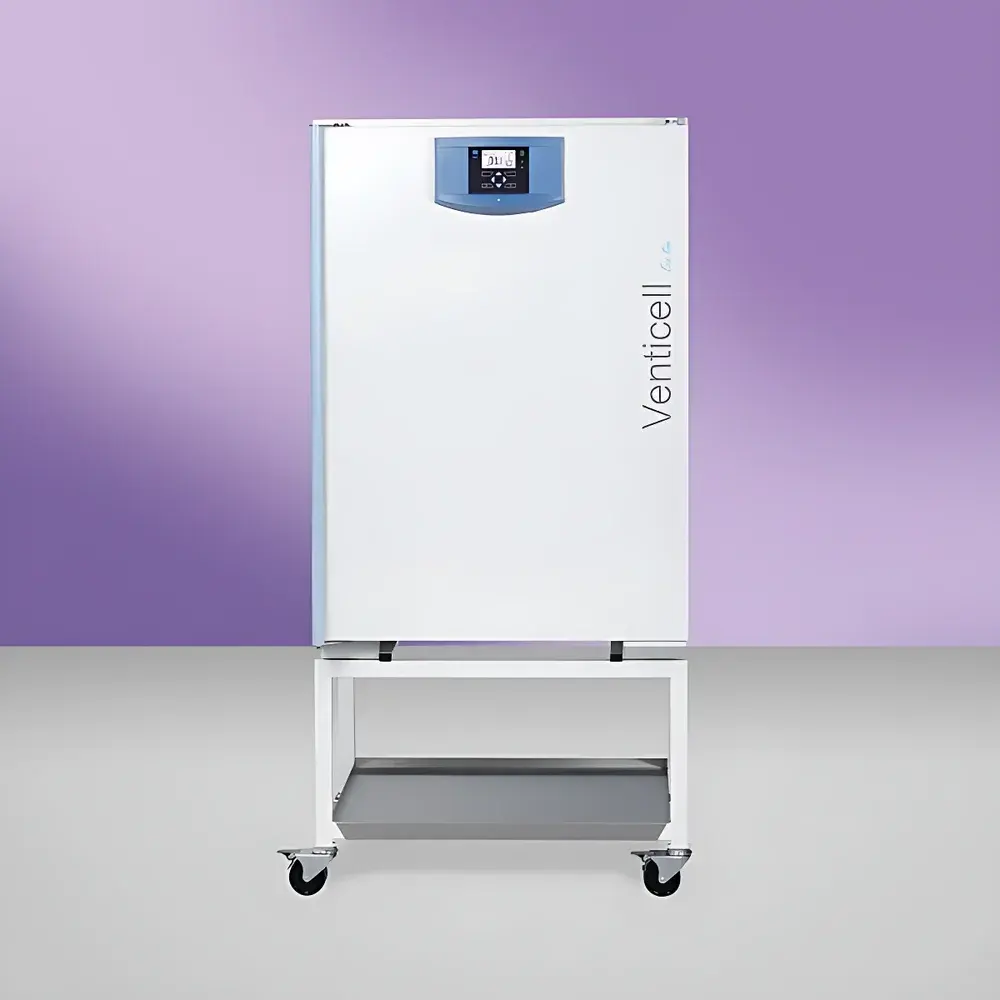
MMM Venticell Forced-Convection Drying Oven Series (Model Venticell 22 / 55 / 111 / 222 / 404 / 707L)
| Brand | MMM |
|---|---|
| Origin | Germany |
| Model | Venticell 22, 55, 111, 222, 404, 707L |
| Temperature Range | 10 °C to 300 °C |
| Temperature Uniformity | Standard (per IEC 60068-3-5) |
| Chamber Material | AISI 304 Stainless Steel |
| Heating Method | Electric Resistance Heating |
| Compliance | CE, TÜV, ISO 9001, IEC 61010-1, BS EN 61010-1 |
| Regulatory Alignment | USP <1211>, EP 2.6.12, FDA 21 CFR Part 11 (software-enabled variants), cGMP Annex 15, ICH Q5C |
Overview
The MMM Venticell series of forced-convection drying ovens represents over six decades of precision engineering in thermal laboratory instrumentation. Designed and manufactured in Munich, Germany since 1953, these ovens employ a robust convection architecture based on upward-spiral airflow generated by a top-mounted, all-stainless steel centrifugal fan. This configuration ensures high thermal homogeneity across the entire working chamber—critical for applications requiring reproducible drying, depyrogenation, moisture content determination (per USP ), and thermal stabilization of pharmaceutical intermediates, analytical standards, or sterile packaging components. Unlike natural convection ovens, the Venticell’s active air circulation system minimizes thermal stratification and accelerates heat transfer kinetics, enabling tighter process control within the specified operating range of 10 °C to 300 °C. The design adheres strictly to IEC 60068-3-5 for temperature uniformity testing and is validated for use in GLP- and GMP-regulated environments.
Key Features
- German-engineered forced-air convection system with top-mounted AISI 316 stainless steel fan, delivering consistent vertical laminar–spiral airflow for ±0.8 °C chamber uniformity (at 150 °C, per internal validation protocol)
- Microprocessor-based fuzzy logic controller with 3-inch backlit LCD interface, supporting programmable ramp/soak profiles, real-time deviation logging, and password-protected parameter locking
- Chamber constructed entirely from electropolished AISI 304 stainless steel (1.4301), including rounded internal corners and tool-free modular panel assembly for rapid disassembly and autoclave-compatible cleaning
- Double-walled insulated enclosure with mineral wool insulation and corrosion-resistant exterior cladding (powder-coated stainless steel)
- Overtemperature protection via independent mechanical safety thermostat (DIN 12880-compliant), integrated door interlock, and ground-fault circuit interruption (GFCI)
- Optional data logging module compliant with FDA 21 CFR Part 11 requirements, featuring electronic signature capability, audit trail, and encrypted CSV export
Sample Compatibility & Compliance
The Venticell series accommodates standard laboratory glassware (e.g., Petri dishes, weighing bottles, volumetric flasks), stainless steel trays, polymer containers rated for continuous exposure up to 300 °C, and pre-sterilized tubing assemblies. It supports validated processes aligned with pharmacopoeial methods—including USP (Sterilization of Dry Heat), European Pharmacopoeia 2.6.12 (Dry Heat Sterilization), and ISO 11140-1 (Validation of dry heat sterilization cycles). All models are certified to IEC 61010-1:2010 for laboratory electrical safety and bear CE marking under the EU Machinery Directive 2006/42/EC and Low Voltage Directive 2014/35/EU. TÜV SÜD certification confirms compliance with EN 61326-1 (EMC) and EN 60529 (IP20 ingress protection).
Software & Data Management
Selected Venticell configurations integrate MMM’s proprietary VentiControl software (v3.2+), enabling remote monitoring, multi-oven fleet management, and automated report generation in PDF or XML format. The system implements full 21 CFR Part 11 compliance—including user role-based access control (admin/operator/auditor), electronic signatures with biometric or token-based authentication, immutable audit trails with timestamped event logs (start/stop, setpoint changes, alarms), and secure data archiving. Raw temperature data is recorded at configurable intervals (1 s to 60 min) and stored locally on SD card or exported via Ethernet/Wi-Fi to LIMS or MES platforms using OPC UA or Modbus TCP protocols.
Applications
- Pharmaceutical: Depyrogenation of glass vials and stoppers (250 °C × 45 min), residual solvent removal from API batches, stability-indicating drying per ICH Q1A(R2)
- Biotechnology: Pre-sterilization conditioning of stainless steel bioreactor parts, drying of lyophilization trays prior to aseptic processing
- Materials Science: Thermal aging studies of polymers and composites, moisture content analysis (ASTM D229, ISO 15512), binder burnout in ceramic green bodies
- Academic Research: Sample preparation for SEM/TEM, gravimetric analysis, calibration standard conditioning, and reference material drying per ISO Guide 35
- Quality Control Labs: Routine drying of filter papers, crucibles, and desiccators; water activity determination (ISO 21807); and glassware decontamination prior to trace metal analysis
FAQ
What is the maximum allowable load volume for thermal uniformity compliance?
Thermal uniformity specifications assume ≤70% chamber volume occupancy with standard stainless steel trays. Full-load validation reports are available upon request.
Can the Venticell be used for depyrogenation validation per USP ?
Yes—models equipped with Class II temperature sensors (IEC 60751 Pt100, tolerance A) and optional validation ports support IQ/OQ/PQ execution per PDA Technical Report No. 1 and EU Annex 15.
Is the fan speed adjustable during operation?
Fan speed is fixed per model to maintain laminar–spiral flow integrity; however, airflow direction and intensity are optimized via internal baffle geometry and chamber aspect ratio.
Does MMM provide installation qualification (IQ) documentation?
Yes—factory-issued IQ templates, wiring diagrams, calibration certificates (traceable to DKD/DAkkS), and FAT/SAT protocols are included with each delivery.
How often does the temperature sensor require recalibration?
Annual recalibration is recommended per ISO/IEC 17025; field verification using NIST-traceable reference thermometers can be performed quarterly.



