
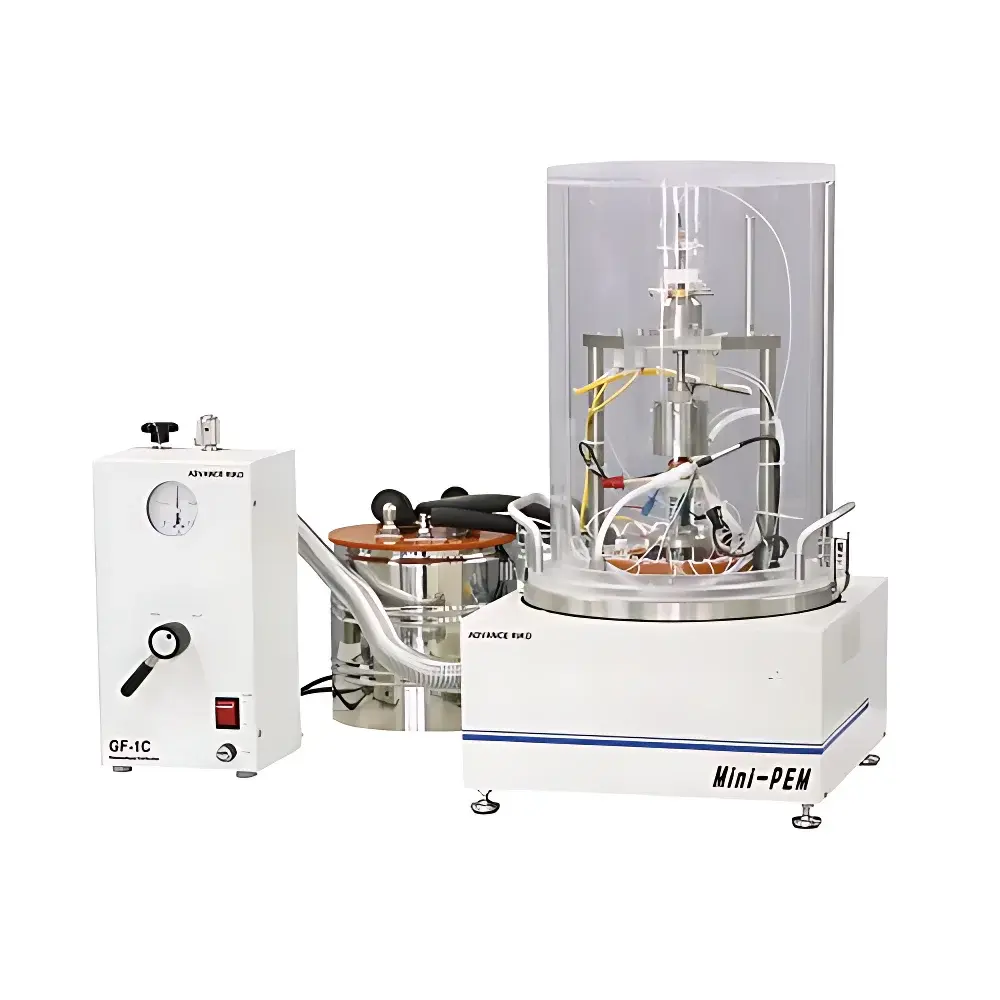
Advance Riko Mini-PEM Small-Scale Thermoelectric Conversion Efficiency Measurement System
| Brand | Advance Riko |
|---|---|
| Origin | Japan |
| Model | Mini-PEM |
| Operating Temperature Range (Hot Side) | 50–500 °C |
| Sample Dimensions | 2–10 mm × 1–20 mm (square/rectangular bulk) |
| Atmosphere | Vacuum-compatible |
| Measured Parameters | Thermoelectric conversion efficiency (η), electrical power output, heat flux |
| Measurement Principle | Simultaneous four-probe electrical characterization + calibrated heat flux sensor (thermopile-based) |
| Compliance | Designed for ASTM E3049–22 (Standard Practice for Measuring Thermoelectric Module Efficiency) and ISO 14405-1:2016 (Geometrical product specifications) alignment |
Overview
The Advance Riko Mini-PEM is a precision-engineered benchtop system designed for direct, in-situ measurement of thermoelectric conversion efficiency (η) of single-leg or monolithic thermoelectric modules under controlled thermal gradients. Unlike indirect estimation methods relying on separate Seebeck coefficient (S), electrical resistivity (ρ), and thermal conductivity (κ) measurements, the Mini-PEM implements a first-principles calorimetric approach: it concurrently quantifies the net electrical power output (Pelec = V·I) via four-point probe electronics and the incident heat flux (Q̇) across the sample using a traceable, NIST-traceable thermopile-based heat flow sensor. The conversion efficiency is then calculated as η = Pelec/Q̇ × 100%, satisfying the fundamental energy balance required for rigorous device-level validation. The system operates with a programmable hot-side heater capable of stable temperatures from 50 °C to 500 °C, while maintaining high thermal uniformity and low axial conduction loss—critical for minimizing parasitic heat losses in small-footprint samples (2–10 mm × 1–20 mm). Its vacuum-compatible chamber enables inert or reduced-pressure testing environments, essential for evaluating oxidation-sensitive chalcogenides such as GeTe, SnSe, and Bi2Te3-based alloys.
Key Features
- Integrated dual-channel metrology: Synchronized acquisition of voltage, current, and differential temperature across the heat flux sensor ensures time-aligned calculation of η without post-hoc data interpolation.
- Modular sample stage with precision-machined copper electrodes and adjustable clamping force to minimize contact resistance variability—validated per ASTM E3049 Annex A2 for interfacial thermal resistance control.
- Programmable thermal ramping and dwell protocols with real-time feedback from dual Pt100 sensors (hot-side and cold-side) enabling reproducible ΔT sweeps from 10 K to >300 K.
- Passive cooling base with integrated water-jacket interface compatible with standard laboratory chillers (flow rate: 0.5–2.0 L/min), supporting steady-state operation at cold-side temperatures near ambient (20–30 °C).
- Compact footprint (< 400 × 350 × 300 mm) and tool-free sample loading—designed for rapid turnaround between material iterations in academic and industrial R&D labs.
Sample Compatibility & Compliance
The Mini-PEM accommodates bulk polycrystalline or single-crystal thermoelectric specimens in rectangular geometry (2–10 mm width × 1–20 mm length × 0.5–3 mm thickness), including sintered pellets, hot-pressed discs, and spark-plasma-sintered (SPS) bars. It has been extensively validated for Bi2Te3, PbTe, SnSe, GeTe, and Mg3Sb2-based systems—as cited in peer-reviewed publications in Science, Nature Communications, and Energy & Environmental Science. All hardware and firmware comply with IEC 61000-6-3 (EMC emission limits) and IEC 61010-1 (safety requirements for electrical equipment). Data acquisition meets ALCOA+ principles (Attributable, Legible, Contemporaneous, Original, Accurate, Complete, Consistent, Enduring, Available) and supports 21 CFR Part 11-compliant audit trails when paired with optional LabVIEW-based software licensing.
Software & Data Management
The Mini-PEM is operated via Advance Riko’s proprietary PEM-Control Suite—a Windows-based application providing full instrument orchestration, real-time visualization of V–I curves, Q̇–I profiles, and η–I optimization maps. Raw data are exported in CSV and HDF5 formats, preserving metadata including timestamp, setpoint temperatures, ambient pressure, and calibration coefficients. The software includes built-in routines for uncertainty propagation analysis per GUM (JCGM 100:2018), estimating combined standard uncertainty in η based on uncertainties in voltage (±0.02% FS), current (±0.05% FS), and heat flux (±2.5% FS). Exported datasets integrate natively with MATLAB, Python (via pandas/h5py), and OriginLab for advanced statistical modeling of zT–T dependence and module-level performance extrapolation.
Applications
- Quantitative benchmarking of new thermoelectric materials (e.g., defect-engineered GeTe, Cu-doped SnSe) against state-of-the-art reference modules under identical ΔT conditions.
- Accelerated lifetime assessment via repeated η measurement over thermal cycling (50–400 °C, 100+ cycles) to detect degradation in interfacial adhesion or phase segregation.
- Validation of computational models predicting maximum η under realistic boundary conditions—including finite-element thermal modeling of electrode contact resistance and lateral heat leakage.
- Supporting GLP-compliant qualification of thermoelectric generators for aerospace, waste-heat recovery, and IoT micro-power applications where regulatory documentation of η repeatability (RSD < 3.2% across n=6 replicates) is mandatory.
FAQ
Can the Mini-PEM measure both thermoelectric generators (TEGs) and coolers (TECs)?
Yes—the system measures net electrical power generation (TEG mode) and, with reversed thermal gradient configuration, can quantify cooling power and coefficient of performance (COP) for single-stage TECs, provided cold-side heat rejection is actively managed.
Is calibration traceable to national standards?
All heat flux sensors are factory-calibrated against NIST SRM 1450c (fiberglass board) and certified per ISO/IEC 17025 by Advance Riko’s A2LA-accredited calibration lab; electrical modules are verified using Fluke 8508A reference standards.
What sample preparation is required?
Samples must be polished to Ra < 0.8 µm on contacting faces; electrode deposition (e.g., Ni/Cu sputtering or Ag paste firing) is recommended but not mandatory—bare metal contacts yield valid results if surface oxide is removed in situ under vacuum.
Does the system support automated long-term stability testing?
Yes—scheduled measurement sequences (e.g., hourly η checks over 72 h at fixed ΔT) are fully scriptable via PEM-Control Suite’s macro engine and logged with system health diagnostics (heater duty cycle, coolant temp drift, sensor offset stability).



