
RHK PAN STM/AFM Low-Temperature Scanning Probe Microscope
| Brand | RHK |
|---|---|
| Origin | USA |
| Model | PAN STM/AFM |
| Operating Modes | STM & Non-Contact AFM |
| Temperature Range | <300 mK, Room Temperature (RT), Variable Temperature (VT), High Temperature (HT) |
| X-Y-Z Coarse Motion Range | 5 mm × 5 mm × 10 mm |
| Scan Range (RT) | 5 µm × 5 µm |
| Sample Size Capacity | 10 mm × 10 mm |
| Scanner Dimensions | 40 mm × 70 mm |
| Vibration Damping | Integrated Spring & Eddy-Current Damping System |
| Compatibility | Flow-type & Bath-type Cryostats, Superconducting Magnets, UHV Systems |
| Controller | RHK R9 Full-Digital SPM Controller with IVP-R9 Preamp |
Overview
The RHK PAN STM/AFM Low-Temperature Scanning Probe Microscope is an ultra-compact, cryogenic-capable scanning probe platform engineered for atomic-scale surface characterization under extreme thermal and vacuum conditions. Based on the fundamental principles of quantum tunneling (STM) and van der Waals force detection (non-contact AFM), the system delivers high-fidelity topographic, electronic, and nanomechanical data across a broad thermal spectrum—from sub-300 mK dilution refrigerator temperatures to elevated temperatures (>300 K). Its monolithic scanner architecture integrates coarse three-axis motion (5 mm × 5 mm × 10 mm) with fine piezoelectric scanning (5 µm × 5 µm at RT), enabling both large-area survey and atomic-resolution imaging within a single vacuum-compatible module. Designed for integration into custom UHV cryostat systems—including flow-type and bath-type configurations—the PAN platform maintains mechanical stability and thermal anchoring critical for long-duration spectroscopic measurements in condensed matter physics and quantum materials research.
Key Features
- Ultra-compact scanner footprint (40 mm × 70 mm), minimizing thermal mass and enhancing cooling efficiency in cryogenic environments
- Integrated spring-and-eddy-current damping system for passive vibration isolation—no external active cancellation required
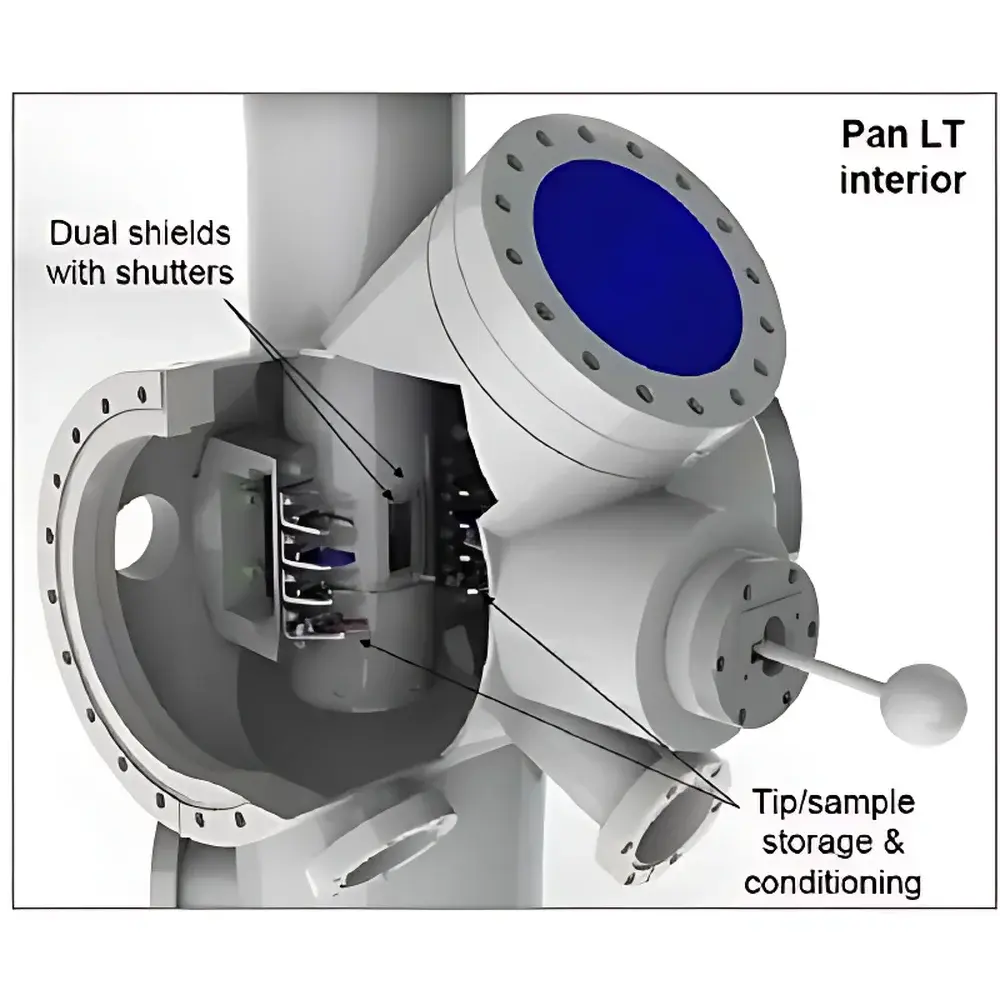
- In-situ tip and sample exchange mechanism compatible with UHV and <300 mK operation, supporting rapid experimental iteration without breaking vacuum or warming the cryostat
- Modular orientation flexibility: configurable for horizontal or vertical mounting to accommodate diverse cryostat geometries and magnet bore constraints
- Full compatibility with commercial cryogenic systems (e.g., BlueFors, Janis, Oxford Instruments) and superconducting magnets (up to 12 T)
- RHK R9 full-digital controller with real-time FPGA processing, low-noise IVP-R9 preamplifier, and deterministic timing for synchronized spectroscopy (dI/dV, d²I/dV², force-distance curves)
Sample Compatibility & Compliance
The PAN system accommodates standard 10 mm × 10 mm planar samples and supports interchangeable sample holders for in-situ heating, cleaving, ion sputtering, and electron beam irradiation. It is fully compatible with commercially available SPM sample stages and electrical feedthroughs rated for UHV (<1×10⁻¹⁰ mbar) and cryogenic thermal cycling. All mechanical interfaces comply with ISO-KF and CF flange standards for seamless integration into multi-chamber UHV systems. The design adheres to GLP-aligned operational documentation practices; raw data acquisition metadata (timestamp, setpoint, gain, filter settings, thermal state) is embedded per scan line in HDF5 format, supporting traceability for peer-reviewed publication and regulatory audit readiness.
Software & Data Management
Acquisition and analysis are performed using RHK’s proprietary Scienta Omicron-based software suite, which supports scriptable automation (Python API), real-time FFT filtering, multi-channel lock-in demodulation, and batch-processing pipelines for spectral data cubes. All controller firmware and acquisition logs are timestamped and checksum-verified to meet FDA 21 CFR Part 11 requirements for electronic records integrity. Data export conforms to open formats (HDF5, ASCII) and is interoperable with third-party analysis tools including WSxM, Gwyddion, and MATLAB. Audit trails record user login, parameter changes, and hardware state transitions—enabling full reproducibility and compliance with institutional GLP/GMP protocols for materials certification labs.
Applications
- Atomic-resolution imaging of topological insulator surfaces (e.g., Bi₂Se₃, Sb₂Te₃) at 4 K
- Quasiparticle interference mapping and gap spectroscopy in unconventional superconductors
- In-situ cleavage and surface reconstruction studies (e.g., Si(111)-7×7, graphene on SiC)
- Correlative transport + topography measurements under magnetic field (via integrated vector magnet compatibility)
- Nanoscale dielectric and piezoelectric response mapping in ferroelectric oxides at variable temperature
- Surface diffusion kinetics and defect dynamics monitored via time-lapse STM at stable sub-K temperatures
FAQ
What cryostat types are supported out-of-the-box?
The PAN scanner is mechanically and thermally qualified for integration with standard flow cryostats (e.g., APD, Leiden Cryogenics) and bath cryostats (e.g., BlueFors LD series, Oxford Instruments Proteox). Custom flange adapters and thermal anchor kits are available upon request.
Is the R9 controller compatible with third-party DAQ systems?
Yes—the R9 provides TTL-triggered synchronization, analog voltage outputs (±10 V), and Ethernet-based SCPI command interface, enabling bidirectional control with National Instruments PXI or Keysight DAQ platforms.
Can the system perform simultaneous STM and AFM measurements?
No—STM and non-contact AFM operate in distinct modes requiring different feedback electronics and cantilever/tip configurations. Mode switching is software-controlled and requires manual reconfiguration of the probe assembly.
What is the minimum base temperature achievable with standard integration?
When mounted on a dilution refrigerator cold plate with optimized thermal anchoring, the scanner body reaches <300 mK; tip-sample junction temperature follows closely, limited primarily by wiring thermal conductance and RF noise coupling.
Does RHK provide application support for first-time low-temperature SPM users?
Yes—RHK offers remote commissioning, on-site installation assistance, and structured training modules covering UHV bakeout procedures, cryogenic alignment, tunneling current optimization, and spectroscopic protocol development.



