
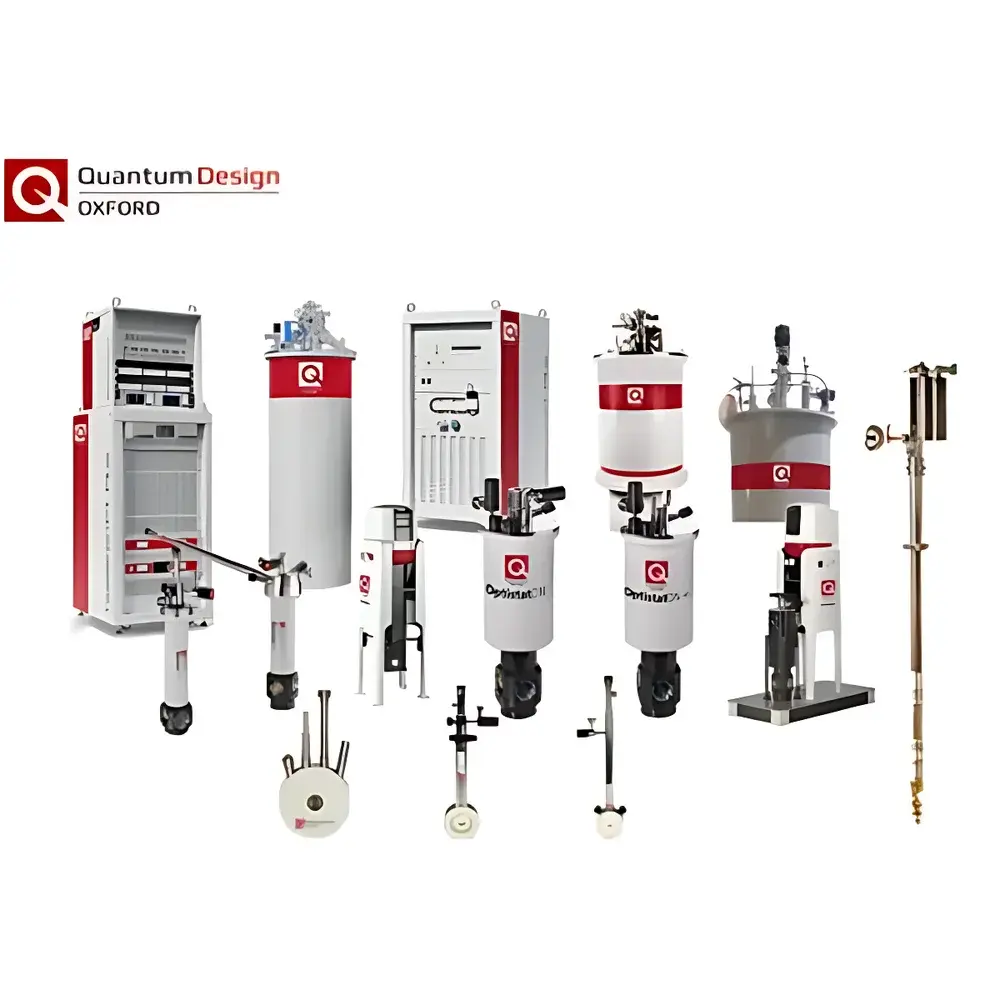
Quantum Design Oxford Superconducting Magnet and Cryogenic System
| Brand | Quantum Design |
|---|---|
| Origin | USA |
| Manufacturer Type | Manufacturer |
| Origin Category | Imported |
| Model | Quantum Design Oxford Superconducting Magnet and Cryogenic System |
| Instrument Type | Vertical |
| Temperature Range | < 1.5 K to 600 K |
| Magnetic Field Options | 6–14 T (including 6-1-1 T hybrid) |
| Helium-3 Insert Temperature Range | 300 mK – 300 K |
| Sample Space Diameter | up to 50 mm (variable by configuration) |
| Temperature Stability | ±50 mK (standard cryostat), ±3 mK @ 350 mK (HelioxVT), ±0.1 K (optical systems) |
| Cooling Time (RT → base T) | <2 hr (<2 K, dry system), ~90 min (to 5 K, optical magnet), <10 min (Microstat LN₂), <150 min (<3 K, dry refrigeration) |
| Refrigeration Method | Cryogen-free (pulse tube or GM), liquid helium (open-cycle), or liquid nitrogen (open-cycle) |
| Software | oi.DECS (open architecture, Python API, multi-instrument control) |
| Compliance | Designed for GLP/GMP-aligned workflows |
Overview
The Quantum Design Oxford Superconducting Magnet and Cryogenic System is a modular, high-integrity platform engineered for precision physical property measurements under extreme conditions—combining stable ultra-low temperatures (down to 300 mK) with high-field magnetic environments (up to 14 T). Built upon Oxford Instruments’ heritage in low-temperature physics and Quantum Design’s integration expertise, the system employs superconducting magnet technology based on NbTi or Nb₃Sn windings, cooled via closed-cycle pulse-tube or Gifford-McMahon cryocoolers, eliminating dependency on bulk cryogens in most configurations. Its core measurement principle relies on controlled thermal equilibration within vacuum-jacketed cryostats, coupled with persistent-mode magnet operation and active field regulation. This architecture enables reproducible, long-duration experiments in quantum transport, magnetic susceptibility, specific heat, muon spin rotation (μSR), and resonant spectroscopy—where thermal drift, field homogeneity (<0.01% over 1 cm³), and mechanical stability are critical to data fidelity.
Key Features
- Modular open-architecture design: Integrates seamlessly with Lake Shore M81/M91 temperature controllers and third-party measurement electronics via IEEE-488, USB, or Ethernet.
- Cryogen-free operation: Pulse-tube-based cooling achieves <1.5 K base temperature without liquid helium; optional dry compressor packages support air- or water-cooled operation.
- Field-flexible magnet configurations: Standard options include 8 T, 12 T, and 14 T vertical-bore superconducting magnets; hybrid 6-1-1 T systems provide independent control of orthogonal fields for vector magnet applications.
- oi.DECS software suite: Provides real-time monitoring, scriptable automation (Python API), multi-instrument synchronization, and configurable alarm thresholds—designed for unattended overnight runs and reproducible thermal ramping protocols.
- Vibration-optimized optical platforms: Microstat series cryostats feature low-vibration sample stages (<5 nm RMS at 1 Hz), adjustable working distance optics mounts, and direct DC wiring (up to 10 leads) for in-situ electrical characterization during microscopy.
- HelioxVT 3He insert: Enables sub-kelvin variable-temperature operation (300 mK–300 K) with exceptional stability (±3 mK below 1.2 K) and calibrated refrigeration power (50 μW @ 350 mK), suitable for quantum coherence and dilution-limited thermometry.
Sample Compatibility & Compliance
The system accommodates diverse sample geometries—including bulk crystals, thin films, nanowires, powders, and suspended membranes—across interchangeable sample probes and vacuum chambers. Standard bore diameters range from 20 mm (Microstat) to 50 mm (TeslatronPT-derived platforms), with vacuum sample spaces rated to 10−6 mbar. All cryostats meet ISO 21649:2021 requirements for vacuum integrity and thermal shielding performance. For regulated environments, the oi.DECS software supports 21 CFR Part 11-compliant user access controls, electronic signatures, and immutable audit logs—enabling traceability in GLP, GMP, and ISO/IEC 17025-accredited laboratories. Calibration certificates for temperature sensors (Cernox®, RuO₂, carbon-glass) and field probes (Hall, NMR) are supplied with each system.
Software & Data Management
oi.DECS serves as the unified control and data acquisition interface, supporting both graphical workflow builders and programmatic scripting. It natively imports and exports HDF5 and CSV formats, enabling direct integration with Python-based analysis pipelines (e.g., SciPy, NumPy, Matplotlib) and commercial tools such as Igor Pro and LabVIEW. Real-time metadata tagging includes timestamped environmental parameters (temperature, field, pressure, cooling power), instrument status flags, and user-defined experimental annotations. Data provenance is preserved through hierarchical file naming, automated versioning of configuration files, and optional network-attached storage (NAS) archiving with checksum validation.
Applications
- Quantum materials research: Mapping phase diagrams of unconventional superconductors, topological insulators, and correlated electron systems via magnetotransport and torque magnetometry.
- Nanoscale magnetism: Vector-field hysteresis loop acquisition in single-domain nanoparticles and skyrmion lattices using SQUID or Hall bar detection.
- Low-temperature spectroscopy: FTIR, Raman, and photoluminescence studies requiring <2 K stability and optical access with minimal thermal background.
- Spintronics device testing: In-situ current-induced switching and domain imaging under simultaneous magnetic field and sub-100 mK thermal bias.
- Fundamental metrology: Precision determination of the von Klitzing constant, Josephson voltage standard verification, and quantum Hall effect benchmarking.
FAQ
What cooling methods are supported across the platform?
The system supports cryogen-free (pulse-tube or GM cryocooler), liquid helium (open-cycle), and liquid nitrogen (open-cycle) operation—configurable per application requirements and infrastructure constraints.
Can the system be upgraded from a basic cryostat to a full magnet-cryostat integration?
Yes. Oxford’s modular design allows staged upgrades: users may begin with an Optistat or Microstat platform and later integrate into TeslatronPT or HelioxVT-based magnet systems via compatible flange standards (CF-63, CF-100) and control interface mapping.
Is remote operation supported for unattended experiments?
All systems ship with oi.DECS remote server mode, enabling secure SSH or TLS-encrypted web-based access for real-time monitoring, parameter adjustment, and emergency shutdown from off-site locations.
How is temperature calibration validated?
Each system includes factory-calibrated primary sensors traceable to NIST standards; users may perform in-situ verification using embedded reference resistors or external calibrated thermometers per ASTM E2913 guidelines.
What maintenance intervals are recommended for dry cryocoolers?
Compressor service is recommended every 18–24 months under continuous operation; cold-head refurbishment is typically required after 20,000–30,000 operating hours, with full service documentation provided in the maintenance manual.



