
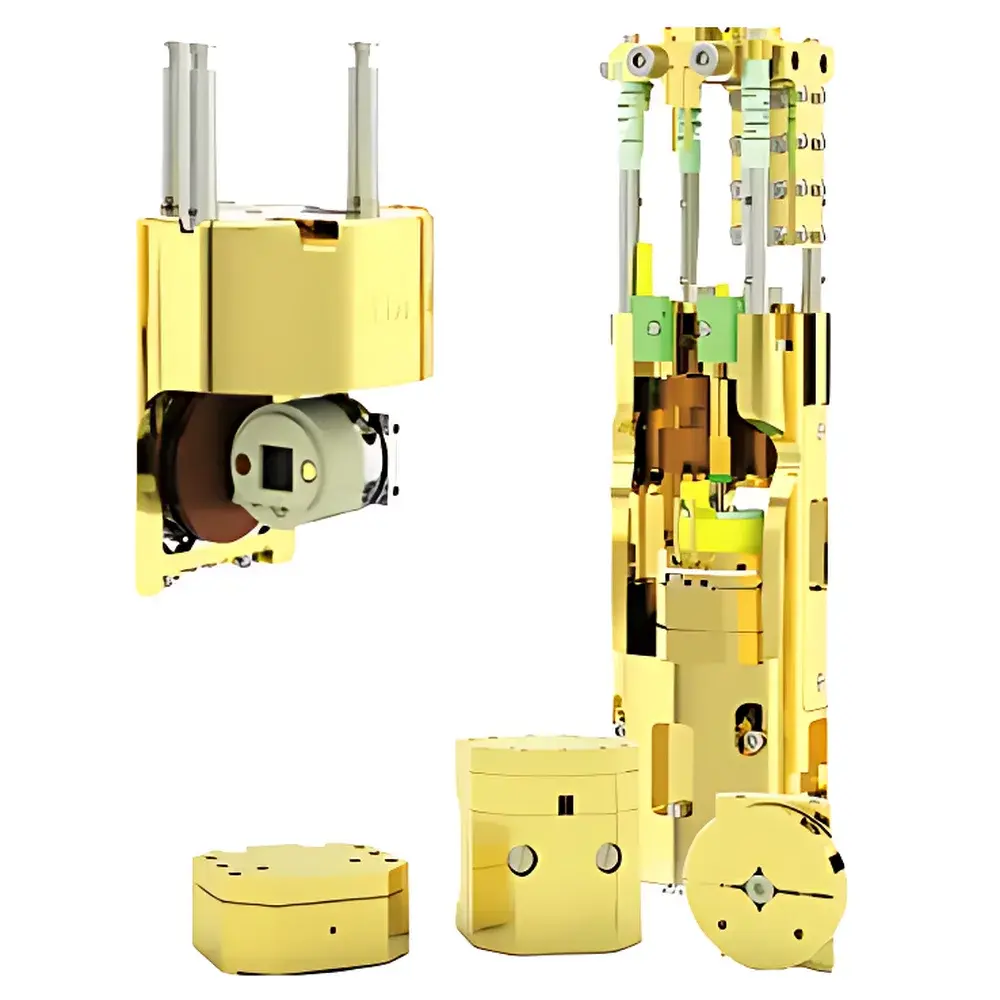
Attocube ANR101/RES mK-Grade Nanopositioning Translation Stage
| Brand | Attocube Systems AG |
|---|---|
| Origin | Germany |
| Model | ANR101/RES |
| Product Type | Motorized Translation Stage |
| Operating Temperature Range | 10 mK – 373 K |
| Magnetic Field Compatibility | 0 – 31 T |
| Vacuum Compatibility | Ambient – 5×10⁻¹¹ mbar |
| Closed-Loop Positioning Resolution | 1 nm |
| Maximum Travel Range | 50 mm |
| Minimum Stage Footprint | 11 × 11 mm |
| Load Capacity | Up to 2 kg |
| Actuation Voltage | 60 V or 150 V (low-voltage compatible) |
| Material | Beryllium Copper (BeCu) |
| Compliance | Designed for GLP/GMP-aligned quantum transport & optical spectroscopy workflows requiring traceable positioning under cryogenic, ultra-high vacuum, and high-field conditions |
Overview
The Attocube ANR101/RES is a cryogenically engineered nanopositioning translation stage explicitly designed for operation in extreme experimental environments—down to 10 mK in dilution refrigerators, up to 31 T in superconducting magnets, and under ultra-high vacuum (UHV) conditions as low as 5×10⁻¹¹ mbar. Built upon piezoelectric inchworm actuation principles, the stage delivers sub-nanometer closed-loop positional stability without continuous voltage bias: once a target coordinate is reached, the drive voltage drops to 0 V, eliminating thermal drift and electromagnetic interference commonly associated with sustained piezoelectric excitation. Its monolithic beryllium copper (BeCu) construction ensures exceptional thermal conductivity at millikelvin temperatures, mechanical rigidity across thermal contraction gradients, and negligible magnetic susceptibility—critical for magnetotransport and spin-resolved measurements where stray fields must remain below 10 nT.
Key Features
- True mK-compatible architecture: validated for continuous operation at base temperatures <20 mK in Leiden CF-CS81-600 and BlueFors LD400 dilution refrigerators.
- Beryllium copper (BeCu) structural body: provides >3× higher thermal conductance than stainless steel at 10 mK and zero ferromagnetic contribution—enabling integration into SQUID magnetometry and NV-center quantum sensing setups.
- Zero-hold-voltage positioning: eliminates Joule heating and low-frequency noise injection during static hold phases—essential for long-integration optical spectroscopy and time-resolved quantum coherence experiments.
- Dual-role functionality: serves simultaneously as coarse approach stage (50 mm travel) and fine scanning actuator (1 nm closed-loop resolution), reducing mechanical complexity and alignment sensitivity in multi-axis cryogenic probe stations.
- Low-voltage drive electronics: operates at ≤150 V, avoiding high-voltage shielding requirements; compatible with standard SMA and LEMO connectors used in commercial cryogenic wiring harnesses.
- Hermetic UHV-rated feedthroughs: all electrical interfaces meet ISO-KF40 and ConFlat 63 standards; stage body complies with ASTM E595 outgassing specifications (<1.0% TML, <0.1% CVCM).
Sample Compatibility & Compliance
The ANR101/RES is routinely deployed in quantum materials characterization platforms where sample integrity, signal fidelity, and environmental fidelity are co-constrained. It supports substrates ranging from 2 mm × 2 mm nanofabricated Hall bars to 10 mm × 10 mm epitaxial heterostructures on sapphire or SiC wafers. Mechanical mounting uses kinematic stainless-steel interface plates with adjustable pre-load screws, ensuring repeatable thermal anchoring without microfracture risk. The stage conforms to ISO 14644-1 Class 4 cleanroom handling protocols during assembly and is certified for use in facilities adhering to IEC 61000-4-3 (radiated immunity) and IEC 61000-4-6 (conducted immunity). For regulated research environments—including those subject to FDA 21 CFR Part 11 or EU Annex 11—optional firmware logging modules provide timestamped, tamper-evident position audit trails with SHA-256 hash verification per movement event.
Software & Data Management
Control is implemented via Attocube’s ASC500 controller platform, supporting both LabVIEW-based VI libraries (NI-VISA compliant) and Python 3.8+ API (PyPI package: attocube_asc). All motion commands support synchronous trigger input (TTL/LVDS) and hardware interlock feedback (opto-isolated), enabling tight synchronization with lock-in amplifiers, pulsed lasers, or RF synthesizers. Position data streams at up to 1 kHz with 24-bit ADC resolution and are logged in HDF5 format compliant with NeXus conventions (NXpositioner class). Audit logs include controller firmware version, ambient sensor readings (temperature, pressure), and real-time encoder status flags—facilitating full traceability required for GLP-compliant publications and instrument qualification reports (IQ/OQ/PQ).
Applications
- Quantum transport metrology: Angular-dependent Shubnikov–de Haas oscillations in GaAs/AlGaAs 2DEGs at <22 mK, enabled by integrated ANR101/RES rotation stages achieving <0.1° angular resolution (Rev. Sci. Instrum. 90, 023905).
- Fractional quantum Hall nonlinear optics: Sub-100 mK cavity tuning for time-resolved four-wave mixing in ETH Zürich’s fractional QHE polariton experiments (Nature 572, 91–94).
- 2D magnetism characterization: Nonreciprocal second-harmonic generation mapping in bilayer CrI₃ under 9 T vertical field, leveraging BeCu stage stability to maintain optical overlap over 12-hour acquisitions (Nature 572, 497–501).
- Pressure-tuned quantum sensing: Nanopositioning of diamond anvil cells inside attocube attoDRY800 cryostats for NV-center detection of local strain gradients under >100 GPa (Science 366, 1349–1354).
- Moiré superlattice engineering: In situ alignment of ABC-trilayer graphene/hBN heterostructures relative to 15 T vector magnets, confirming Mott–superconductor–metal phase transitions (Nature 572, 215–219).
FAQ
Can the ANR101/RES operate continuously at 10 mK in a dry dilution refrigerator?
Yes—its BeCu body, low-power drive electronics (<15 mW static dissipation), and absence of hold voltage enable stable operation at base temperature in cryogen-free systems including BlueFors LD400 and Leiden CF-CS81-600.
Is closed-loop feedback provided by integrated capacitive sensors or external interferometers?
Capacitive position sensors are monolithically embedded within the stage body and calibrated traceably to NIST SRM-2036 step-height standards; no external metrology is required for 1 nm repeatability.
Does the stage generate measurable magnetic noise in a 31 T solenoid?
No—BeCu’s relative permeability μr = 1.00002 ± 0.00001 at 4 K, confirmed by SQUID magnetometry (Phys. Rev. Appl. 12, 044029); residual field distortion is <5 nT at 1 mm distance.
What vacuum-compatible cabling options are available for signal routing?
Standard configurations include twisted-pair CuNi cables with NbTi shields (≤1 nΩ/√Hz noise floor) and custom UHV feedthroughs rated to 10⁻¹¹ mbar; fiber-optic position readout variants are available upon request.
How is thermal anchoring achieved between the stage and cold plate?
Via two-point kinematic mounting using oxygen-free high-conductivity (OFHC) copper pads and indium foil gaskets; thermal resistance measured at 10 mK is <15 mK/mW (independent calorimetry).



