
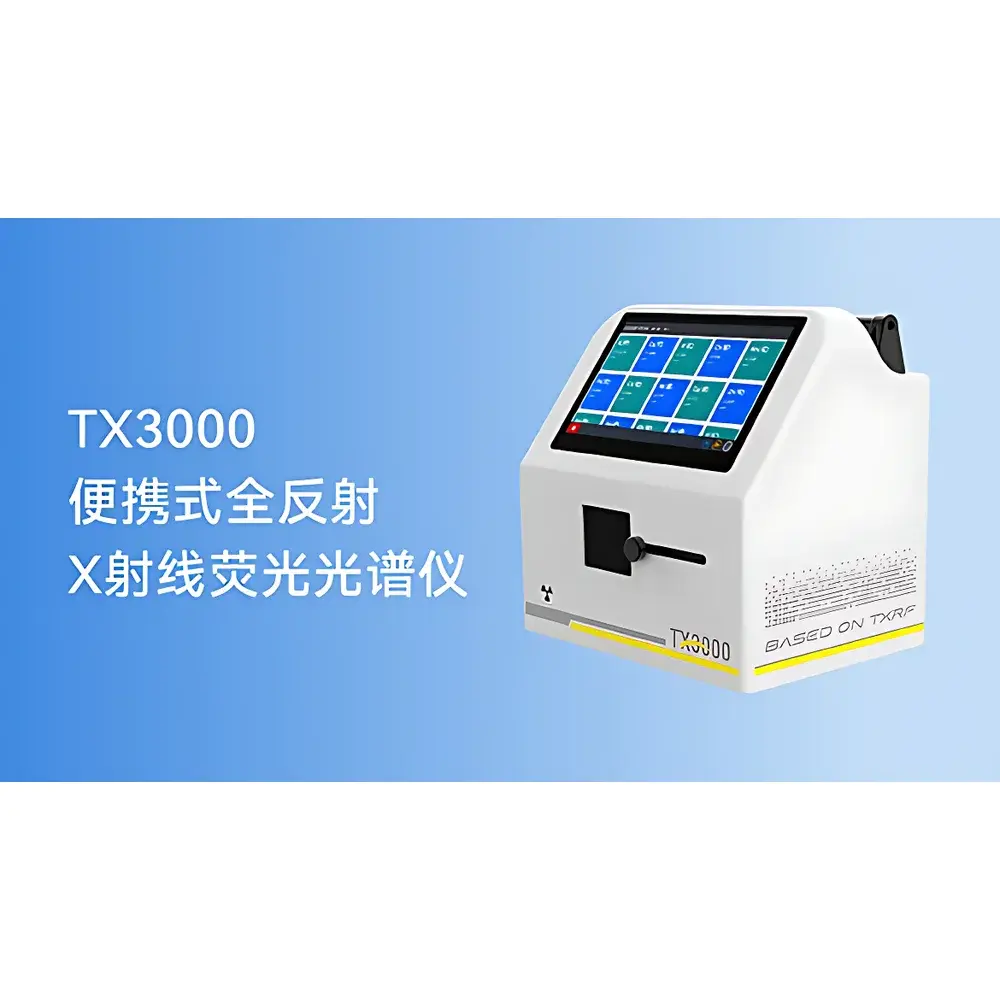
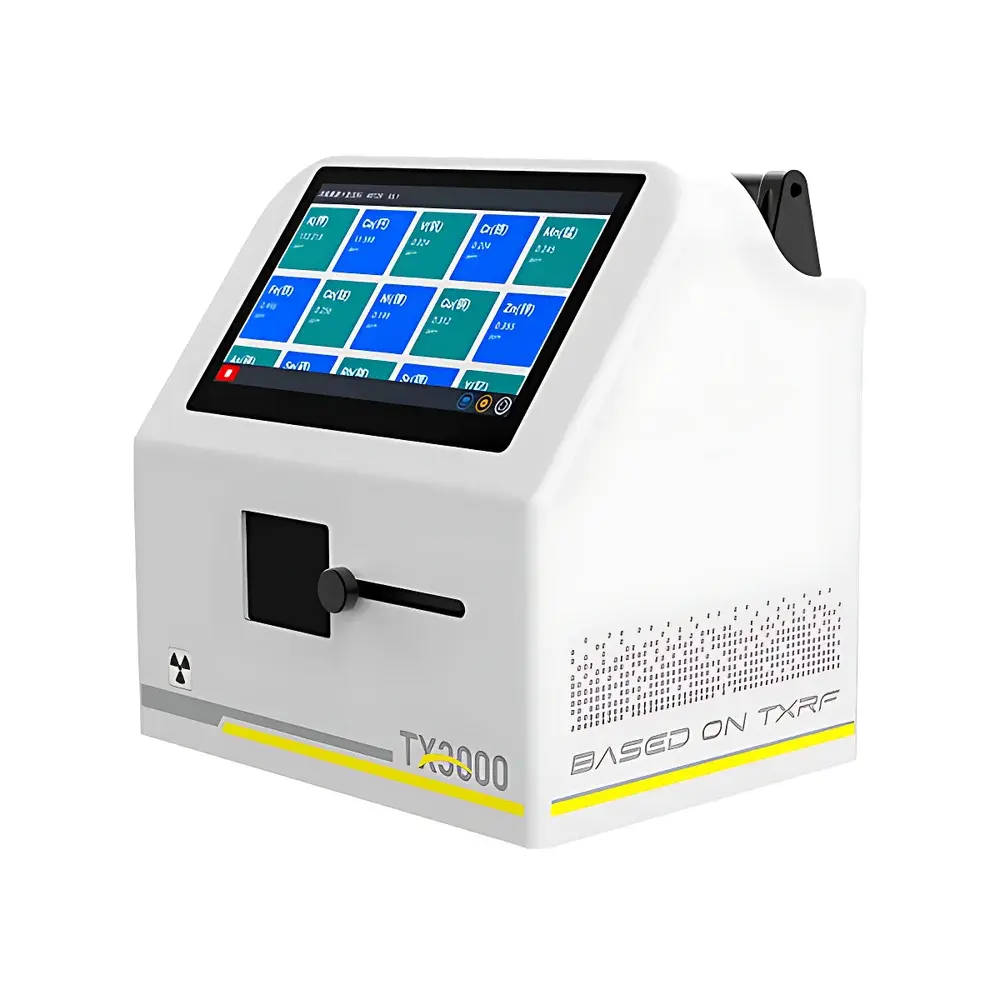
LANScientific TX3000 Total Reflection X-Ray Fluorescence Spectrometer
| Brand | LANScientific |
|---|---|
| Origin | Jiangsu, China |
| Manufacturer Type | Original Equipment Manufacturer (OEM) |
| Product Category | Domestic |
| Model | TX3000 |
| Application | Portable/Field-Deployable |
| Instrument Type | Total Reflection XRF (TXRF) |
| Industry-Specific Use | Soil & Atmospheric Analysis |
| Elemental Range | Mg (12) to U (92) |
| Detection Range | 30 ppb – 100 ppm |
| Detector | 20 mm² Silicon Drift Detector (SDD) |
Overview
The LANScientific TX3000 Total Reflection X-Ray Fluorescence (TXRF) Spectrometer is a field-deployable, benchtop-compatible analytical instrument engineered for ultra-trace elemental quantification in minimal sample volumes. Unlike conventional energy-dispersive X-ray fluorescence (ED-XRF) systems, the TX3000 employs a total external reflection geometry: the primary X-ray beam strikes the quartz carrier substrate at a grazing incidence angle (3 orders of magnitude. This physical configuration enables detection limits down to 30 parts-per-trillion (ppt) equivalent for matrix-matched standards—achievable with ≤10 µL liquid deposits or ≤100 ng solid residues. The system integrates a high-brightness microfocus X-ray tube, multilayer monochromator for spectral purity enhancement, and a large-area (20 mm²) silicon drift detector (SDD) with Peltier cooling and <125 eV Mn-Kα energy resolution. Designed for compliance with ISO 8258 (control charts), ASTM D7088 (trace metal analysis in soils), and EPA Method 6020B (ICP-MS/TXRF cross-validation), the TX3000 delivers metrologically traceable results without cryogenic cooling or vacuum pumping.
Key Features
- True TXRF optical architecture with fixed-angle monochromatic excitation and total reflection geometry
- Integrated 20 mm² SDD detector with real-time pulse processing and dead-time correction
- Monochromated W-target X-ray source (50 kV / 1 mA) optimized for low-Z to high-Z element excitation
- Automated sample stage with motorized Z-height adjustment for optimal take-off angle calibration
- Zero-consumables operation: no liquid nitrogen, helium purge, or high-purity gases required
- Ruggedized aluminum chassis with IP54-rated enclosure for field deployment and mobile lab integration
- Embedded ARM-based controller with dual-boot OS (Linux RT + Windows IoT) for deterministic timing
Sample Compatibility & Compliance
The TX3000 accepts liquid aliquots (aqueous/organic), dried residues, filter-collected particulates (e.g., PM2.5 filters), digested soil extracts, and thin-film-coated substrates. Sample preparation follows ISO 29232 (TXRF sample deposition) and EN 14385 (environmental water analysis). Quantitative analysis uses internal standardization (e.g., Ga or Y addition) per ISO 18557, with calibration traceable to NIST SRM 2783 (Air Particulate Matter) and BAM BCR-723 (Soil). The system meets IEC 61000-6-3 (EMC) and IEC 61000-6-4 (industrial emission) standards. Radiation safety complies with IEC 62495 (handheld XRF devices) and national GBZ 188-2014 occupational exposure limits—dose rate at 5 cm from housing < 0.5 µSv/h during operation.
Software & Data Management
The proprietary SpectraView TXRF software provides full GLP/GMP-compliant workflow management: audit-trail-enabled method creation, electronic signature support (21 CFR Part 11 ready), and automated uncertainty propagation per GUM (JCGM 100:2008). Spectral deconvolution uses fundamental parameter (FP) modeling with matrix correction algorithms validated against certified reference materials. Data export supports ASTM E1392 (analytical data interchange), CSV, and XML formats compatible with LIMS integration. Firmware updates are delivered via secure HTTPS with SHA-256 signature verification; all raw spectra and processing parameters are stored immutably in SQLite3 databases with write-once archival mode.
Applications
- Environmental monitoring: Quantification of As, Cd, Cr, Pb, Hg, Ni, Cu, Zn in soil leachates, atmospheric deposition filters, and wastewater effluents
- Geochemical prospecting: Rapid screening of exploration samples for pathfinder elements (e.g., Au-Te-Bi associations)
- Pharmaceutical QC: Residual catalyst metal analysis (Pd, Pt, Rh) in active pharmaceutical ingredients (APIs) per ICH Q2(R2)
- Cultural heritage: Non-destructive pigment composition mapping on manuscripts and ceramics
- Food safety: Screening for toxic elements (As, Pb, Cd) in rice, infant formula, and dietary supplements
- Materials science: Surface contamination control in semiconductor wafer cleaning validation
FAQ
What sample volume is required for reliable quantification?
Typical liquid samples require 5–20 µL deposited onto quartz carriers; solid samples need ≤100 ng mass for sub-ppb detection.
Can the TX3000 analyze powdered solids directly?
No—powders must be acid-digested or suspended in dilute nitric acid prior to deposition to ensure homogeneous monolayer formation.
Is spectral interference correction available for overlapping peaks (e.g., Sb Kβ / Sn Kα)?
Yes—the FP engine applies iterative peak deconvolution using library-based line shape fitting and secondary fluorescence correction.
Does the system support regulatory reporting for EU RoHS or China GB/T 26572?
Yes—preconfigured methods include limit checking, pass/fail flagging, and PDF report generation compliant with both directives.
What maintenance intervals are recommended for field operation?
Detector calibration verification every 90 days; X-ray tube output stability check every 6 months; quartz carrier cleaning after each batch.






