
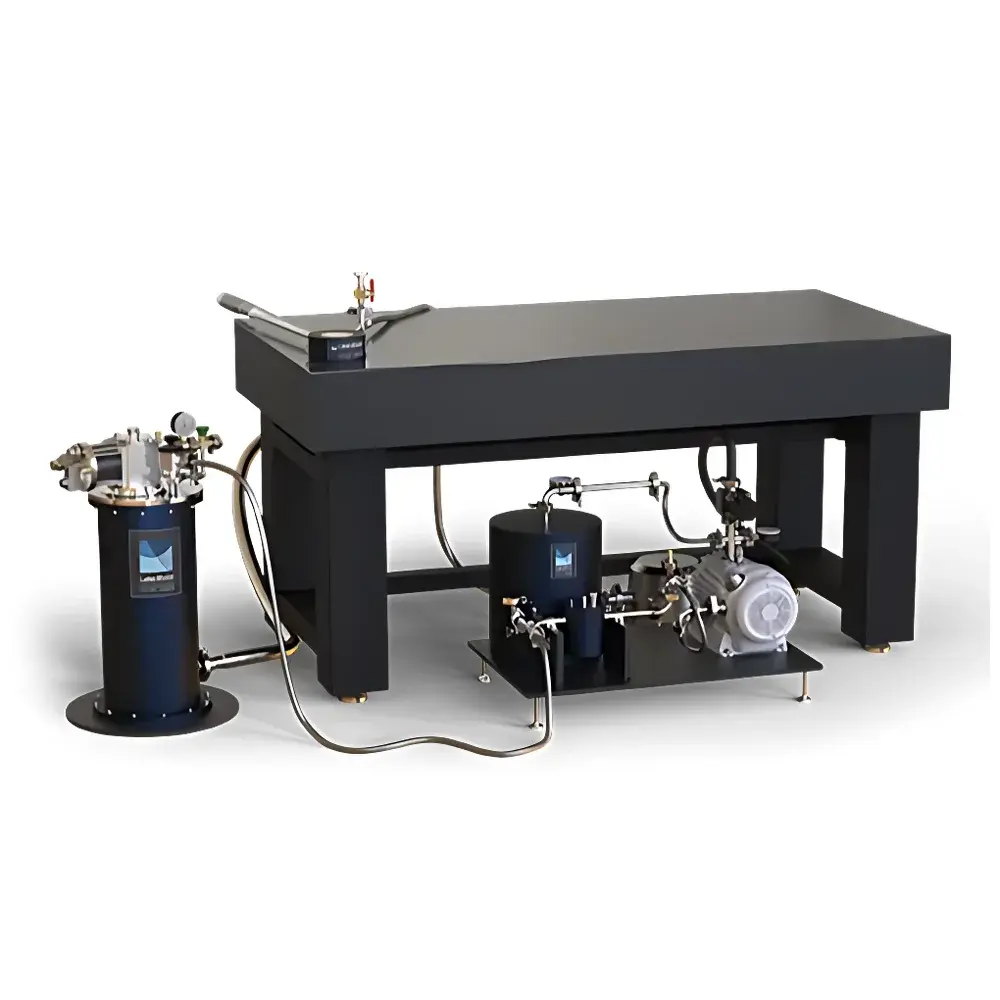
Lake Shore RGC Series Closed-Cycle Helium Recirculating Refrigerator
| Brand | Lake Shore |
|---|---|
| Origin | USA |
| Model | RGC |
| Cooling Medium | Helium (gaseous & liquefied) |
| Operating Principle | Closed-loop cryogenic recirculation with pulse-tube or GM-based cold head |
| Compatible Cryostats | Lake Shore ST-100, ST-300, ST-400, ST-500, STVP series |
| Base Temperature (with ST-500) | ≤3.3 K (RGC4-20), ≤3.5 K (RGC4-15), ≤3.9 K (RGC4-12), ≤4.3 K (RGC4-10) |
| Cooling Power @ 5 K | up to 280 mW (RGC4-20) |
| Vibration Level (ST-500 + RGC) | <50 nm RMS (1–100 Hz) |
| Sample Exchange | Cold-insertion compatible (no warm-up required) |
| Compliance | Designed for GLP/GMP-adjacent research environments |
Overview
The Lake Shore RGC Series Closed-Cycle Helium Recirculating Refrigerator is an engineered solution for eliminating liquid helium dependency in continuous-flow cryogenic applications. Unlike traditional liquid helium dewars, the RGC operates a fully sealed, closed-loop helium circuit—compressing, cooling, liquefying, and recirculating gaseous helium through vacuum-jacketed flexible transfer lines. At its core, the system integrates a high-efficiency cryocooler (pulse-tube or Gifford-McMahon type) that achieves sub-4 K base temperatures without consumables. The refrigerated helium is delivered to a compatible cryostat—such as the Lake Shore ST-500 ultra-stable microscope cryostat—where it undergoes phase change at the cold tip, absorbs heat from the sample stage, and returns as vapor to the RGC for recondensation. This thermodynamic cycle enables sustained operation at temperatures down to 2.6 K (RGC4-15) and 2.6 K (RGC4-20), with verified stability of ±5 mK over 24 hours under steady-state conditions. Its design specifically targets applications requiring both extreme thermal stability and mechanical quietness—particularly low-vibration scanning probe microscopy (SPM), quantum transport measurements, and superconducting device characterization.
Key Features
- True zero-boil-off operation: Eliminates recurring liquid helium procurement, storage, and handling risks while reducing long-term operational cost and logistical overhead.
- Cold-sample exchange capability: Samples can be inserted or replaced without warming the cryocooler or breaking vacuum—enabling rapid experimental turnaround and minimizing thermal cycling stress on delicate devices.
- Ultra-low vibration architecture: Optimized cold head suspension, helium flow damping, and rigid mechanical decoupling between compressor and cold stage yield vibration amplitudes below 50 nm RMS across 1–100 Hz—critical for atomic-resolution imaging and interferometric sensing.
- Modular scalability: Four standard configurations (RGC4-10, RGC4-12, RGC4-15, RGC4-20) offer progressively higher cooling power and lower base temperatures, allowing users to match performance precisely to experimental requirements.
- Interoperability by design: Native integration with Lake Shore ST and STVP cryostats—including full electrical, thermal, and control signal compatibility—and backward compatibility with select third-party continuous-flow cryostats via standardized helium inlet/outlet interfaces and pressure regulation protocols.
Sample Compatibility & Compliance
The RGC series supports a wide range of sample geometries and mounting configurations when used with Lake Shore ST-series cryostats, including optical access windows (UV–IR), electrical feedthroughs (DC to GHz), magnetic field compatibility (up to ±9 T with optional split-pair magnets), and vacuum-integrated nanopositioning stages. All RGC units are manufactured in accordance with ISO 9001-certified processes and conform to CE marking requirements for electromagnetic compatibility (EMC Directive 2014/30/EU) and low-voltage safety (LVD Directive 2014/35/EU). While not classified as medical or pharmaceutical equipment, the system’s deterministic temperature control, non-volatile memory logging, and traceable calibration pathways align with principles outlined in FDA 21 CFR Part 11 for electronic records and signatures—making it suitable for regulated research environments where audit trails and instrument qualification (IQ/OQ/PQ) are required.
Software & Data Management
The RGC operates under coordinated control of Lake Shore’s CrossBridge™ software platform, which provides synchronized monitoring and setpoint management across refrigeration, temperature sensing (via calibrated Cernox® or RuO₂ sensors), and auxiliary subsystems (e.g., magnet power supplies, vacuum gauges). Real-time telemetry—including helium pressure differentials, cold-head temperature gradients, compressor current draw, and mass flow rate estimates—is logged at user-defined intervals and exportable in CSV or HDF5 format. CrossBridge supports scripting via Python API, enabling automated cooldown ramps, thermal hysteresis mapping, and failure-mode detection based on deviation thresholds. All configuration changes and operator actions are timestamped and stored locally with SHA-256 integrity hashing—ensuring full traceability per GLP documentation standards.
Applications
- Low-temperature scanning tunneling microscopy (LT-STM) and atomic force microscopy (LT-AFM) requiring sub-nanometer positional stability.
- Quantum Hall effect and topological insulator studies demanding stable sub-3 K environments with minimal thermal drift.
- Single-photon detector characterization (e.g., SNSPDs, TES) where dark count rate suppression depends critically on base temperature and microphonics.
- In-situ magneto-optical Kerr effect (MOKE) and photoluminescence spectroscopy with cryogenic excitation sources.
- Development and validation of cryo-CMOS circuits and superconducting qubit testbeds requiring repeatable thermal anchoring and EMI-free operation.
FAQ
Does the RGC require periodic helium refills?
No—the RGC is a fully sealed, closed-cycle system. Once initially charged with high-purity helium (≥99.999%), no replenishment is necessary under normal operation.
Can the RGC be operated unattended for extended periods?
Yes—when paired with Lake Shore’s auto-recovery firmware and monitored via CrossBridge, the RGC supports autonomous operation for >72 hours, including automatic restart after brief power interruptions.
What maintenance is required?
Annual inspection of compressor oil level and helium circuit integrity is recommended; cold head service intervals exceed 20,000 operating hours per manufacturer specifications.
Is remote diagnostics supported?
Yes—via Ethernet-connected CrossBridge controllers with secure SSH/TLS-enabled access and real-time health dashboard visualization.
How does the RGC compare to traditional liquid helium cryostats in terms of temperature stability?
The RGC delivers superior short-term stability (±1 mK over 10 minutes) due to absence of boiling-induced pressure fluctuations and continuous-phase thermal buffering—exceeding typical liquid helium dewar performance by a factor of 3–5×.



