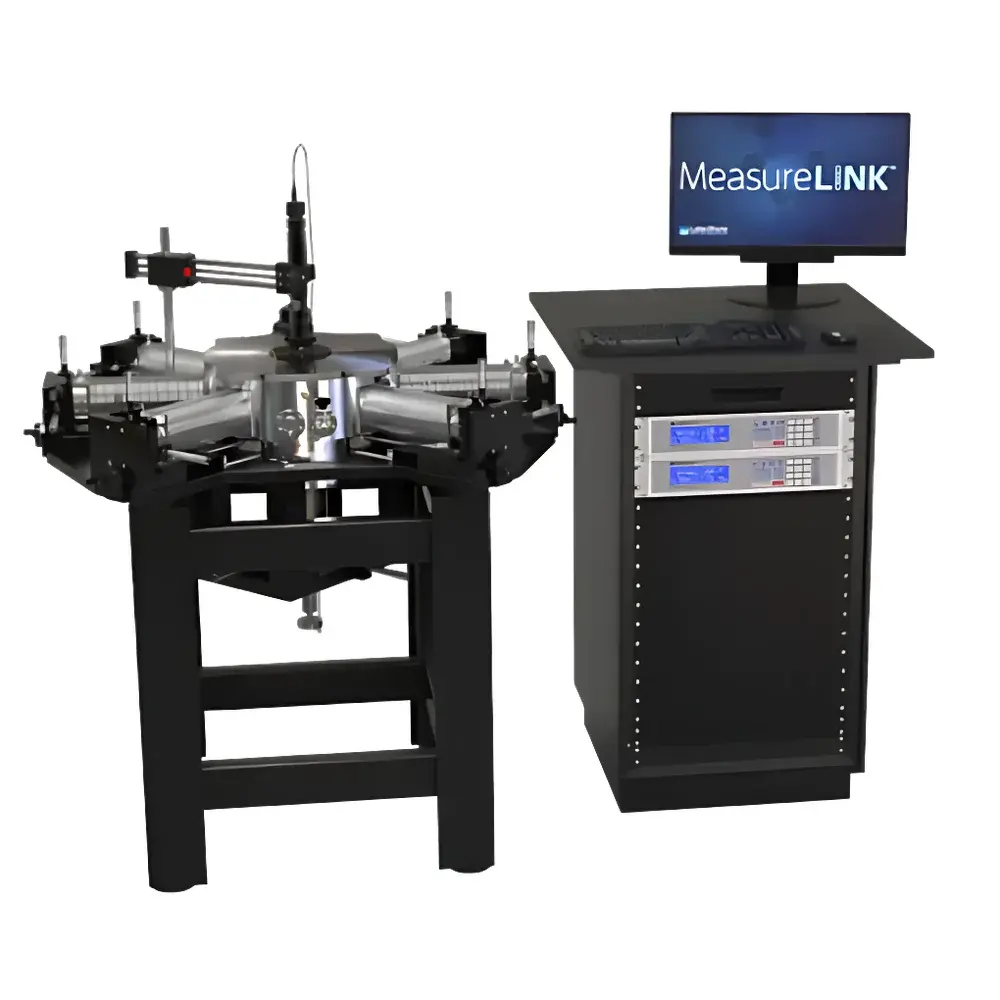
Lake Shore FWPX 4-Inch Cryogenic Probe Station
| Brand | Lake Shore |
|---|---|
| Origin | USA |
| Manufacturer Status | Authorized Distributor |
| Product Origin | Imported |
| Model | FWPX |
| Pricing | Upon Request |
Overview
The Lake Shore FWPX 4-Inch Cryogenic Probe Station is a high-precision, research-grade instrumentation platform engineered for low-temperature electrical, optoelectronic, and microwave characterization of semiconductor materials and devices. Built upon a continuous-flow cryogenic architecture, the system utilizes liquid helium or liquid nitrogen to achieve stable thermal control across an exceptionally broad operational range—from 3.5 K (with optional PS-LT low-temperature kit) up to 475 K. Its core design follows the Couette-flow–compatible vacuum chamber geometry and rigid mechanical layout required for sub-30 nm vibration stability—critical for nanoscale transport measurements and quantum device testing. The FWPX serves as a foundational tool in university cleanrooms, national lab metrology facilities, and industrial R&D centers where reproducible, traceable cryogenic probing of large-area substrates—particularly 102 mm (4-inch) wafers—is essential. Unlike production-oriented handlers, the FWPX prioritizes measurement fidelity over throughput, supporting DC, RF, microwave (up to 67 GHz), and electro-optic modalities under ultra-high vacuum (UHV)-compatible conditions.
Key Features
- Continuous-flow cryogenic cooling with dual-fluid compatibility (liquid helium or liquid nitrogen)
- Standard operating temperature range: 4.5 K to 475 K; extendable to 3.5 K base temperature with PS-LT option
- Thermal stability ≤ ±20 mK (below 100 K, liquid helium mode); ≤ ±50 mK (up to 350 K, liquid nitrogen mode)
- Ultra-low mechanical vibration: <30 nm RMS (sample stage, at base temperature)
- Optimized for 102 mm (4-inch) wafers; configurable for up to 152 mm (6-inch) substrates via custom chamber retrofit
- Full in-plane sample rotation (±5°) and precision XY translation (covering full 102 mm wafer area)
- Modular probe arm architecture supporting up to six independently cooled, thermally anchored micro-manipulators
- DC/RF probe insulation >100 GΩ for ultra-low leakage current measurements (pA-level resolution)
- Integrated microwave probe support (DC–67 GHz) with calibrated SMA/K connectors and waveguide-compatible mounting
- Fiber-optic feedthroughs available for concurrent optical excitation/detection in electro-optic experiments
Sample Compatibility & Compliance
The FWPX accommodates rigid and flexible substrates—including silicon, GaAs, SiC, sapphire, organic semiconductors, 2D materials (e.g., graphene, TMDs), and hybrid perovskite thin films—without requiring specialized clamping or backside heating interfaces. Sample mounting uses a gold-plated copper chuck with integrated platinum resistance thermometer (PRT) and heater for closed-loop temperature control. Vacuum integrity complies with ISO 2859-1 sampling standards for UHV systems: base pressure <1 × 10⁻⁵ Torr at 4.5 K, maintained by a TPS-FRG turbomolecular pump set. Pump-down time to <1 × 10⁻³ Torr is ≤30 minutes. All metallic components meet ASTM B117 corrosion resistance specifications, and surface finishes adhere to SEMI F24-0201 cleanliness requirements for Class 100 cleanroom integration. The system supports GLP-compliant operation when paired with Lake Shore’s CrossBridge™ software and optional 21 CFR Part 11 audit trail modules.
Software & Data Management
Control and automation are managed through Lake Shore’s CrossBridge™ software suite (v5.2+), a Windows-based application supporting IEEE-488 (GPIB), USB-TMC, and Ethernet (VXI-11) instrument communication protocols. CrossBridge enables synchronized ramping of temperature, bias voltage, RF power, and optical parameters while logging timestamped metadata—including PRT readings, chamber pressure, cryogen flow rate, and probe position coordinates. Raw data export is supported in HDF5, CSV, and MATLAB (.mat) formats. For automated test sequences (e.g., parameter sweeps across temperature and gate bias), users may deploy Python-based scripting via the official lakeShore SDK (pip-installable, documented on GitHub). Audit trails, user access levels, and electronic signatures comply with FDA 21 CFR Part 11 when configured with network-authenticated login and encrypted database logging.
Applications
- Low-temperature Hall effect and van der Pauw mobility mapping of wide-bandgap semiconductors
- Cryogenic I-V/C-V characterization of FinFETs, nanowire transistors, and superconducting qubit test structures
- Microwave S-parameter extraction (S₁₁, S₂₁) for THz detector calibration and on-wafer RF model validation
- Electro-absorption and photoluminescence spectroscopy under variable magnetic field (when integrated with split-coil magnets)
- Transport studies of topological insulators and correlated electron systems (e.g., Mott insulators, heavy fermions)
- Reliability testing of organic photovoltaics and perovskite solar cells across thermal stress cycles
- Calibration of cryogenic reference sensors (e.g., RuO₂ thermometers, carbon-glass resistors) per ITS-90 protocol
FAQ
What is the standard vacuum pumping configuration?
The FWPX ships with a TPS-FRG turbomolecular pump set rated for 300 L/s N₂ speed, achieving <1 × 10⁻³ Torr in ≤30 minutes and <1 × 10⁻⁵ Torr at base temperature.
Can the system be upgraded for magnetic field integration?
Yes—optional bore adapters and non-magnetic probe arm variants allow integration with external 0–9 T superconducting magnets or 0–2 T electromagnets without compromising thermal or vibrational performance.
Is remote operation supported?
Fully supported via CrossBridge™’s secure Ethernet interface; includes VNC-compatible GUI mirroring, REST API endpoints for third-party test executive integration (e.g., Keysight PathWave, NI TestStand), and TLS 1.2 encrypted command streaming.
What probe types are certified for use with the FWPX?
Lake Shore validates GGB Picoprobe® series (DC/RF), Cascade Microtech Infinity™ (microwave), and OZ Optics fiber-coupled probes; third-party probes require thermal anchoring verification per FWPX Mechanical Interface Specification Rev. D.
How is temperature uniformity validated across the 102 mm sample area?
Each unit undergoes factory calibration using a 5-point PRT array mounted on a dummy silicon wafer; spatial uniformity is reported in the Certificate of Conformance (±0.15 K max deviation over central 80 mm diameter at 10 K).
Related Products