
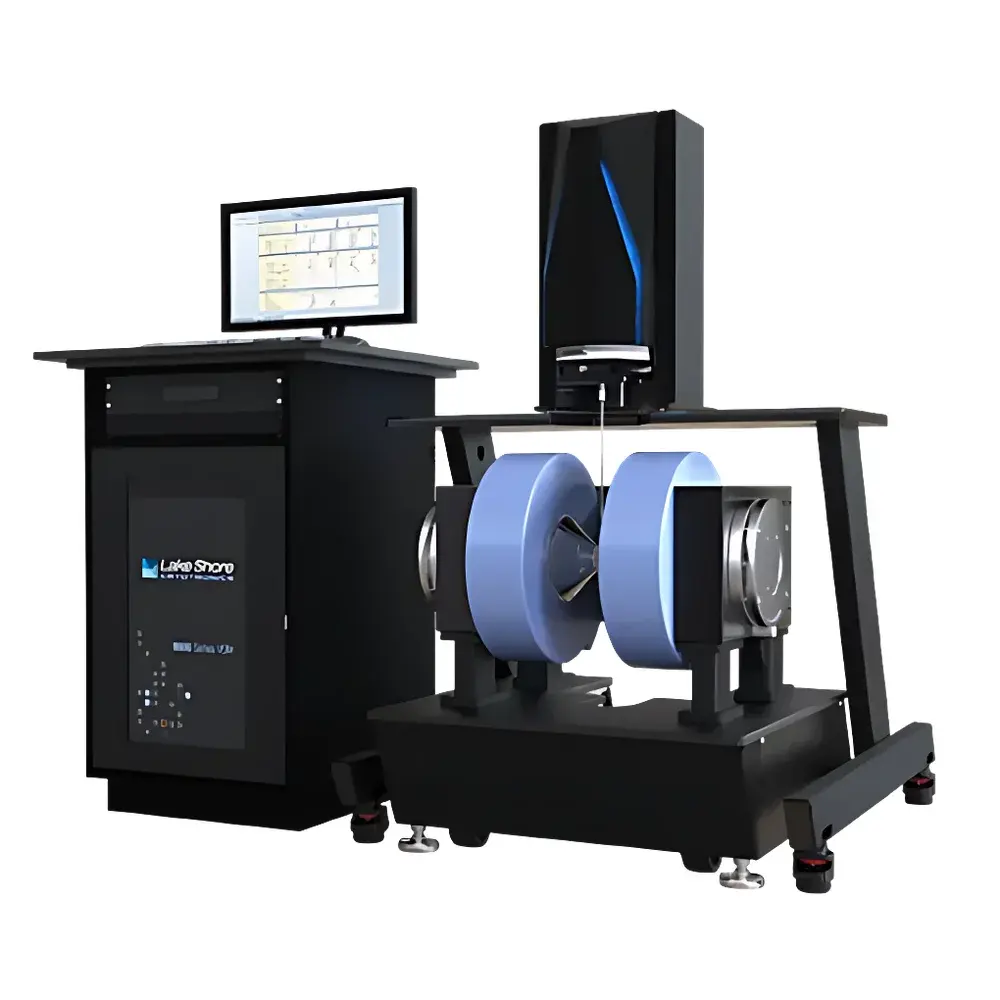
Lake Shore 8600 Series Vibrating Sample Magnetometer
| Brand | Lake Shore |
|---|---|
| Origin | USA |
| Manufacturer Type | Authorized Distributor |
| Product Origin | Imported |
| Model | 8600 |
| Magnet Type | Electromagnetic |
| Measurement Principle | Vibrating Sample Magnetometry (VSM) |
| Temperature Range | 10 K – 1273 K |
| Magnetic Field Range | Up to 3.62 T |
| Magnetic Moment Sensitivity | 5 × 10⁻⁸ emu |
| Field Sweep Rate | 10,000 Oe/s |
Overview
The Lake Shore 8600 Series Vibrating Sample Magnetometer (VSM) is a high-performance, cryogen-free magnetic characterization system engineered for precision measurement of magnetic moment as a function of applied magnetic field and temperature. Based on the proven architecture of the 7400 Series VSM, the 8600 platform integrates fundamental advances in vibration mechanics, electromagnetic field control, signal conditioning, and thermal management to deliver industry-leading sensitivity, speed, and operational robustness. The system operates on the classical VSM principle: a sample is sinusoidally vibrated at a fixed frequency (typically 80–120 Hz) within a uniform magnetic field gradient; the induced AC voltage in detection coils is proportional to the sample’s magnetic moment and phase-locked to the vibration reference. This method enables quantitative, absolute moment determination without calibration standards, supporting traceable measurements compliant with ASTM A977/A977M and ISO 10113 for magnetic property evaluation.
Key Features
- Ultra-high magnetic moment resolution: 5 × 10⁻⁸ emu (root-mean-square), validated under controlled background conditions and optimized coil geometry.
- High-speed data acquisition: 10 ms per data point, enabling full hysteresis loop acquisition in ≤30 seconds at standard field sweep rates.
- Rapid field modulation: Programmable sweep rates up to 10,000 Oe/s, facilitating dynamic magnetization studies and coercivity analysis under non-equilibrium conditions.
- Exceptional field stability and resolution: ±0.05% full-scale drift per day; 1 mOe field resolution achieved via high-stability power supply and real-time Hall probe feedback.
- QuickLIGN™ sample mounting system: Tool-free, single-hand sample insertion and alignment; maintains mechanical repeatability across thermal cycles and field orientations.
- Integrated GlideLOCK™ thermal module recognition: Automatic firmware identification and configuration of SSVT, Cryostat, or Oven accessories upon physical installation.
- Motorized sample rotation: Continuous, programmable azimuthal rotation (0–360°) synchronized with field sweeps for anisotropy mapping and vector magnetization analysis.
Sample Compatibility & Compliance
The 8600 Series accommodates solid samples ranging from sub-milligram thin films (<5 nm thickness) to bulk rods (up to 10 mm diameter × 25 mm length), including powders, pellets, epitaxial wafers, and nanostructured composites. All configurations comply with vacuum integrity requirements per ISO 27874 for ultra-low-background magnetic measurements. Optional vacuum-tight thermal stages (SSVT, Cryostat, Oven) maintain base pressures <1 × 10⁻⁶ Torr during operation. System design supports GLP/GMP-aligned workflows: audit trails, user access controls, and electronic signatures are enabled via optional 21 CFR Part 11-compliant software modules. Calibration protocols follow NIST-traceable procedures for field (Hall sensor) and moment (reference standard) verification.
Software & Data Management
The 8600 Series is operated via the proprietary MMS (Magnetic Measurement Suite) software, built on a modular, Python-embeddable architecture. The GUI provides intuitive setup of field profiles (linear, step, triangular), temperature ramps, rotation sequences, and multi-axis parameter sweeps. A fully integrated script engine supports custom protocol development using Python-based syntax—enabling automated batch runs, conditional logic, real-time data filtering, and external hardware triggering (e.g., laser heating, RF excitation). Raw time-domain signals, calibrated moment vs. field (M–H), and derived parameters (saturation magnetization Ms, remanence Mr, coercivity Hc, anisotropy constants) are stored in HDF5 format with embedded metadata (timestamp, instrument ID, operator, environmental logs). Export options include ASCII, CSV, and MATLAB-compatible .mat files for third-party analysis.
Applications
The 8600 Series serves as a core instrument in academic magnetism laboratories, national metrology institutes, and industrial R&D centers developing permanent magnets, spintronic devices, magnetic nanoparticles, multiferroics, and soft magnetic alloys. Typical use cases include:
- Temperature-dependent hysteresis characterization from 10 K (dilution refrigerator interface compatible) to 1273 K (high-temperature furnace).
- Vector magnetometry via synchronized field orientation and sample rotation—quantifying uniaxial, cubic, and planar anisotropy energy densities.
- Dynamic susceptibility measurements using field-modulated techniques (e.g., AC susceptibility amplitude/phase vs. frequency at fixed bias fields).
- Quality control of magnetic thin films (e.g., CoPt, FeCoB, NiFe) in semiconductor fabrication lines, where moment uniformity and interfacial dead-layer effects must be quantified at process-relevant temperatures.
- Validation of first-principles DFT predictions through direct comparison of experimental Ms(T) curves with theoretical Bloch-law extrapolations.
FAQ
What temperature ranges are supported by the standard 8600 Series configurations?
The base system operates at room temperature. With optional thermal stages: SSVT covers 77–950 K (LN₂-assisted), Cryostat extends to 4.2 K (LHe) or 77 K (LN₂), and the high-temperature oven reaches up to 1273 K.
Is the 8600 Series compatible with external cryogenic systems?
Yes—the system features standardized flange interfaces (CF-63, CF-100) and electrical feedthroughs for integration with custom cryostats, dilution refrigerators, or superconducting magnet systems.
How is magnetic field homogeneity ensured across different pole gaps?
Each pole gap configuration (3.5 mm to 24 mm) is paired with pre-characterized pole pieces and calibrated field maps; real-time Hall probe compensation corrects for spatial non-uniformity during scanning.
Can the 8600 Series perform AC susceptibility measurements?
Yes—via optional lock-in amplifier integration and software-controlled field modulation, enabling χ′(ω) and χ″(ω) extraction at frequencies from 0.1 Hz to 1 kHz.
What documentation is provided for regulatory compliance?
Factory calibration certificates, ISO/IEC 17025-compliant uncertainty budgets, and 21 CFR Part 11 readiness documentation (including electronic signature validation reports) are available upon request.



