
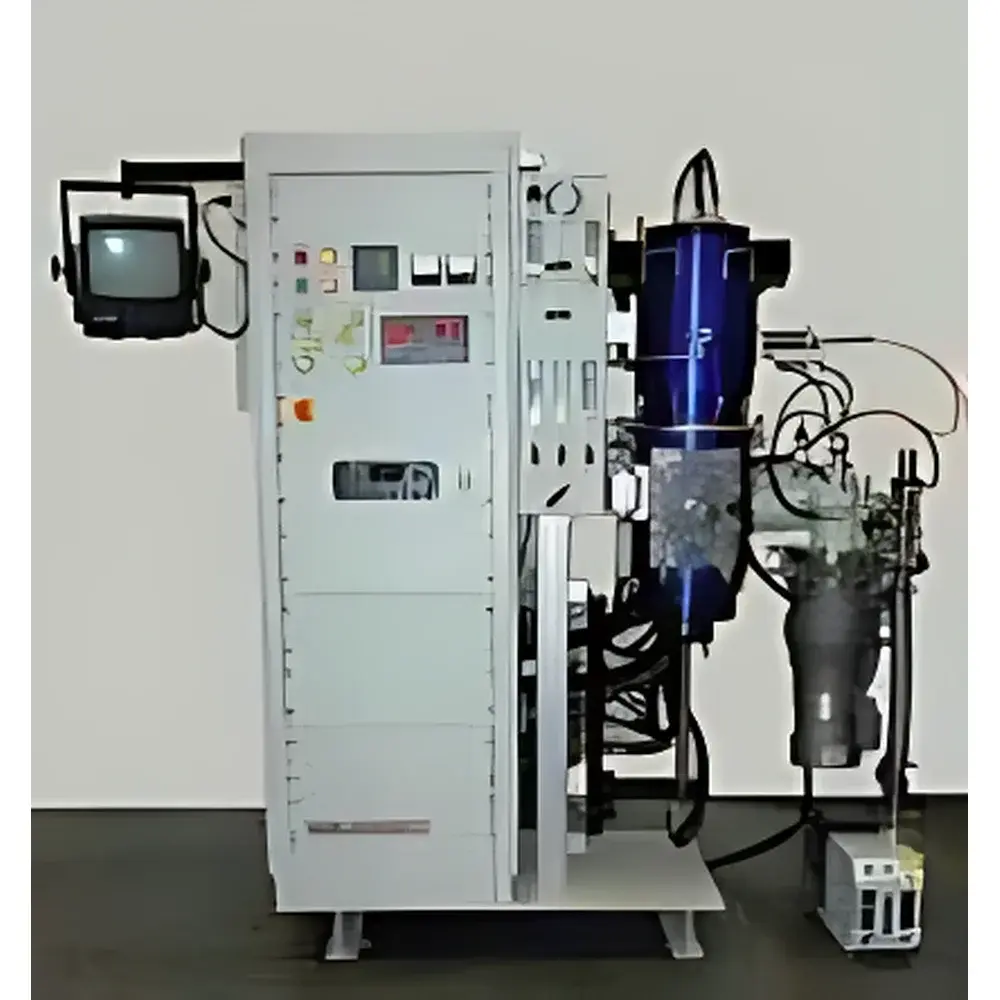
Thermal Technology Model 1000 Vacuum High-Temperature Tube Furnace
| Key | Brand: Thermal Technology |
|---|---|
| Origin | USA |
| Model | Model 1000 |
| Type | Tube Furnace |
| Max Temperature | 3000 °C |
| Temperature Control Accuracy | ±0.1 °C |
| Max Power | 3000 W |
| Heating Rate to Max Temp | 100 °C/min |
| Heating Zone Material | Graphite or Molybdenum |
| Internal Chamber Dimensions | 30 × 20 × 20 cm |
| Atmosphere Options | Vacuum (mechanical pump standard, high-vacuum optional), Ar, N₂, O₂, H₂ |
| Compliance | ASTM E2550, ISO 8573-1 (for gas purity control), GLP-compliant operation architecture |
Overview
The Thermal Technology Model 1000 Vacuum High-Temperature Tube Furnace is an engineered solution for controlled thermal processing under inert, reactive, or ultra-high-vacuum conditions. Based on resistive heating principles with precisely regulated current delivery to high-purity graphite or refractory metal (e.g., molybdenum) heating elements, the system achieves stable, repeatable operation up to 3000 °C—enabling synthesis, sintering, annealing, and phase transformation studies in advanced materials research. Its rigid double-walled stainless-steel vacuum chamber, water-cooled flanges, and integrated pressure monitoring ensure structural integrity during rapid thermal cycling and extended dwell periods. Designed for laboratory-scale process development and small-batch prototyping, the Model 1000 supports both vertical and horizontal configurations, accommodating diverse sample geometries and loading protocols while maintaining axial temperature uniformity within ±2 °C across the hot zone.
Key Features
- Graphite or metal hot-zone options—selectable per application requirements: graphite for ultra-high temperatures (up to 3000 °C) under inert/vacuum; molybdenum-based zones for enhanced oxidation resistance in low-O₂ environments.
- High-precision temperature control via dual-loop PID algorithm with thermocouple feedback (Type C or B, depending on configuration), delivering ±0.1 °C stability at setpoint over 24-hour continuous operation.
- Integrated mechanical vacuum pumping system (base pressure ≤10⁻² mbar); high-vacuum option available with turbomolecular pump (≤10⁻⁶ mbar) and residual gas analyzer (RGA) compatibility.
- Programmable ramp/soak profiles with up to 32 segments, supporting complex multi-step thermal cycles required for ceramic densification, carbide formation, or semiconductor dopant activation.
- Water-cooled vacuum feedthroughs and sealed quartz or alumina tube liners ensure long-term operational reliability and minimize contamination risk during repeated thermal cycling.
- Front-panel touchscreen interface with real-time graphing, data logging (≥1 Hz sampling), and USB export; optional Ethernet connectivity for remote monitoring and integration into lab-wide SCADA systems.
Sample Compatibility & Compliance
The Model 1000 accommodates cylindrical, crucible-loaded, or suspended wire samples up to 30 cm in length and 20 cm in diameter. Compatible sample holders include high-purity graphite, tungsten, molybdenum, and alumina crucibles—each selected to match thermal expansion, chemical inertness, and vapor pressure constraints of target processes. The furnace meets design criteria aligned with ASTM E2550 (thermal stability testing), ISO 8573-1 (compressed gas purity classification for purge atmospheres), and supports GLP/GMP audit readiness through configurable electronic logbooks, user-access controls, and timestamped event tracking—including door opening, vacuum breach, and temperature deviation alerts. Optional FDA 21 CFR Part 11 compliance packages are available with digital signature support and audit trail encryption.
Software & Data Management
Thermal Technology’s proprietary FurnaceControl™ software provides full remote supervision, including real-time temperature/pressure waveform visualization, automated calibration reporting, and CSV/Excel-compatible data export. All thermal profiles are stored with metadata (operator ID, date/time, atmosphere settings, vacuum level), enabling traceability for peer-reviewed publication or regulatory submission. Software logs retain ≥30 days of continuous operation history by default, scalable to network-attached storage. Integration with LabArchives ELN and Thermo Fisher SampleManager is supported via standardized OPC UA and RESTful API interfaces.
Applications
This furnace serves as a critical platform for reproducible high-temperature synthesis and characterization in multiple domains: preparation of YAG:Ce:Pr transparent ceramics for solid-state lighting (J. Eur. Ceram. Soc. 37, 3403–3409, 2017); structural evolution studies of carbon nanotubes under argon up to 1800 °C (Mater. Res. Bull. 48, 41–47, 2013); sintering of silicon carbide composites; reduction of rare-earth oxides; growth of single-crystal thin films; and thermal aging validation of aerospace-grade superalloys. End-user institutions—including Jiangsu Normal University, Shanghai Institute of Ceramics (CAS), Beijing Jiaotong University, and Wuhan University—leverage its programmability and environmental flexibility for method development prior to industrial scale-up.
FAQ
What vacuum levels can be achieved with the standard configuration?
The base system includes a two-stage rotary vane pump achieving ≤10⁻² mbar; high-vacuum variants with turbomolecular pumps reach ≤10⁻⁶ mbar.
Is hydrogen atmosphere operation supported?
Yes—H₂ compatibility requires optional explosion-proof wiring, leak-tested gas manifolds, and integrated H₂ sensors meeting IEC 60079-29-1 standards.
Can the furnace be validated for GMP manufacturing use?
With the Part 11 add-on package, IQ/OQ documentation, calibration certificates traceable to NIST, and electronic signature workflows are provided.
What maintenance intervals are recommended for graphite hot zones?
Under typical usage (≤2500 °C, <50 cycles/year), graphite insulation and heating elements require inspection every 200 operating hours; replacement intervals range from 6–18 months depending on thermal cycling frequency and atmosphere purity.
Are custom furnace dimensions available?
Yes—Thermal Technology offers engineering consultation for non-standard chamber geometries, specialized gas inlets, and hybrid heating configurations (e.g., combined RF + resistive).



