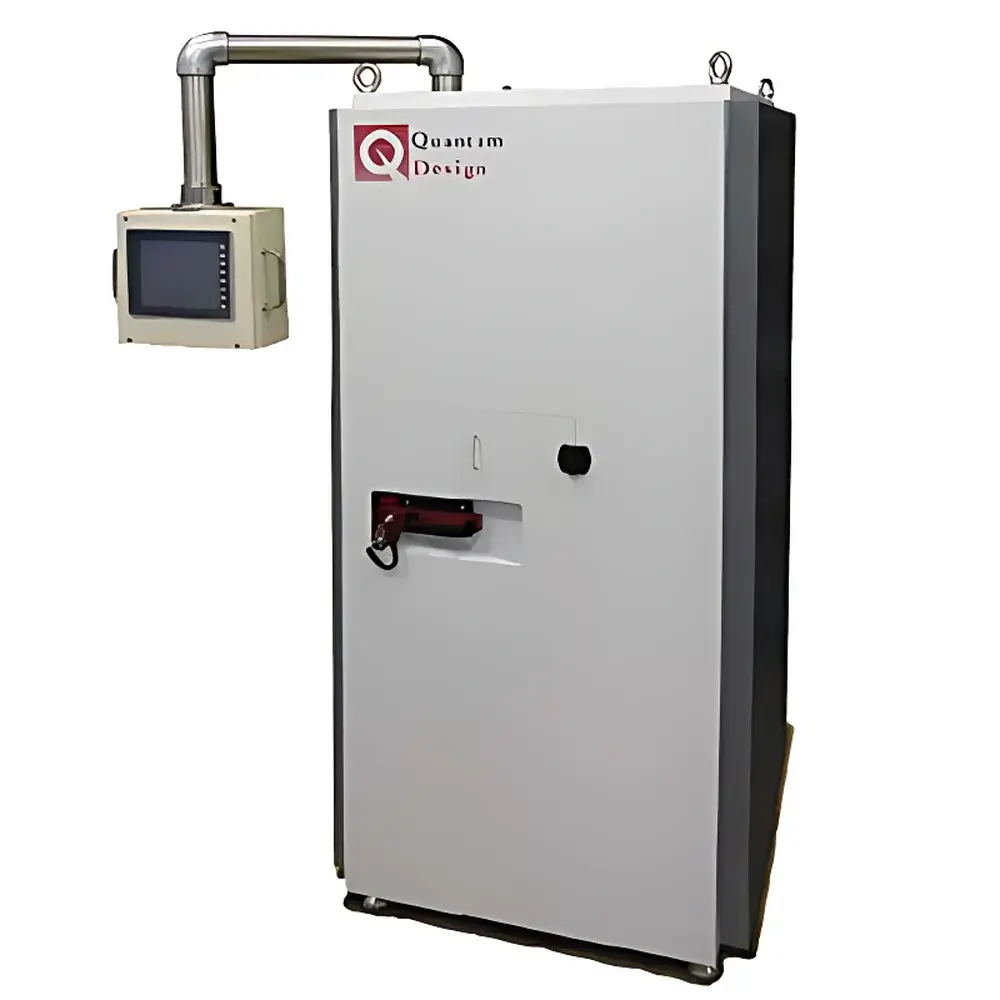
Quantum Design IR-Furnace High-Precision Optical Floating-Zone Single Crystal Furnace
| Brand | Quantum Design |
|---|---|
| Origin | Japan |
| Manufacturer Type | Original Equipment Manufacturer (OEM) |
| Origin Category | Imported |
| Model | IR-Furnace |
| Crystal Growth Rate | 0.1–1.4 mm/h, 1–14 mm/h, or 10–140 mm/h (selectable via lamp power and feed rate calibration) |
| Maximum Crystal Diameter | 6 mm |
| Operating Temperature Range | Up to 2150 °C |
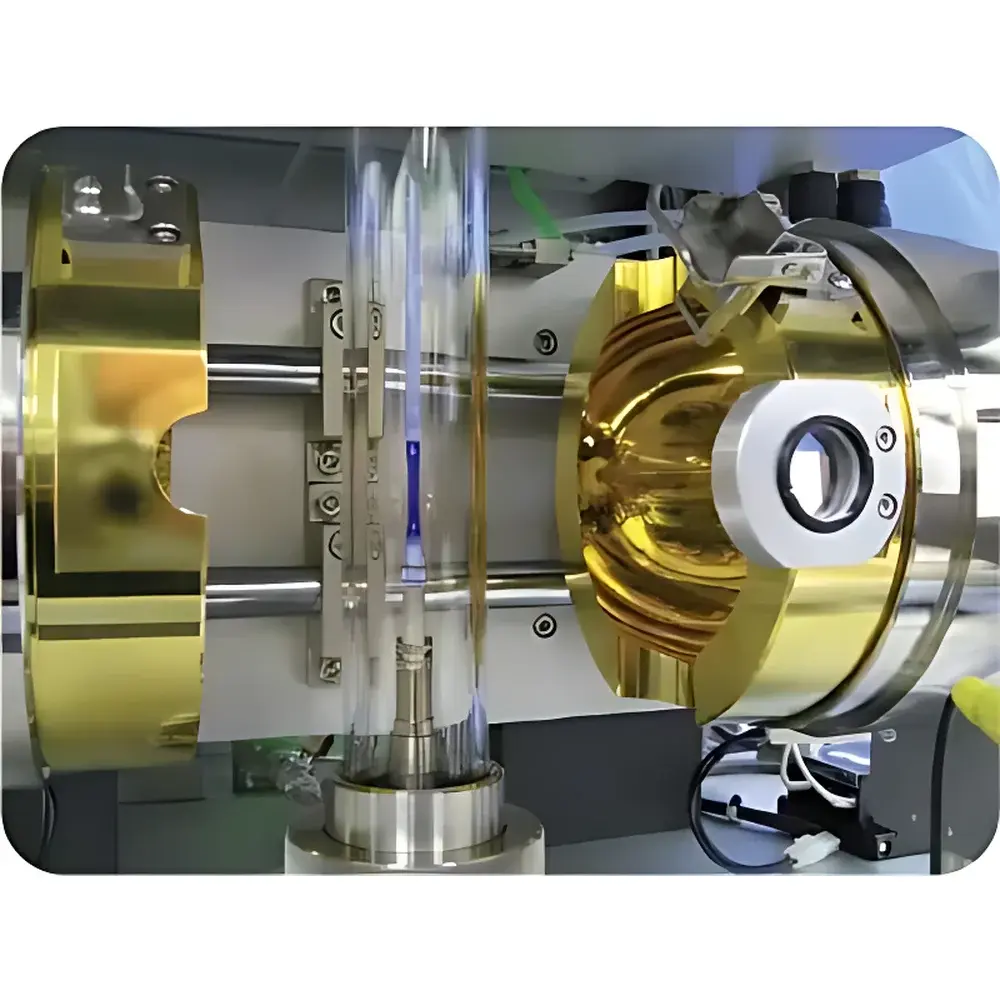
| Heating Source | Commercial-grade halogen lamps with gold-coated dual-curved mirrors |
| Cooling System | Integrated closed-loop air-cooling (no external water supply required) |
| Compliance | Designed for ISO/IEC 17025-aligned lab environments |
Overview
The Quantum Design IR-Furnace is a high-precision optical floating-zone (OFZ) single crystal growth system engineered for research-scale synthesis of high-melting-point functional crystals without crucible contamination. Based on the vertical floating-zone principle — a variant of zone melting where a narrow molten zone is sustained solely by surface tension at the solid–liquid interface — the IR-Furnace enables containerless crystal growth under controlled atmospheres (e.g., O2, Ar, N2, or vacuum-compatible configurations). Its core architecture leverages two opposing high-power halogen lamps focused through gold-coated parabolic mirrors to generate a highly localized, axially symmetric thermal gradient. This design achieves stable melt-zone formation in materials with high surface tension and low density contrast between solid and liquid phases — essential criteria for OFZ process viability. With a maximum operating temperature of 2150 °C and precise axial translation control (±0.01 mm/s resolution), the system supports reproducible growth of stoichiometrically sensitive oxides, intermetallics, and wide-bandgap semiconductors.
Key Features
- Gold-coated dual-curved mirror optics delivering >92% infrared reflectivity and minimal thermal loss across the 1–3 µm spectral band
- Modular lamp power regulation enabling fine-tuned melt-zone stability across growth rates from 0.1 to 140 mm/h
- Compact monolithic frame with vertical column support — footprint under 0.8 m² — optimized for cleanroom integration
- Integrated closed-loop forced-air cooling system eliminating dependency on external chillers or tap water
- High-stability DC power supply with <0.1% RMS output ripple, ensuring consistent radiant flux during multi-day growth runs
- Motorized crystal rod feed mechanism with programmable acceleration/deceleration profiles to minimize thermal shock at start-up and termination
Sample Compatibility & Compliance
The IR-Furnace is validated for growth of refractory single crystals including high-temperature superconductors (e.g., YBCO, REBCO), dielectric oxides (e.g., TiO2, Ga2O3), magnetic insulators (e.g., Mn4Nb2O9), intermetallic compounds (e.g., Ni3Al, Fe3Si), and optical-grade sapphire analogues. All chamber components are constructed from ultra-high-purity fused silica and oxygen-free copper, minimizing outgassing and metallic impurity incorporation. The system meets mechanical and electrical safety requirements per IEC 61000-6-2 (immunity) and IEC 61000-6-4 (emission), and its operational log structure supports audit-ready data traceability aligned with ISO/IEC 17025 and FDA 21 CFR Part 11 principles when paired with optional timestamped digital logging modules.
Software & Data Management
Growth parameters — including lamp voltage/current, rod translation speed, chamber pressure, and ambient gas flow rates — are monitored in real time via a dedicated LabVIEW-based control interface. Raw sensor data are logged at 10 Hz with embedded metadata (operator ID, sample ID, atmospheric condition, date/time stamp). Export formats include CSV and HDF5, facilitating post-run thermal profile reconstruction and correlation with XRD or resistivity mapping results. Optional add-ons include automated video capture synchronized with thermal events and MATLAB-compatible API access for custom feedback-loop development (e.g., melt-zone width stabilization via image processing).
Applications
- Synthesis of quantum spin liquid candidates (e.g., Ca10Cr7O28) requiring ultra-low defect density and precise cation stoichiometry
- Growth of magnetoelectric oxides for multiferroic device prototyping, where compositional homogeneity along the c-axis dictates coupling strength
- Preparation of doped Ga2O3 and (In,Nb)-TiO2 substrates for UV photodetectors and transparent electronics
- Development of Nb-doped SrTiO3 and LaAlO3 templates for oxide heterostructure epitaxy
- Fundamental studies of melt-zone fluid dynamics and Marangoni convection in high-Prandtl-number oxides
FAQ
What atmosphere options are supported during crystal growth?
Standard configurations support continuous-flow O2, Ar, N2, or synthetic air; vacuum-compatible variants (10−5 mbar base pressure) are available upon request.
Can the system grow crystals larger than 6 mm in diameter?
The standard hot-zone geometry is optimized for ≤6 mm rods to ensure radial thermal uniformity and melt-zone stability; custom furnace inserts for 8–10 mm diameters can be engineered subject to material-specific feasibility assessment.
Is remote operation supported?
Yes — the control interface supports secure SSH and VNC access over institutional LAN/WAN; all critical alarms trigger email/SMS notifications via configurable SMTP gateways.
How is temperature calibrated and verified?
Two-point calibration using W/Re thermocouples (Type C) at known fixed points (e.g., Pd melting point at 1554.9 °C) is performed prior to each high-temperature campaign; emissivity-compensated pyrometry (0.8–1.1 µm band) provides real-time surface temperature estimation.
Does the system comply with GLP or GMP documentation standards?
While not a regulated manufacturing tool, its digital log architecture — with user authentication, electronic signatures, and immutable audit trails — satisfies key technical requirements for GLP-compliant crystal synthesis records when deployed in QA/QC laboratories.