
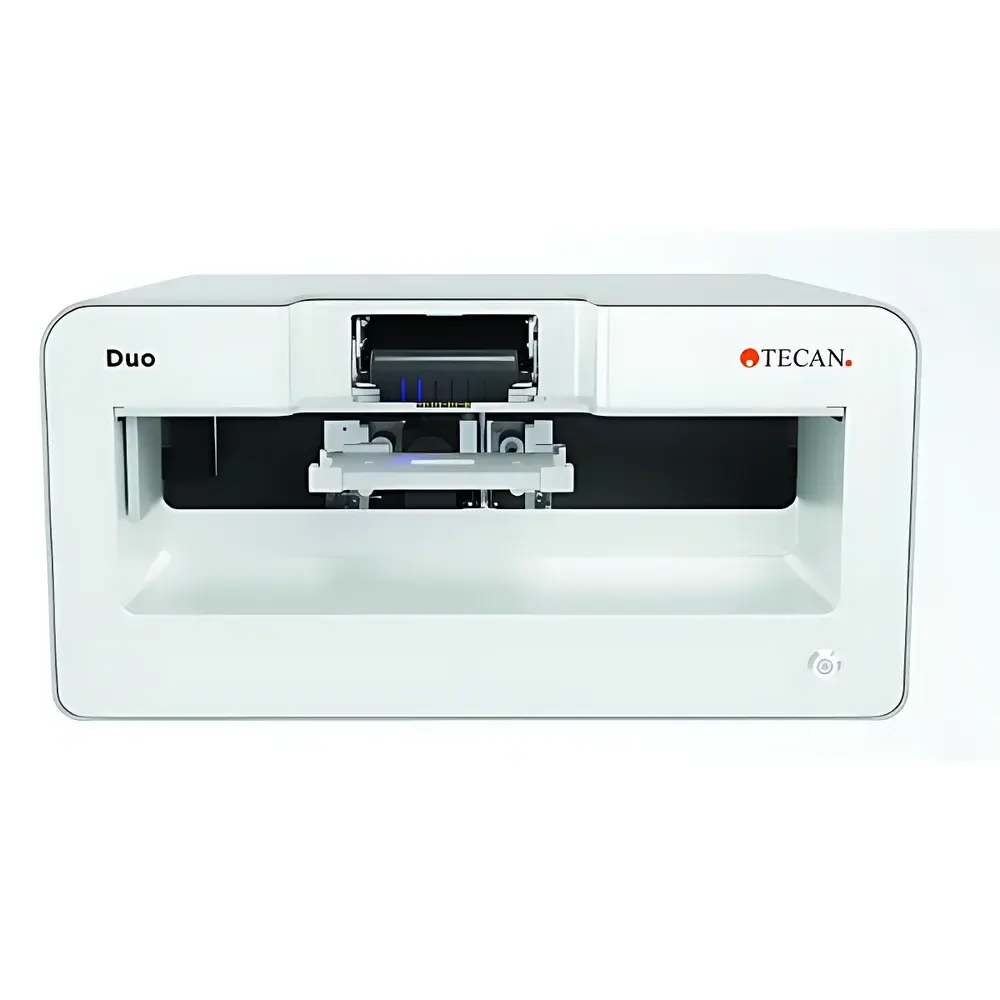
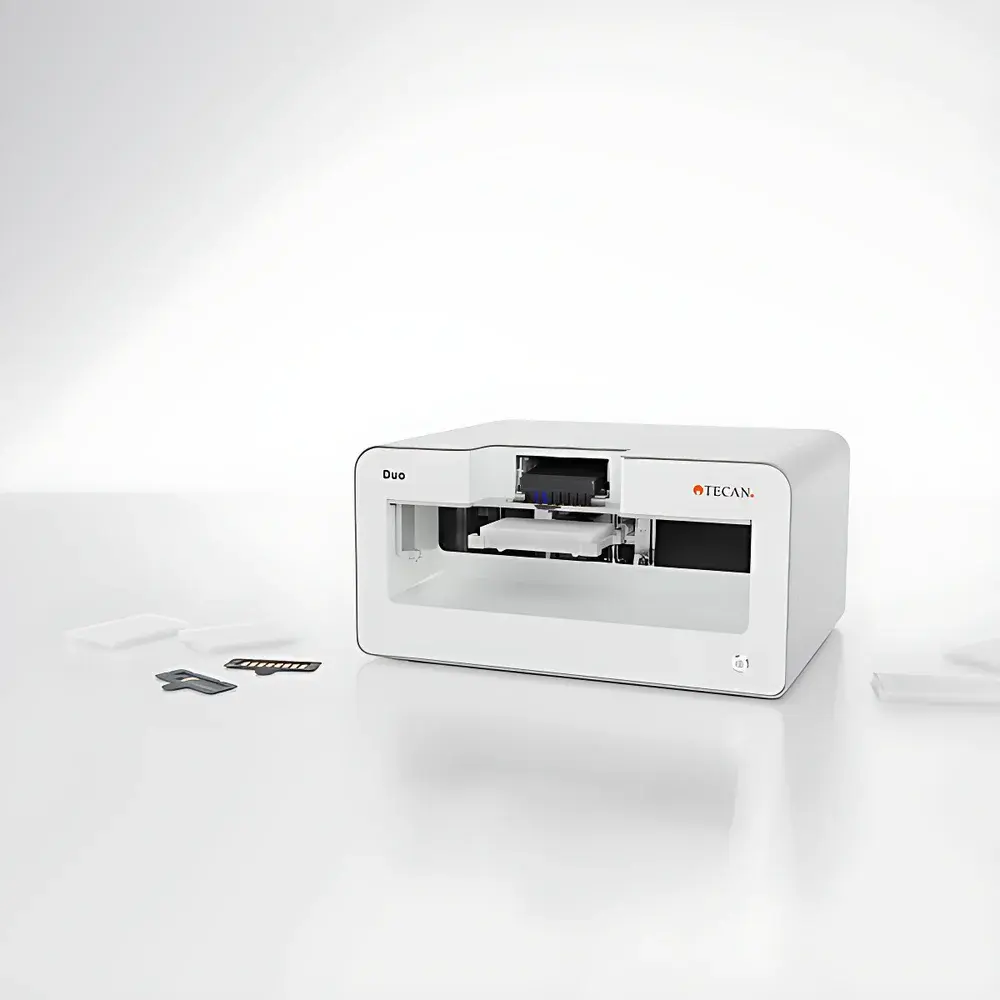
TECAN Duo Digital Dispenser
| Brand | TECAN |
|---|---|
| Origin | Switzerland |
| Model | Duo |
| Automation Level | Motorized Liquid Handler |
| Volume Range | Picoliter to Microliter (varies by cartridge) |
| Application Scope | Single-Cell Dispensing & Reagent Dispensing |
| Regulatory Context | Designed for GLP-compliant workflows |
Overview
The TECAN Duo Digital Dispenser is a benchtop motorized liquid handler engineered for high-precision, low-volume dispensing across two distinct operational modes: digital reagent dispensing and single-cell isolation. Leveraging validated microfluidic partitioning technology originally developed and refined in collaboration with Hewlett-Packard (HP), the Duo operates on the principle of digital dispensing—where sample fluid is segmented into discrete, monodisperse picoliter-scale droplets within a microstructured cartridge, enabling absolute volumetric control without reliance on traditional piston-driven or air-displacement mechanisms. This architecture eliminates carryover, minimizes shear stress on sensitive biological entities, and ensures reproducible delivery across heterogeneous liquid classes—from DMSO-based small-molecule libraries to viscous recombinant protein solutions and live mammalian cells. The system is purpose-built for applications demanding trace-level accuracy, minimal sample consumption, and stringent cell viability preservation—including single-cell cloning, dose-response profiling, combinatorial screening, and miniaturized genomic assay setup.
Key Features
- Dual-mode operation: Simultaneous or independent execution of digital reagent dispensing and single-cell dispensing on the same platform
- Picoliter-to-microliter dispensing range: Achieved via interchangeable microfluidic cartridges—each optimized for specific volume spans (e.g., 1–100 pL, 100 pL–1 µL, or 1–10 µL) and fluid properties
- Single-cell dispensing capability: Supports targeted deposition of 1–25 viable cells per well in standard 384-well plates, with >90% cell viability retention post-dispensing and >90% clonal recovery efficiency validated against manual limiting dilution
- Low-shear microfluidic architecture: No moving parts contact sample; laminar flow conditions and pressure-controlled actuation preserve membrane integrity and functional phenotype of sensitive cell lines (e.g., CHO, HEK293, primary tumor cells)
- Rapid workflow turnaround: Full plate dispensing completed in <3 minutes for reagents; single-cell sorting and deposition across 384 wells completed in ≤5 minutes
- Native compatibility with diverse solvents: Handles aqueous buffers, organic solvents (DMSO, acetonitrile), surfactant-containing formulations, and biologics (antibodies, cytokines, nucleic acids) without cross-contamination or clogging
Sample Compatibility & Compliance
The Duo accommodates a broad spectrum of sample types without hardware modification: chemically synthesized small molecules, short peptides, oligonucleotides, CRISPR guide RNA complexes, recombinant proteins, monoclonal antibodies, and suspension or adherent mammalian cells. All microfluidic cartridges are sterilized via gamma irradiation and certified non-pyrogenic. The instrument supports audit-ready operation under Good Laboratory Practice (GLP) and current Good Manufacturing Practice (cGMP) environments. Software logs include timestamped user actions, parameter changes, and run reports—fully compliant with FDA 21 CFR Part 11 requirements when deployed with appropriate electronic signature configuration. System validation documentation aligns with ISO/IEC 17025 guidelines for testing and calibration laboratories.
Software & Data Management
The Duo is controlled via intuitive, Windows-based DispenseControl™ software featuring drag-and-drop plate mapping, multi-step protocol scripting, and real-time status monitoring. Users define dispensing patterns, cell density thresholds, and quality-control checkpoints (e.g., image-based cell counting pre-dispense). All runs generate immutable .csv and .pdf reports containing dispense volumes, cell counts per well, success/failure flags, and environmental metadata (temperature, humidity, operator ID). Raw data files are stored in vendor-neutral formats for downstream integration with LIMS, ELN, or analysis platforms such as R or Python-based single-cell pipelines.
Applications
- Monoclonal antibody development: High-fidelity single-cell isolation of transfected CHO or HEK293 clones with preserved productivity and stability
- CRISPR screening: Arrayed delivery of sgRNA/Cas9 ribonucleoprotein complexes into 384-well formats at sub-nanoliter precision
- Drug combination studies: Dose-matrix generation for synergy assessment using <100 nL compound stocks in DMSO
- Single-cell multi-omics prep: Parallel dispensing of lysis buffer, barcoded primers, and reverse transcriptase into individual wells for scRNA-seq or scATAC-seq library construction
- Toxicology profiling: Miniaturized cytotoxicity assays using primary hepatocytes or iPSC-derived cardiomyocytes with picoliter-level test article dosing
FAQ
What types of microfluidic cartridges are available for the Duo?
Three standardized cartridge families are offered: pL-Range (1–100 pL), nL-Range (100 pL–1 µL), and µL-Range (1–10 µL), each validated for specific viscosity and surface tension ranges.
Can the Duo be integrated into automated laboratory workflows?
Yes—the instrument features RS-232 and Ethernet interfaces, supports third-party scheduling via API commands, and is compatible with common robotic deck standards (e.g., SLAS footprint, gripper-accessible height).
Is calibration required between runs or cartridge changes?
No routine recalibration is needed; each cartridge is factory-calibrated and includes embedded NIST-traceable reference data read automatically upon installation.
Does the Duo support sterile processing for cell culture applications?
Cartridges are supplied sterile and single-use; the dispensing head and plate stage are designed for easy wipe-down with ethanol or isopropanol between runs, supporting aseptic technique in biosafety cabinets.
How is data integrity ensured during long-term deployment?
All software-generated records include cryptographic hashing, automatic backup to network drives, and configurable retention policies aligned with institutional data governance frameworks.



