
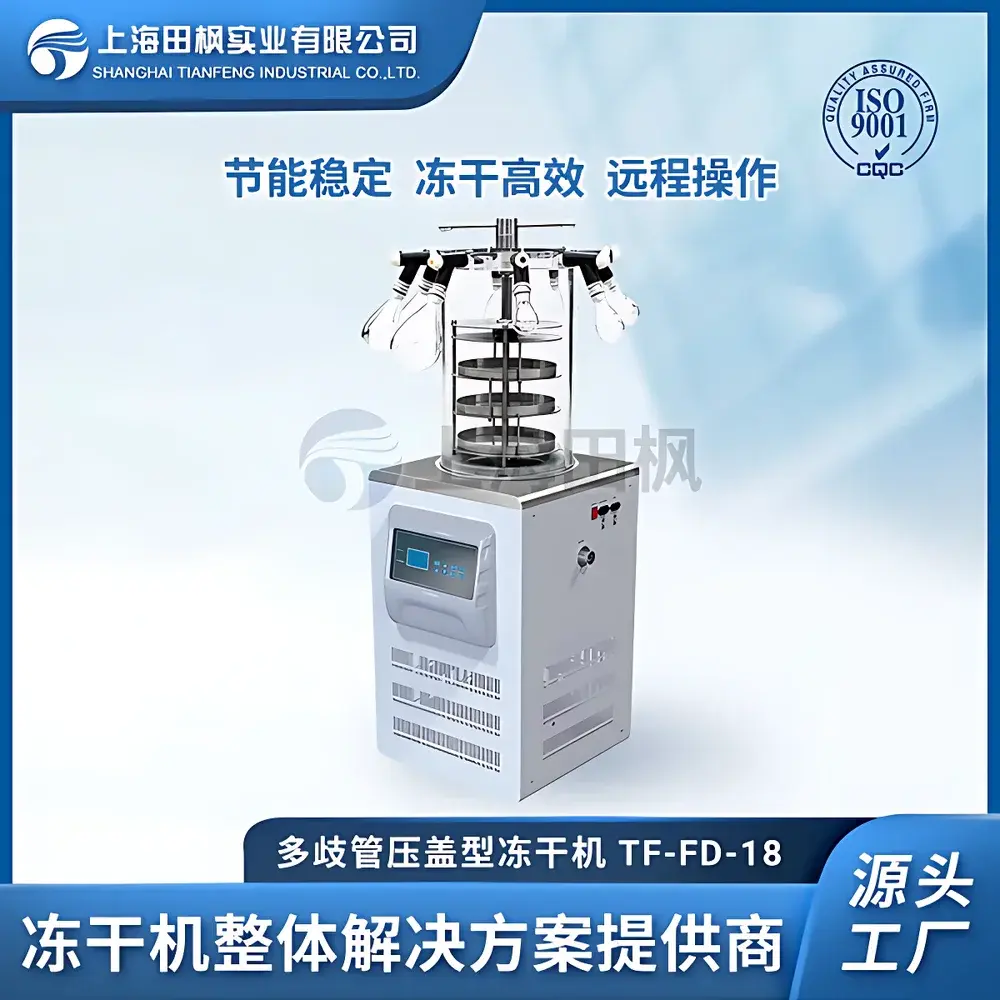
Tianfeng TF-FD-18 Manifold-Type Stoppering Freeze Dryer
| Brand | Tianfeng |
|---|---|
| Origin | Shanghai, China |
| Manufacturer Type | Manufacturer |
| Product Category | Domestic |
| Model | TF-FD-18 Manifold-Type Stoppering |
| Instrument Type | Manifold Freeze Dryer |
| Application Scope | Laboratory Use |
| Lyophilization Area | 0.11 m² |
| Ultimate Vacuum | <15 Pa (at no load) |
| Condenser Temperature | <−60 °C |
| Ice Capacity | 6 kg/24 h |
| Main Unit Dimensions | 550 mm × 550 mm × 960 mm |
| Power Consumption | 1500 W |
| Electrical Supply | 220 V, 50 Hz |
| Shelf Configuration | 3-tier Φ220 mm stainless steel trays |
| Construction Material | 304 Stainless Steel Interior |
| Refrigeration System | Dual-stage cascade compressor |
| Optional Features | In-chamber pressure control valve (inert gas purging), temperature recording system, eutectic point detection kit, automatic stoppering module |
Overview
The Tianfeng TF-FD-18 Manifold-Type Stoppering Freeze Dryer is a laboratory-scale lyophilization system engineered for reproducible, low-temperature drying of thermolabile biological and pharmaceutical materials. It operates on the fundamental principle of sublimation—removing water from frozen samples under deep vacuum while maintaining product integrity. Unlike conventional thermal drying methods that induce denaturation, shrinkage, or oxidation, freeze drying preserves structural morphology, bioactivity, and reconstitution fidelity. The TF-FD-18 employs a dual-stage cascade refrigeration architecture to achieve condenser temperatures below −60 °C, enabling efficient capture of both aqueous and moderately volatile solvent vapors—including acetone, ethanol, and ethyl acetate—common in formulation development workflows. Its manifold configuration supports parallel processing of up to eight vials via individual isolation valves, allowing independent sample loading/unloading without compromising chamber vacuum. This design is particularly suited for comparative stability studies, small-batch formulation optimization, and preclinical dosage form development.
Key Features
- Manifold-type stoppering configuration with eight independent stainless steel ports and precision-machined silicone gaskets for leak-tight sealing
- 3-tier removable 304 stainless steel shelves (Φ220 mm each), compatible with standard serum vials (50–1000 mL) and custom glassware
- Cascade refrigeration system delivering sustained condenser performance at <−60 °C, optimized for high ice-loading capacity (6 kg/24 h)
- Touchscreen HMI with real-time graphical display of chamber pressure, shelf temperature, and condenser temperature; programmable PID control loops for process stability
- Integrated observation window fabricated from high-transmittance, UV-stable acrylic for non-invasive monitoring of sublimation front progression and cake morphology
- In-chamber inert gas inlet valve (N₂ or argon) for controlled backfilling and oxygen-sensitive sample handling
- Full 304 stainless steel interior chamber and condenser housing, compliant with ISO 14644-1 Class 7 cleanroom-compatible cleaning protocols
- Modular expandability: optional eutectic point detection probe, USB-based temperature data logger (±0.5 °C accuracy), and automated stoppering actuator for terminal vial sealing
Sample Compatibility & Compliance
The TF-FD-18 accommodates a broad spectrum of heat-sensitive matrices, including monoclonal antibodies, plasmid DNA, viral vectors, probiotic cultures, herbal extracts, and sterile parenteral formulations. Its validated operating envelope meets critical requirements for GLP-compliant preclinical research and early-phase process development under ICH Q5C and Q5A guidelines. While not certified for GMP manufacturing, the system’s traceable temperature logging, pressure stability (<±2 Pa drift over 4 h), and documented calibration procedures support audit readiness for FDA 21 CFR Part 11–aligned data integrity frameworks. All wetted surfaces conform to USP material compatibility standards; the absence of silicone oil in direct contact with samples eliminates leachable risk in biopharmaceutical applications.
Software & Data Management
The embedded control firmware records time-stamped sensor data at 1-second intervals across all operational phases—pre-freeze, primary drying, secondary drying, and desorption. Export formats include CSV and PDF reports compliant with ALCOA+ principles (Attributable, Legible, Contemporaneous, Original, Accurate, Complete, Consistent, Enduring, Available). Optional temperature recording modules provide configurable sampling rates (1–60 s), user-defined alarm thresholds, and encrypted local storage. For laboratories implementing electronic lab notebooks (ELNs), the system supports manual metadata tagging (batch ID, operator, formulation code) prior to report generation. No cloud connectivity or remote access functionality is included—data sovereignty remains fully under institutional control.
Applications
- Stability assessment of lyophilized reference standards per USP and Ph. Eur. 2.9.40
- Process parameter screening for cycle development: shelf ramp rate, hold duration, and endpoint determination via pressure rise test (PRT)
- Drying of cell lysates, enzyme preparations, and diagnostic reagents requiring >95% activity retention post-reconstitution
- Preparation of sterile powders for inhalation (DPI) and injectables, including buffer-exchanged protein solutions
- Preservation of microbial strains (bacteria, yeasts, actinomycetes) for culture collections and QC strain banks
- Dehydration of botanical concentrates and nutraceutical actives without Maillard reaction or terpene loss
FAQ
What is the maximum vial size supported by the manifold ports?
Standard ports accept vials up to 1000 mL volume with external diameters ≤38 mm; custom port inserts are available for oversized containers.
Does the system support in-situ freezing of samples on shelves?
No—the TF-FD-18 is configured for external pre-freezing only; it lacks shelf cooling capability. Pre-frozen samples must be loaded under cryogenic conditions.
Can the condenser handle solvents other than water?
Yes—its <−60 °C condensing surface effectively traps methanol, acetonitrile, and isopropanol vapors when used with appropriate cold trap liners and reduced primary drying rates.
Is validation documentation provided with the instrument?
Factory-installed IQ/OQ protocols are supplied, including as-delivered vacuum leak test results, temperature uniformity mapping (±1.2 °C across shelf area), and pressure transducer calibration certificates.
What maintenance intervals are recommended for the cascade compressor?
Compressor oil analysis every 2000 operating hours; full refrigerant charge verification and filter-drier replacement every 5 years or after 10,000 freeze-dry cycles, whichever occurs first.



