
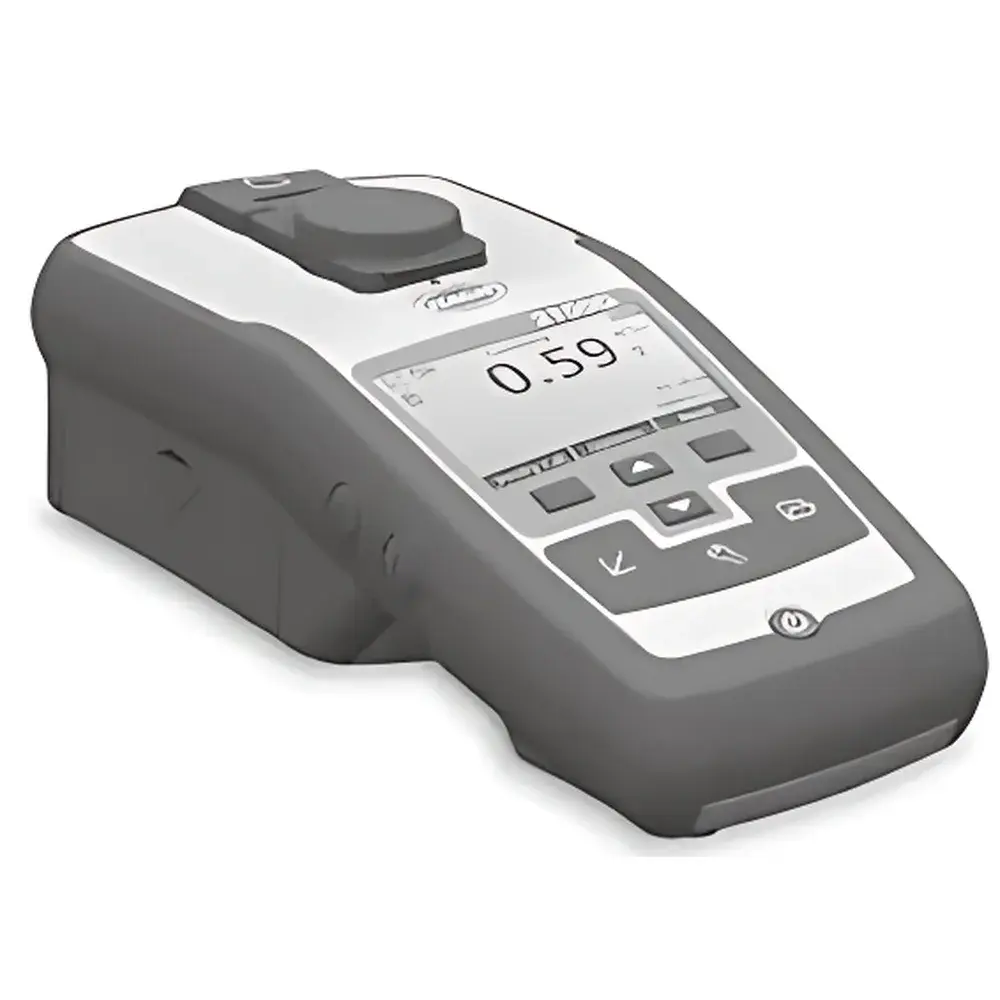
Hach 2100Q Portable Turbidimeter
| Brand | Hach |
|---|---|
| Origin | USA |
| Model | 2100Q |
| Measurement Range | 0–1000 NTU |
| Accuracy | ±2% of reading + stray light contribution |
| Stray Light | < 0.02 NTU (FNU) |
| Resolution | 0.01 NTU at lowest range |
| Calibration Options | Single-point RapidCal (0–40 NTU), Full-range (0–1000 NTU), and Turbidity-to-TSS correlation (0–100 mg/L) |
| Data Storage | Up to 500 measurements with timestamp, operator ID, sample ID, calibration status, and error logs |
| Compliance | 2100Q complies with USEPA Method 180.1 |
| Signal Averaging | User-selectable On/Off |
| Measurement Modes | Normal, Signal-Averaged, Rapid-Settling Turbidity (RST) |
| Display Guidance | On-screen calibration & verification prompts |
| Data Transfer | USB + power module (no additional software required) |
Overview
The Hach 2100Q Portable Turbidimeter is an EPA-compliant, field-deployable optical instrument engineered for high-fidelity turbidity measurement in drinking water, wastewater, environmental monitoring, and process control applications. It operates on the principle of nephelometric detection—measuring the intensity of light scattered at 90° from a collimated incident beam—as defined in USEPA Method 180.1. Its dual-detector ratiometric optical architecture compensates for color interference, ambient light fluctuations, and stray light artifacts, enabling laboratory-grade accuracy under variable field conditions. Unlike conventional single-beam systems, the 2100Q’s patented ratio-based photometry minimizes drift and enhances long-term stability without requiring frequent recalibration. The instrument is designed for robustness in outdoor environments, featuring IP67-rated housing, shock-absorbing elastomer bumpers, and low-power LED illumination with >100,000-hour source lifetime.
Key Features
- Ratiometric dual-detector optical system for compensation of sample color, ambient light, and stray light
- Rapid-Settling Turbidity (RST) algorithm—automatically acquires and processes sequential readings to compute representative turbidity values for fast-sedimenting suspensions (e.g., alum coagulated waters, stormwater runoff)
- On-screen calibration and verification guidance in English—eliminates reliance on printed manuals during field operation
- Three user-selectable calibration protocols: RapidCal (single-point, 0–40 NTU), full-range (0–1000 NTU), and TSS-correlated (0–100 mg/L) for cross-parameter estimation
- Configurable signal averaging to improve precision in low-turbidity or noisy environments
- Integrated data logging: stores up to 500 complete records—including date/time stamp, operator ID, sample ID, measurement mode, units, calibration timestamp, calibration status, and diagnostic flags
- USB + power module interface enables direct data export to Windows/macOS systems without proprietary drivers or third-party software
Sample Compatibility & Compliance
The 2100Q accepts standard 25-mm round glass vials (10 mL volume) and accommodates samples with suspended solids ranging from clarified potable water (<0.1 NTU) to highly turbid industrial effluents (up to 1000 NTU). Its optical path geometry and detector response are optimized for compliance with regulatory measurement frameworks: the base 2100Q model meets all performance criteria of USEPA Method 180.1 for drinking water and wastewater analysis, while the optional 2100Q IS variant satisfies ISO 7027:2016 requirements—including spectral bandwidth control and formalin-formazin calibration traceability. All factory calibrations are NIST-traceable, and the instrument supports GLP/GMP-aligned audit trails via stored calibration history (last 25 successful events) and timestamped measurement metadata.
Software & Data Management
Data management is implemented through hardware-level integration rather than cloud-dependent platforms. The optional USB + power module functions as both a rechargeable battery pack and a mass-storage-class device: measurement files are saved in plain-text CSV format with UTF-8 encoding, ensuring compatibility with LIMS, Excel, and statistical analysis tools. No installation of vendor-specific software is required—plug-and-play recognition occurs natively under Windows 10/11 and macOS 12+. Each exported record includes column headers compliant with ASTM D6508 and ISO/IEC 17025 documentation standards: “Timestamp”, “Operator_ID”, “Sample_ID”, “NTU_Value”, “Measurement_Mode”, “Calibration_Status”, “Stray_Light_Corrected”, and “Error_Code”. Internal memory retains full integrity during power loss due to non-volatile flash storage architecture.
Applications
- Drinking water treatment: raw intake screening, filter effluent monitoring, and distribution system integrity verification per NSF/ANSI 60 and 61
- Wastewater facilities: activated sludge settling assessment, clarifier performance tracking, and discharge compliance reporting under NPDES permits
- Environmental field studies: lake and river turbidity profiling, sediment transport modeling, and stormwater BMP validation
- Industrial process control: pharmaceutical rinse water clarity verification (USP <788>), food & beverage line clearance checks, and semiconductor ultrapure water QC
- Educational laboratories: teaching nephelometric principles, method validation exercises, and inter-laboratory comparison studies
FAQ
What regulatory methods does the 2100Q support?
The 2100Q conforms to USEPA Method 180.1 for turbidity measurement in drinking water and wastewater. The 2100Q IS variant is certified to ISO 7027:2016 for international standardization and metrological equivalence.
Can the 2100Q measure samples with high color or fluorescence?
Yes—the ratiometric dual-detector design inherently corrects for absorbance-related interference, including yellow-colored humic substances and low-level fluorescent contaminants, without requiring chemical decolorization pretreatment.
Is calibration traceable to national standards?
All factory calibrations use NIST-traceable StablCal® standards (formazin-free polymer suspensions), with documented uncertainty budgets available upon request per ISO/IEC 17025 requirements.
Does the instrument support FDA 21 CFR Part 11 compliance?
While the 2100Q itself does not include electronic signature or role-based access controls, its CSV export format, immutable timestamping, and full calibration audit trail enable integration into validated Part 11–compliant LIMS or ELN environments when deployed with appropriate procedural controls.
How is stray light performance verified during operation?
The instrument performs automatic zero-checks using air-filled vials prior to each measurement sequence; stray light contribution (<0.02 NTU) is continuously monitored and reported in diagnostic logs—flagging deviations beyond specification limits.




