
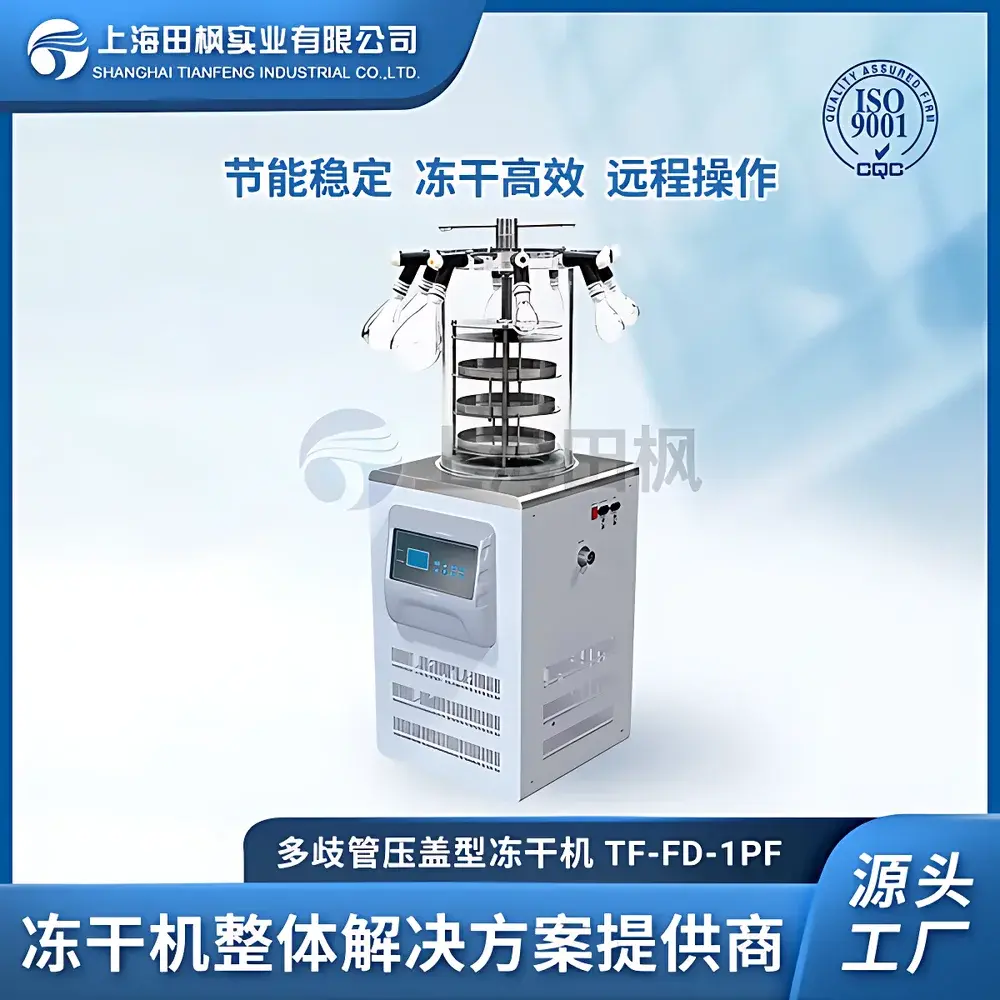
Tianfeng TF-FD-1PF Multi-Manifold Stoppering Freeze Dryer
| Brand | Tianfeng |
|---|---|
| Origin | Shanghai, China |
| Manufacturer Type | Direct Manufacturer |
| Instrument Type | Multi-Manifold Laboratory Freeze Dryer |
| Freeze-Drying Area | 0.07 m² |
| Ultimate Vacuum | <15 Pa (empty chamber) |
| Condenser Temperature | ≤−50 °C |
| Ice Capacity | 3 kg/24 h |
| Power Consumption | 1100 W |
| Input Voltage | 220 V, 50 Hz |
| Chamber Material | 304 Stainless Steel |
| Viewport | High-transparency acrylic door |
| Sample Format | Compatible with 50–1000 mL flasks (8 ports), Φ180 mm trays (3 layers) |
| Optional Features | In-chamber pressure regulation valve, temperature data logger, eutectic point measurement kit, automatic stoppering module |
Overview
The Tianfeng TF-FD-1PF is a compact, vertically oriented laboratory freeze dryer engineered for precise lyophilization of heat-sensitive biological materials—including corneal tissues, hirudin formulations, and other biopharmaceutical actives—under controlled low-temperature and high-vacuum conditions. Based on the principle of sublimation, this system first freezes aqueous samples to solid ice at ≤−50 °C in its integrated stainless-steel condenser, then removes water vapor directly from the frozen state via primary drying under vacuum (<15 Pa), followed by secondary drying to eliminate bound moisture. The process preserves structural integrity, enzymatic activity, immunogenicity, and reconstitution fidelity—critical for ophthalmic biologics (e.g., preserved corneal grafts), anticoagulant proteins (e.g., hirudin), and sterile injectables requiring long-term ambient storage without refrigeration.
Key Features
- Multi-manifold configuration with eight independent valve-controlled ports, enabling simultaneous lyophilization of heterogeneous samples in diverse flask sizes (50–1000 mL) while maintaining individual pressure isolation.
- Stoppering-compatible design allows in-situ vacuum sealing of vials post-drying—essential for aseptic handling of clinical-grade biologics and GMP-aligned small-batch production.
- Dual-stage refrigeration architecture delivers stable condenser temperatures ≤−50 °C, ensuring efficient capture of both water and low-volatility solvents (e.g., ethanol, acetone) during freeze drying of formulation blends.
- Intuitive 7-inch color touchscreen interface with real-time graphical display of chamber pressure, condenser temperature, and time-based drying curves; PID-controlled vacuum regulation enables adaptive process tuning.
- Full 304 stainless-steel cold trap and drying chamber interior, compliant with ISO 14644-1 Class 5 cleanroom maintenance standards; seamless welds and electropolished surfaces minimize particle retention and support validated cleaning protocols.
- Integrated inert gas inlet valve (N₂ or argon) permits backfilling under controlled atmosphere—critical for oxygen-sensitive proteins, unstable peptides, and oxidation-prone enzyme preparations.
- Optional GLP-compliant temperature data logger (21 CFR Part 11 ready) provides audit-trail-capable recording at user-defined intervals, supporting regulatory submissions for preclinical and phase I material manufacturing.
Sample Compatibility & Compliance
The TF-FD-1PF accommodates a broad spectrum of thermolabile matrices: ophthalmic tissue specimens (human and porcine corneas), recombinant hirudin solutions, monoclonal antibody formulations, viral vectors, bacterial lysates, and cell-derived extracellular vesicles. Its ≤−50 °C condenser and <15 Pa ultimate vacuum meet minimum operational thresholds defined in USP for sterile lyophilized products and ASTM F2375-04 for biomedical tissue preservation. The system supports validation per IQ/OQ/PQ protocols and integrates seamlessly into laboratories operating under ISO/IEC 17025, FDA 21 CFR Part 11, and EU Annex 11 frameworks. All wetted parts conform to USP Class VI biocompatibility requirements.
Software & Data Management
The embedded control software logs timestamped process parameters—including chamber pressure, condenser temperature, shelf temperature (if equipped with optional heated shelf), and elapsed drying time—at configurable intervals (1–60 sec). Export formats include CSV and PDF reports compatible with LIMS integration. Optional firmware upgrade enables automated cycle recall, password-protected parameter locking, and electronic signature functionality aligned with ALCOA+ data integrity principles. Raw sensor data is stored locally on encrypted internal memory with tamper-evident file hashing, satisfying traceability mandates for GLP and early-phase GMP environments.
Applications
This instrument serves specialized roles across translational research and pilot-scale development: stabilization of corneal endothelial sheets for transplant logistics; lyophilization of hirudin-loaded nanoparticles for thrombosis therapeutics; preparation of reference standards for ELISA and HPLC assay calibration; long-term archiving of primary neuronal cultures and stem cell derivatives; and formulation screening of lyoprotectant systems (e.g., trehalose/sucrose blends) for biopolymer stability. It is routinely deployed in university ophthalmology labs, biotech CMC departments, contract development organizations (CDOs), and regulatory testing facilities performing compendial freeze-drying validation per Ph. Eur. 2.9.40 and JP 17.
FAQ
Can the TF-FD-1PF be used for organic solvent-containing formulations?
Yes—its ≤−50 °C condenser provides sufficient thermal margin to trap common low-boiling-point solvents (e.g., methanol, acetonitrile) when used with appropriate vacuum pump oil and cold trap pre-cooling protocols.
Is in-chamber pre-freezing supported?
No—the TF-FD-1PF lacks shelf refrigeration; samples must be pre-frozen externally (e.g., −80 °C freezer or liquid nitrogen) prior to loading. For in-situ freezing, consider the TF-FD-1L (−80 °C) or TF-FD-1SL series.
What validation documentation is supplied?
Factory acceptance test (FAT) report, as-built mechanical drawings, material certifications (304 SS), and electrical safety compliance (IEC 61010-1) are provided standard. IQ/OQ protocol templates and third-party qualification support are available upon request.
Does it comply with FDA 21 CFR Part 11 for electronic records?
With optional data logger and firmware version 2.3+, the system supports role-based access control, electronic signatures, and audit trail generation meeting Part 11 Subpart B requirements.
How often does the vacuum pump oil require replacement?
Under typical lab use (≤4 cycles/week), oil change is recommended every 500 operating hours or annually—whichever occurs first—using ISO VG 100 rotary vane pump oil.



