
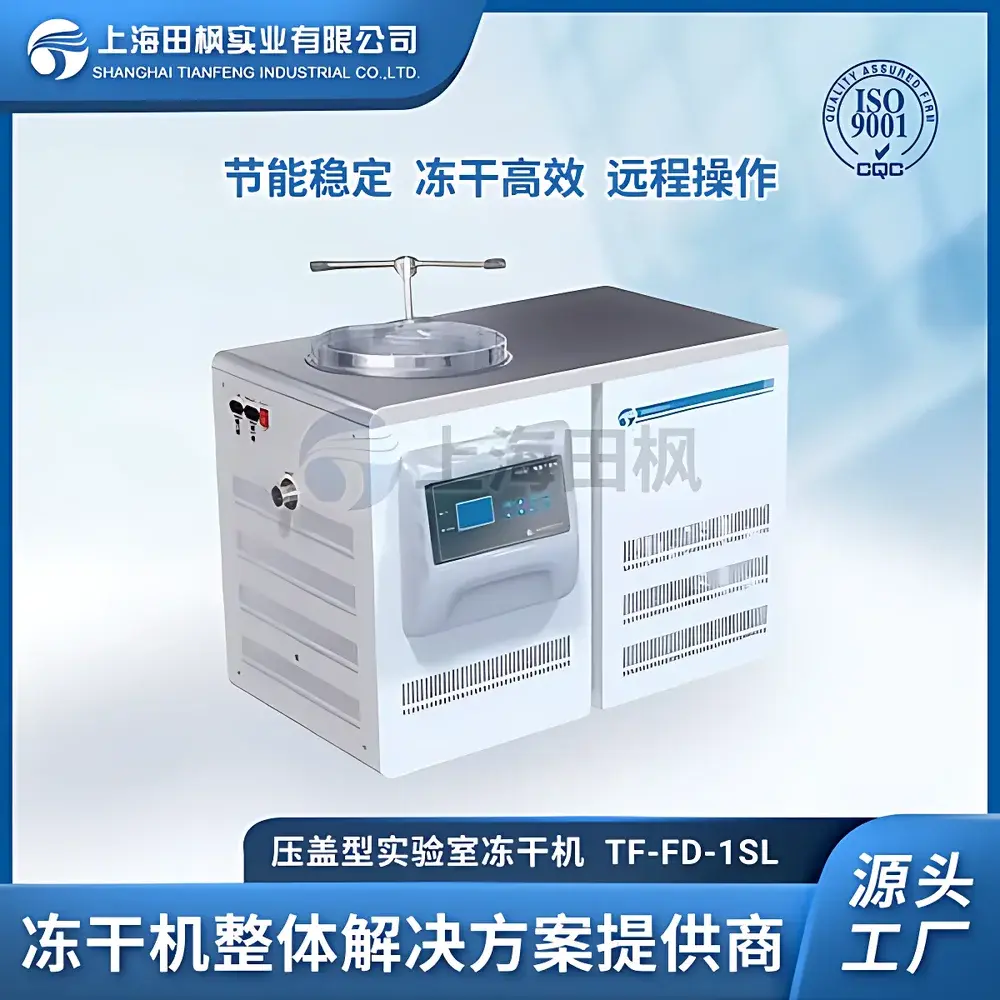
Tianfeng TF-FD-1SL In-Situ Freeze Dryer with Stoppering Function
| Brand | Tianfeng |
|---|---|
| Origin | Shanghai, China |
| Manufacturer Type | Direct Manufacturer |
| Instrument Type | In-situ Stoppering Freeze Dryer |
| Application | Laboratory-Scale Lyophilization |
| Shelf Area | 0.07 m² |
| Ultimate Vacuum | <15 Pa (at no-load) |
| Condenser Temperature | <−80 °C |
| Ice Capacity | 8 kg/24 h |
| Power Supply | 220 V, 50 Hz |
| Rated Power | 2200 W |
| Dimensions (W×D×H) | 900 × 600 × 800 mm |
| Chamber Material | 304 Stainless Steel |
| View Window | High-transparency Acrylic Door |
| Control System | 7-inch Touchscreen with PID Algorithm |
| Data Logging | Real-time Shelf Temperature & Chamber Pressure Curves |
| Optional | Gas Inlet Valve (N₂ or Argon), Co-lyophilization Point Tester, Auto-Stoppering Module |
Overview
The Tianfeng TF-FD-1SL is an in-situ stoppering freeze dryer engineered for precise, reproducible lyophilization of heat-labile biologicals, pharmaceuticals, and high-value research samples in laboratory environments. It operates on the fundamental principle of sublimation: aqueous samples are first frozen solid at ultra-low temperatures (<−80 °C), then subjected to high vacuum (<15 Pa) to enable direct phase transition of ice to vapor without passing through the liquid state. This preserves structural integrity, enzymatic activity, immunogenicity, and reconstitution fidelity—critical for antibiotics, monoclonal antibodies, viral vectors, probiotics, graphene oxide dispersions, and thermally sensitive agricultural extracts. Unlike tray-based or manifold systems, the TF-FD-1SL integrates primary freezing, drying, and sterile stoppering within a single stainless-steel chamber, eliminating manual handling and cross-contamination risks. Its compact footprint (0.9 m × 0.6 m × 0.8 m) and 0.07 m² shelf area support up to three Φ180 mm sample trays—ideal for R&D scale-up studies, formulation development, and GMP-aligned process qualification.
Key Features
- Double-stage cascade refrigeration system delivering stable condenser temperature ≤−80 °C—enabling efficient capture of volatile solvents (e.g., acetone, ethanol, tert-butanol) commonly used in nanomaterial and botanical extract processing.
- In-situ pre-freezing capability: Samples freeze directly on shelves or in the condenser chamber, eliminating separate ultra-low freezer dependency and ensuring uniform nucleation.
- 7-inch industrial-grade touchscreen interface with real-time graphical display of shelf temperature, chamber pressure, and drying progress curves; supports user-defined ramp-hold profiles via PID-controlled electric heating.
- Full 304 stainless-steel construction (chamber, shelves, condenser housing) with electropolished finish—compliant with ISO 14644-1 Class 5 cleanroom compatibility and easy decontamination per FDA-recommended cleaning validation protocols.
- Optical-grade acrylic viewing door with anti-fog coating allows continuous visual monitoring of cake formation, collapse onset, and desiccation endpoints without vacuum interruption.
- Integrated inert gas inlet valve (N₂ or Ar) for controlled backfilling post-drying—essential for oxygen-sensitive APIs, lipid nanoparticles, and redox-labile phytochemicals.
- Compliance-ready architecture: Supports optional 21 CFR Part 11–compliant electronic signatures, audit trail logging, and password-protected parameter locking for GLP/GMP environments.
Sample Compatibility & Compliance
The TF-FD-1SL accommodates diverse sample matrices including aqueous protein solutions, cell lysates, bacterial cultures, herbal decoctions, graphene hydrogels, and food-grade fruit purees. Its −80 °C condenser and 8 kg/24 h ice capacity ensure robust performance with high-solvent formulations (e.g., >15% v/v organic co-solvents), where conventional −50 °C systems risk vapor bypass and chamber contamination. The unit meets mechanical safety requirements per IEC 61010-1 and electromagnetic compatibility per EN 61326-1. While not certified as medical device (Class IIa), its design aligns with ISO 22057 (lyophilization process validation), ASTM F2375 (sterile barrier integrity), and USP (container closure integrity testing) prerequisites. Documentation packages include Factory Acceptance Test (FAT) reports, IQ/OQ templates, and material traceability records for stainless-steel components.
Software & Data Management
Embedded firmware provides continuous acquisition of shelf temperature (±0.5 °C accuracy), chamber pressure (capacitance manometer, 0.1–1000 Pa range), and time-stamped event logs (valve actuation, compressor status, alarm triggers). All data export to CSV via USB port; optional Ethernet connectivity enables integration with LIMS or SCADA platforms. The system supports up to 10 programmable drying cycles, each with independent control of freezing rate, primary drying hold points, secondary drying ramps, and stoppering timing. Audit trails record operator ID, timestamp, parameter changes, and deviation flags—fully compliant with ALCOA+ principles (Attributable, Legible, Contemporaneous, Original, Accurate, Complete, Consistent, Enduring, Available). Optional temperature mapping kits (with ≥12 calibrated PT100 probes) facilitate chamber qualification per ISO 13485 Annex A.
Applications
This instrument serves validated lyophilization workflows across regulated and academic sectors: stabilization of mRNA-LNP formulations prior to stability testing; long-term preservation of microbial consortia for soil microbiome studies; dehydration of anthocyanin-rich berry extracts without pigment degradation; pilot-scale freeze-drying of graphene oxide suspensions for conductive film fabrication; and preparation of sterile, pyrogen-free standards for ELISA assay development. Its stoppering function ensures immediate hermetic sealing under inert atmosphere—eliminating post-drying moisture uptake during transfer to vial storage. In agricultural R&D, it enables reproducible drying of mycorrhizal spore suspensions and biocontrol agent cultures while retaining viability >90% after 12-month ambient storage.
FAQ
What is the maximum sample volume per batch?
With three Φ180 mm trays (total 0.07 m²), the recommended loading is 300–500 mL of 5–10% w/v solution—optimized for complete primary drying within 24–36 hours.
Can the system handle organic solvent-based formulations?
Yes—the −80 °C condenser and large surface-area condenser coil provide effective trapping of acetone, methanol, and ethyl acetate vapors; consult solvent compatibility chart before operation.
Is remote monitoring supported?
Standard USB data export is included; Ethernet/WiFi modules and cloud-based dashboards are available as factory-installed options.
Does the unit comply with FDA 21 CFR Part 11?
Out-of-the-box functionality meets foundational requirements; full Part 11 compliance requires optional software license, biometric authentication module, and validated e-signature workflow.
What maintenance intervals are recommended?
Oil change every 2000 operating hours; refrigerant leak check annually; door seal inspection quarterly; condenser coil cleaning every 6 months using non-abrasive stainless-steel cleaner.



