
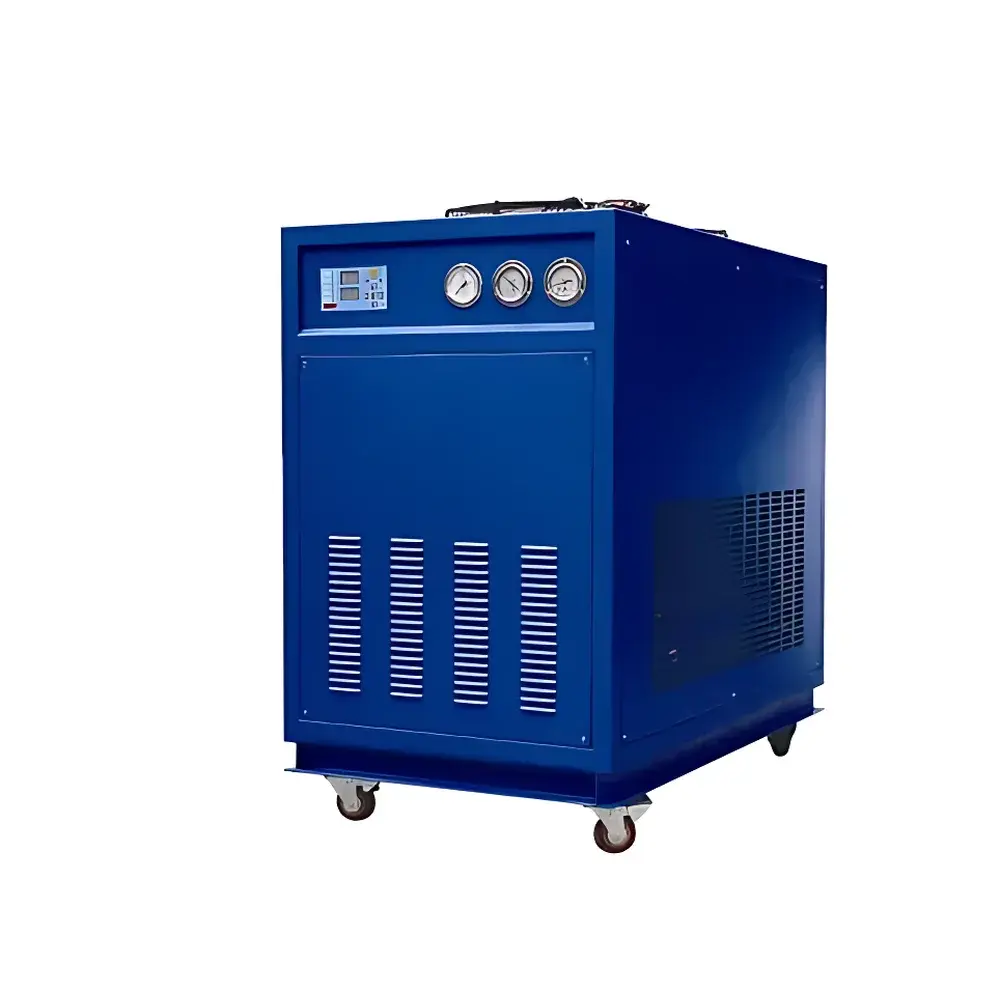
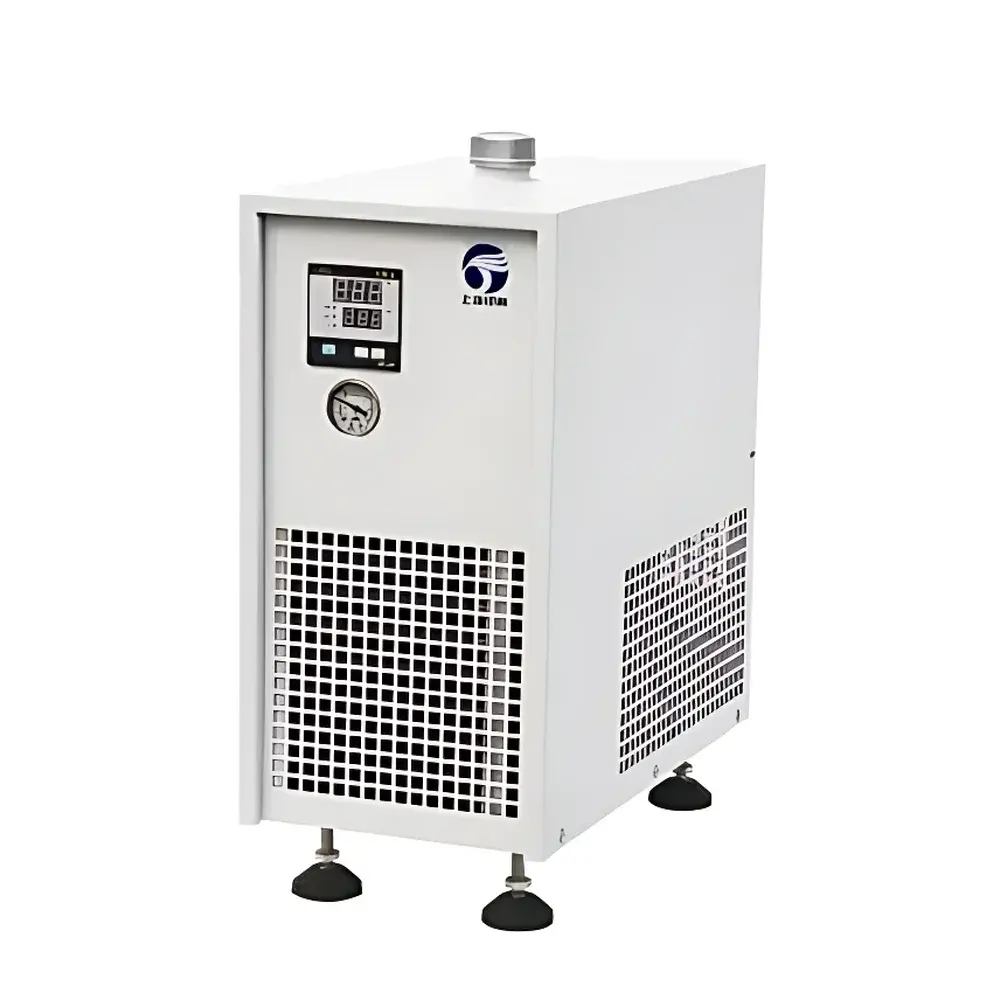
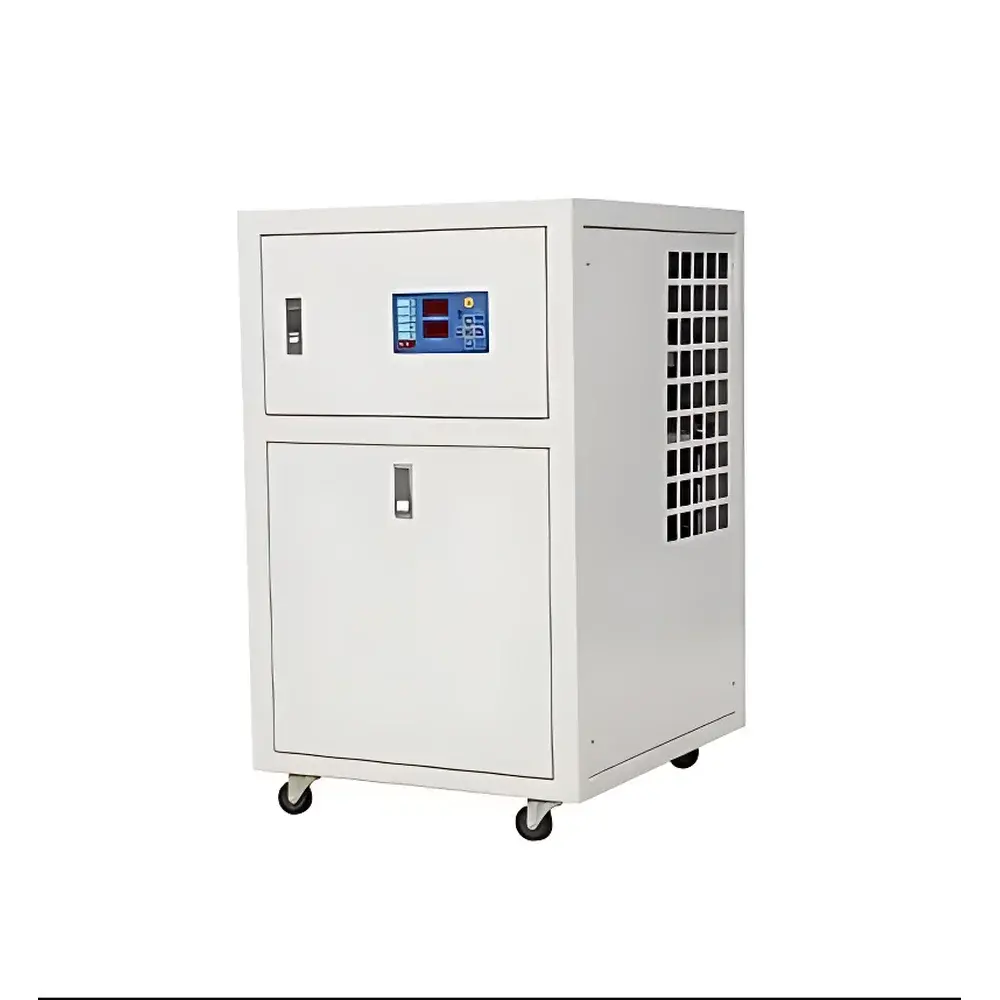
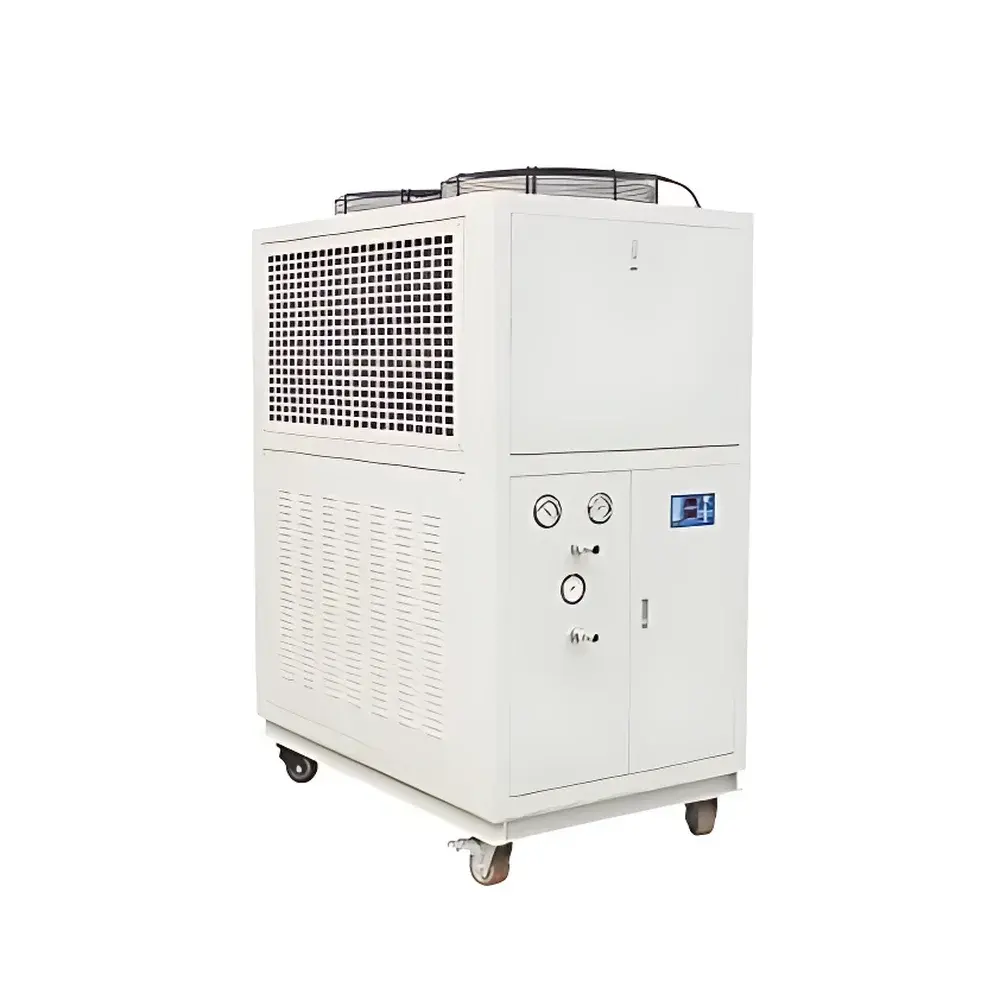
Tianfeng LS-10HP Integrated Circulating Chiller
| Brand | Tianfeng |
|---|---|
| Origin | Shanghai, China |
| Manufacturer Type | Direct Manufacturer |
| Equipment Type | Integrated Circulating Chiller |
| Cooling Method | Water-Cooled |
| Temperature Control Range | 5–30 °C (Freeze Water Outlet) |
| Refrigeration Capacity | 32.5 kW @ ΔT=5 °C (12 °C In / 7 °C Out) |
| Temperature Stability | ±0.3 °C |
| Circulating Pump Pressure | 14 m H₂O |
| Circulating Flow Rate | 5.59 m³/h |
| Reservoir Volume | 200 L |
| Power Supply | 380 V/3Φ/50 Hz |
| Compressor | Hermetic Scroll (9.06 kW) |
| Refrigerant | R22 |
| Condenser | Copper Tube + Aluminum Fin with Low-Noise External Rotor Fan (10,000 m³/h Airflow) |
| Evaporator | Immersed Coil in Stainless Steel Tank |
| Safety Protections | Compressor Overheat, High/Low Pressure, Phase Sequence & Phase Loss, Overcurrent, Overshoot Temperature |
| Noise Level | ≤72 dB(A) |
| Dimensions (L×W×H) | 1350×900×1845 mm |
| Weight | Approx. 620 kg |
| Certifications | ISO 9001:2000 Certified |
Overview
The Tianfeng LS-10HP Integrated Circulating Chiller is an engineered thermal management solution designed for precision temperature stabilization of high-heat-load laboratory and industrial equipment. Based on vapor-compression refrigeration cycle principles—utilizing a hermetic scroll compressor, thermostatic expansion valve, and optimized copper-aluminum heat exchangers—the unit delivers stable chilled water at tightly controlled setpoints across a nominal operating range of 5–30 °C. Its design prioritizes long-term operational reliability under continuous duty cycles, making it suitable for integration with sensitive analytical instrumentation where thermal drift directly impacts measurement repeatability and system longevity.
Key Features
- Hermetically sealed scroll compressor (9.06 kW) ensures consistent refrigeration performance, low vibration, and extended service life under sustained load conditions.
- Stainless steel reservoir (200 L capacity) with integrated coil-type evaporator provides corrosion resistance and minimizes thermal lag during dynamic load changes.
- Dual-mode control architecture supports both fixed-setpoint constant-temperature operation and intelligent adaptive cooling, dynamically modulating pump speed and refrigerant flow to match real-time thermal demand.
- Industrial-grade electrical components—including Siemens contactors, Schneider circuit breakers, and Omron safety relays—meet IEC 60947 standards for robustness in 24/7 environments.
- Comprehensive protection suite includes high/low pressure cutouts, phase sequence monitoring, compressor overheat sensing, and digital overtemperature alarm with relay output for external interlock integration.
- Front-panel digital display shows real-time outlet water temperature, system status, and fault codes; optional RKC temperature controller available for enhanced PID tuning and data logging capability.
- Low-noise condensing unit (≤72 dB[A]) features high-efficiency external rotor fan (10,000 m³/h airflow) and optimized fin-tube geometry for stable heat rejection in ambient temperatures up to 35 °C.
Sample Compatibility & Compliance
This chiller is routinely deployed as a thermal interface for laboratory instruments requiring stable coolant supply, including graphite furnace atomic absorption spectrometers (GFAAS), inductively coupled plasma optical emission spectrometers (ICP-OES), inductively coupled plasma mass spectrometers (ICP-MS), X-ray fluorescence (XRF) analyzers, X-ray diffractometers (XRD), scanning electron microscopes (SEM), and transmission electron microscopes (TEM). It also serves as a primary cooling source for laser systems (cutting, welding, marking), vacuum deposition chambers, high-speed spindles, and semiconductor process tools. All units are manufactured and tested in accordance with ISO 9001:2000 quality management requirements. While not certified to UL/CSA or CE for North American/EU markets out-of-box, the electrical architecture complies with IEC 61000-6-2 (immunity) and IEC 61000-6-4 (emission) standards. Documentation supports GLP/GMP-aligned validation protocols—including IQ/OQ documentation templates and calibration traceability records upon request.
Software & Data Management
The LS-10HP operates via embedded microcontroller-based logic without proprietary software dependencies. Standard configuration includes dry-contact alarm outputs (NO/NC) compatible with building management systems (BMS) or lab information management systems (LIMS) for remote fault monitoring. Optional RKC controller integration enables RS-485 Modbus RTU communication for centralized temperature logging, trend analysis, and audit-trail generation—supporting compliance with FDA 21 CFR Part 11 when paired with validated data acquisition platforms. All temperature setpoints, alarm thresholds, and pump parameters are user-configurable via front-panel keypad and retained through power interruption.
Applications
- Materials Characterization: Stabilizes detector and source temperatures in XRD and XRF systems to reduce thermal noise and improve peak resolution and counting statistics.
- Plasma Instrumentation: Maintains consistent plasma torch and nebulizer gas temperatures in ICP-OES/ICP-MS, minimizing signal drift and improving elemental detection limits.
- Electron Microscopy: Supplies regulated coolant to TEM/SEM column chillers and filament cooling circuits, preventing thermal lensing and beam instability.
- Laser Systems: Removes waste heat from diode-pumped solid-state (DPSS) and fiber lasers, preserving wavelength stability and optical alignment integrity.
- Vacuum Coating: Controls substrate and target temperatures during sputtering and evaporation processes to optimize film adhesion, density, and stoichiometry.
- Industrial Process Support: Provides closed-loop cooling for CNC machine tool hydraulic systems and spindle lubricants, reducing thermal deformation and extending component service intervals.
FAQ
What is the recommended maximum return water temperature for continuous operation?
For optimal compressor longevity and system efficiency, inlet water temperature should not exceed 40 °C. Sustained return temperatures above this threshold accelerate refrigerant oil degradation and increase discharge pressure, triggering high-pressure safety shutdowns.
Can this chiller be integrated into a facility’s central monitoring network?
Yes—standard dry-contact alarm outputs allow basic status signaling. With optional RKC controller, Modbus RTU over RS-485 enables full parameter read/write access and time-stamped event logging compatible with SCADA and LIMS platforms.
Is the unit suitable for use with deionized or corrosive coolant solutions?
The stainless steel reservoir and pump housing are compatible with DI water and common glycol-water mixtures (up to 30% ethylene glycol). For aggressive chemistries (e.g., low-pH cleaning agents), custom wetted-material upgrades (e.g., EPDM seals, titanium heat exchangers) are available upon engineering review.
What maintenance intervals are recommended for laboratory-grade operation?
Compressor oil and refrigerant filter-drier replacement every 24 months; condenser coil cleaning every 6 months in dusty environments; annual verification of temperature sensor calibration against NIST-traceable reference standard.
Does the chiller support dual-temperature zone operation?
No—the LS-10HP is a single-circuit system. Dual-loop or multi-zone configurations require separate chiller units or custom manifold integration, which can be engineered per application requirements.



