
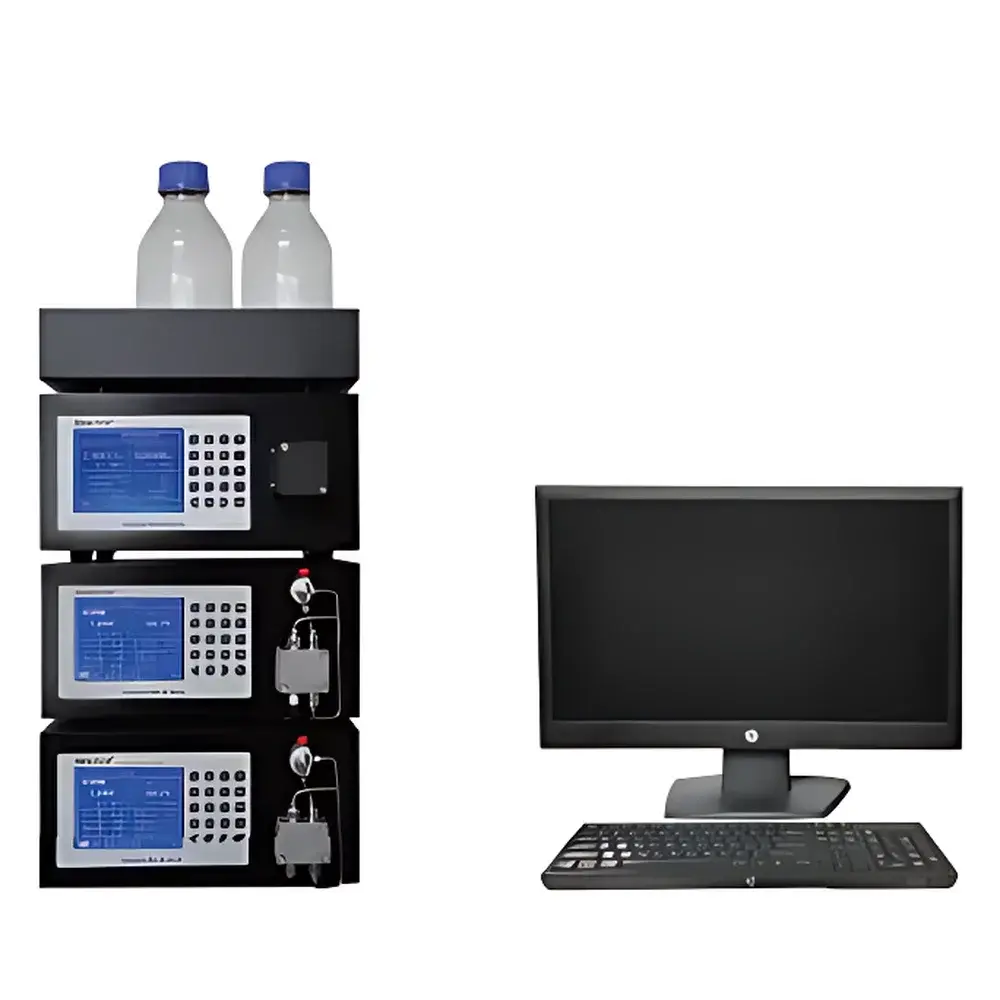
Hanbon NS4205 Binary Semi-Preparative Liquid Chromatography System
| Brand | Hanbon |
|---|---|
| Origin | Jiangsu, China |
| Manufacturer Type | OEM Manufacturer |
| Product Category | Domestic |
| Model | NS4205 |
| Application Level | Laboratory-Scale |
| Instrument Type | High-Pressure Preparative LC System |
| Flow Rate Range | 0.01–49.99 mL/min |
| Flow Accuracy | ±1% |
| Flow Precision (RSD) | ≤0.1% |
| Maximum Pressure | 25 MPa |
| Wavelength Range | 190–800 nm (±2 nm accuracy) |
| Wavelength Reproducibility | ±0.2 nm |
| Baseline Noise | ≤2×10⁻⁵ AU (254 nm, 1 s time constant) |
| Data Acquisition Rate | 5 Hz |
Overview
The Hanbon NS4205 Binary Semi-Preparative Liquid Chromatography System is an engineered solution for scalable chromatographic purification in research and development laboratories. Designed around high-pressure liquid chromatography (HPLC) principles, the system employs a dual-pump gradient architecture to deliver precise solvent composition control across a wide flow range—enabling method translation from analytical to semi-preparative scale. Its core hydraulic architecture follows ISO 13842-compliant pump design standards, incorporating electronically damped flow control to minimize pulsation and ensure stable delivery under variable backpressure conditions typical of preparative columns. The system operates within a pressure envelope up to 25 MPa (250 bar), supporting both standard stainless-steel-packed columns and high-efficiency dynamic axial compression (DAC) and multi-functional axial compression (MAC) columns. It is intended for use in non-GMP laboratory environments where reproducible fractionation, method development, and early-stage process optimization are critical—particularly for natural product isolation, fermentation-derived compound purification, and synthetic pharmaceutical intermediate refinement.
Key Features
- Binary gradient pumping system with independent high-precision piston pumps, each equipped with electronic flow damping for enhanced gradient fidelity and reduced dwell volume effects
- Pump fluidic path constructed from SS316L stainless steel, titanium alloy, or PEEK—configurable per application requirements to ensure chemical compatibility with aggressive solvents (e.g., TFA, HFIP, chlorinated organics)
- Dual-wavelength UV-Vis detector with photodiode array capability (190–800 nm), delivering ±2 nm wavelength accuracy and ±0.2 nm reproducibility over extended operational cycles
- Low-noise optical design achieving baseline noise ≤2×10⁻⁵ AU at 254 nm (1 s time constant), enabling reliable detection of trace-level impurities during fraction collection
- Integrated floating-piston seal mechanism that dynamically compensates for wear, extending seal service life by up to 3× compared to fixed-piston alternatives
- Modular detector interface supporting optional integration of refractive index (RI) or evaporative light scattering (ELSD) detectors for non-UV-absorbing analytes
Sample Compatibility & Compliance
The NS4205 accommodates a broad spectrum of sample matrices—including polar and non-polar small molecules, peptides, glycosides, alkaloids, and labile secondary metabolites—without requiring derivatization. Column compatibility spans standard 10–30 mm ID analytical/prep columns, spring-loaded columns (up to 50 mm ID), and industrial-scale DAC/MAC systems (up to 100 mm ID). All wetted materials comply with ASTM F899 stainless steel specifications and USP Class VI biocompatibility standards for PEEK components. While not certified for GMP manufacturing, the system supports GLP-aligned documentation workflows, including audit-trail-enabled method storage and user-access logging. It meets CE marking requirements for electromagnetic compatibility (EN 61326-1) and low-voltage safety (EN 61010-1).
Software & Data Management
Control and data acquisition are managed via Hanbon ChromaSuite™ v3.x—a Windows-based platform compliant with FDA 21 CFR Part 11 Annex 11 principles for electronic records and signatures. The software provides real-time chromatogram visualization, automated gradient programming, peak integration with customizable baselines, and retention time locking for inter-run comparability. All raw data files (.hcd format) are stored with embedded metadata (user ID, timestamp, method parameters, instrument configuration), ensuring full traceability. Export options include CSV, AIA/ANDI, and PDF reports suitable for regulatory submissions. Optional network deployment enables centralized method library management across multi-instrument labs.
Applications
- Isolation of bioactive compounds from plant extracts and microbial fermentation broths
- Purification of synthetic intermediates and final active pharmaceutical ingredients (APIs) at gram-to-100g scale
- Chiral separation development using polysaccharide- and cyclodextrin-based stationary phases
- Process scouting for crystallization feedstock preparation and impurity profiling
- Method transfer studies between analytical HPLC and preparative platforms per ICH Q5A guidelines
- Stability-indicating assays for degradation product isolation and structural elucidation
FAQ
What column formats are supported by the NS4205 system?
The system accepts standard threaded fittings for 1/4″ and 1/8″ tubing, and is compatible with columns ranging from 10 mm to 100 mm internal diameter—including analytical, spring-loaded, dynamic axial compression (DAC), and multi-functional axial compression (MAC) configurations.
Can the UV-Vis detector be calibrated in-house?
Yes—the detector includes built-in holmium oxide and didymium filters for wavelength calibration, and absorbance verification using NIST-traceable potassium dichromate solutions per ASTM E275 and USP .
Is remote monitoring or control possible?
Remote access is supported via secure RDP or VNC connections when deployed on a local area network; however, no cloud-based telemetry or IoT functionality is integrated due to data sovereignty and cybersecurity policy constraints.
What maintenance intervals are recommended for the pump seals?
Under typical operation (≤15 MPa, acetonitrile/water mobile phase), floating-piston seals require inspection every 1,500 hours or 12 months—whichever occurs first—with replacement recommended based on observed flow deviation exceeding ±0.5%.
Does the system support method validation protocols?
While not pre-validated, the NS4205 provides all necessary performance qualification (PQ) data points—including flow accuracy, pressure stability, wavelength precision, and baseline noise—for users to execute IQ/OQ/PQ per ASTM E2500 and ISO/IEC 17025 frameworks.




