
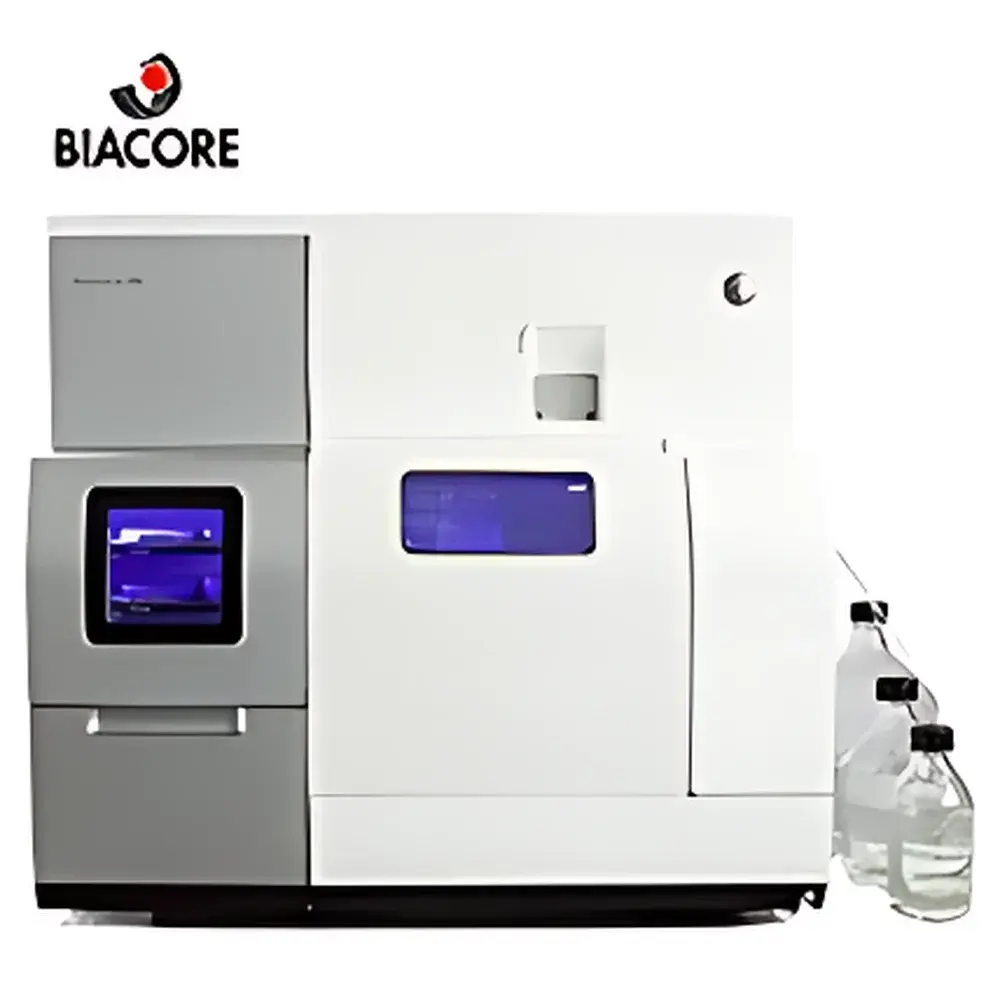
Cytiva Biacore 8K Surface Plasmon Resonance (SPR) Molecular Interaction Analyzer
| Brand | Cytiva |
|---|---|
| Origin | USA |
| Model | Biacore 8K |
| Sample Capacity | Up to four 96-well, 384-well, or deep-well plates |
| Injection Volume | 1–200 µL |
| Analysis Time per Cycle | 2–15 min |
| Temperature Control Range | 4°C to 40°C |
| Detection Principle | Label-free real-time surface plasmon resonance (SPR) |
| Throughput | Parallel 8-channel fluidics for simultaneous kinetic and affinity analysis |
Overview
The Cytiva Biacore 8K is a high-throughput, label-free surface plasmon resonance (SPR) platform engineered for rigorous molecular interaction analysis in early-stage drug discovery and biopharmaceutical characterization. Leveraging an advanced octal microfluidic cartridge architecture, the system enables true parallel processing of up to eight independent analyte injections per cycle—eliminating sequential bottlenecks inherent in single-channel SPR instruments. This architecture supports real-time monitoring of binding events—including association (kon), dissociation (koff), and equilibrium dissociation constants (KD)—with minimal sample consumption and no requirement for fluorescent or enzymatic labeling. The instrument is calibrated for broad molecular weight applicability: from low-molecular-weight fragments (≤200 Da) to large multivalent biologics (e.g., bispecific antibodies, Fc-fusion proteins, membrane protein complexes), including notoriously challenging targets such as G protein-coupled receptors (GPCRs) in native or semi-purified membrane preparations.
Key Features
- 8-channel parallel fluidics: Simultaneous injection and detection across eight independent flow cells, delivering up to 8× higher throughput versus conventional single-needle SPR systems.
- Ultra-low sample consumption: Programmable injection volumes from 1 µL to 200 µL enable efficient use of scarce or costly compounds—critical for fragment-based screening and primary cell-derived samples.
- Extended temperature control (4–40°C): Precise thermal regulation supports kinetic profiling under physiologically relevant conditions and stabilizes thermally labile targets such as solubilized membrane proteins.
- High-sensitivity detection: Optimized optical configuration and low-noise signal processing yield sub-pg/mm² mass sensitivity, enabling reliable KD determination for weak interactions (up to mM range) and accurate koff quantification for ultra-high-affinity binders (sub-pM KD).
- Flexible surface chemistry support: Compatible with amine coupling, thiol coupling, streptavidin-biotin, Ni-NTA/his-tag, and capture-based immobilization strategies—including direct capture of crude lysates or detergent-solubilized membranes without prior purification.
- Unattended operation: Fully programmable assay queues support >60 hours of continuous, walk-away operation—ideal for overnight kinetics runs or multi-day screening campaigns.
Sample Compatibility & Compliance
The Biacore 8K accommodates heterogeneous sample formats, including purified recombinant proteins, antibody fragments, synthetic peptides, small-molecule libraries, lipid nanoparticles, extracellular vesicles, and unpurified membrane fractions. Its robust sensor surface design minimizes non-specific binding while preserving conformational integrity of immobilized ligands. The system complies with regulatory data integrity requirements: raw sensorgram data are timestamped, version-controlled, and stored in a secure, audit-trail-enabled database. Instrument operation and data analysis workflows align with GLP and GMP expectations; optional 21 CFR Part 11-compliant software modules support electronic signatures, role-based access control, and full traceability of method parameters, calibration records, and result derivations. All assays may be documented per ISO/IEC 17025 or ICH Q5C guidelines for comparability studies.
Software & Data Management
Biacore Insight™ software provides an integrated environment for experimental design, real-time monitoring, global fitting of kinetic models (1:1, bivalent analyte, heterogeneous ligand, conformational change), and batch reporting. Built-in quality metrics—including bulk refractive index correction, double-referencing, and residual error mapping—ensure analytical rigor. Data export supports standard formats (CSV, XML, HDF5) for integration into enterprise LIMS or statistical platforms (e.g., Spotfire, JMP, Python/Pandas). Audit trails record all user actions, parameter changes, and reprocessing events. Raw data files are immutable and cryptographically hashed to prevent tampering—meeting ALCOA+ principles (Attributable, Legible, Contemporaneous, Original, Accurate, Complete, Consistent, Enduring, Available).
Applications
- Fragment-based drug discovery (FBDD) with millimolar KD resolution
- Epitope binning and paratope mapping of therapeutic antibodies
- Binding kinetics of bispecific and multispecific constructs
- Stability assessment of protein-protein and protein-small molecule complexes
- Characterization of GPCR-ligand interactions using nanodisc- or liposome-reconstituted targets
- QC release testing of biosimilars per USP <1117> and ICH Q5A(R2)
- Host cell protein (HCP) binding studies during purification process development
FAQ
Does the Biacore 8K require purified target proteins for immobilization?
No—crude lysates, detergent-solubilized membranes, and intact exosomes can be directly captured via tag-specific or antibody-mediated surfaces without prior purification.
Can it resolve fast-on/fast-off interactions typical of kinase inhibitors?
Yes—the system’s 10 Hz data acquisition rate and optimized mass transport correction algorithms enable accurate kon determination for interactions with association rates exceeding 10⁶ M⁻¹s⁻¹.
Is the instrument compatible with automated liquid handlers?
Yes—standardized plate maps and API-driven scheduling allow seamless integration with third-party robotic platforms (e.g., Tecan Freedom EVO, Hamilton STAR).
What level of technical support is provided post-installation?
Cytiva offers on-site qualification (IQ/OQ), application training, method development assistance, and annual preventive maintenance contracts with SLA-backed response times.
Are sensor chips reusable?
Certain chip types (e.g., CM5, SA, NTA) support regeneration and reuse for identical ligand-analyte pairs; however, single-use chips (e.g., Series S, CAP) are recommended for complex or irreversible binding studies to ensure reproducibility.
Related Products





